Johannesburg Stock Exchange (JSE)
Johannesburg, South Africa · Established 1887

This site requires authorization to access.
To request access, contact
william.goetzmann@yale.edu
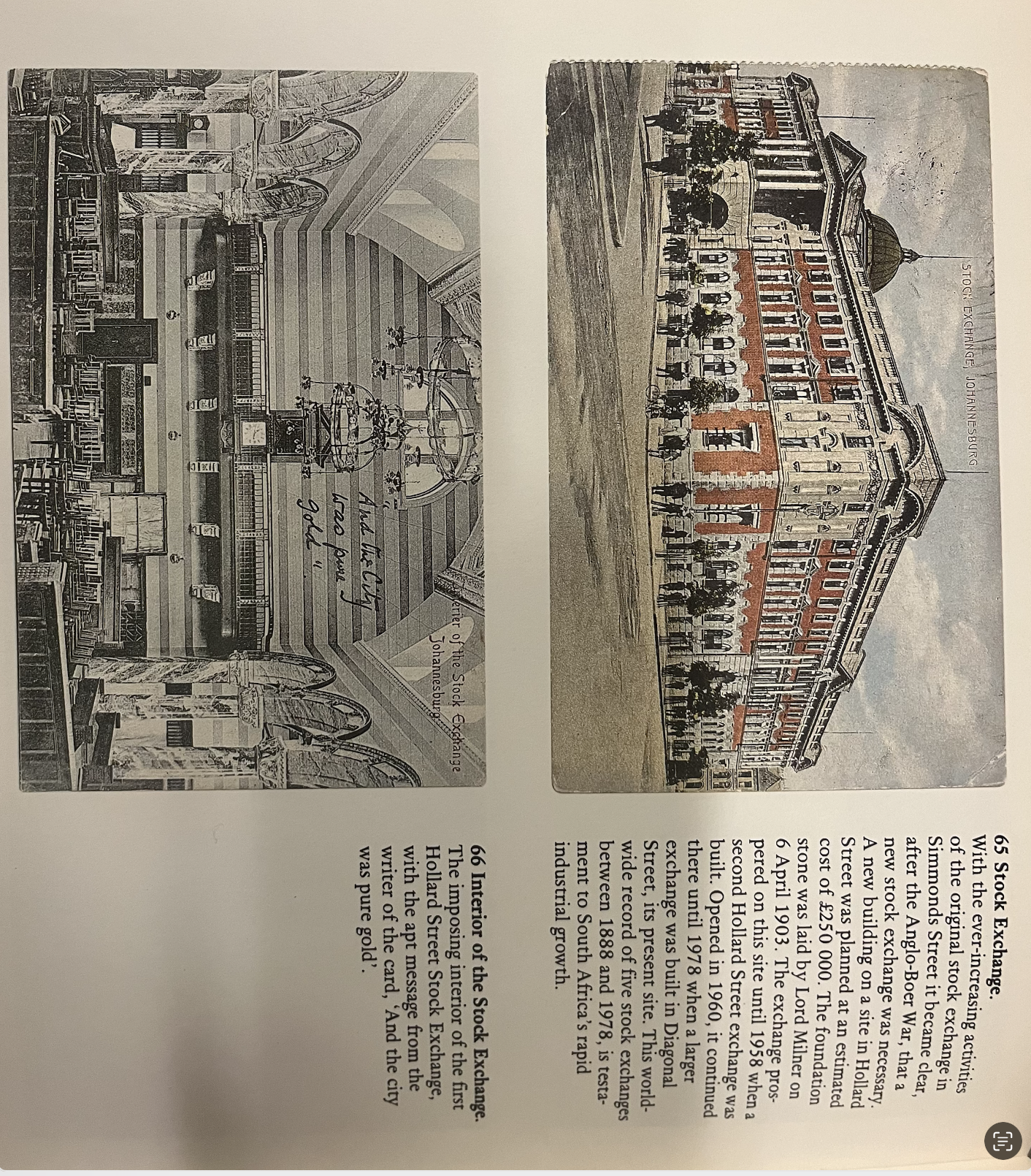
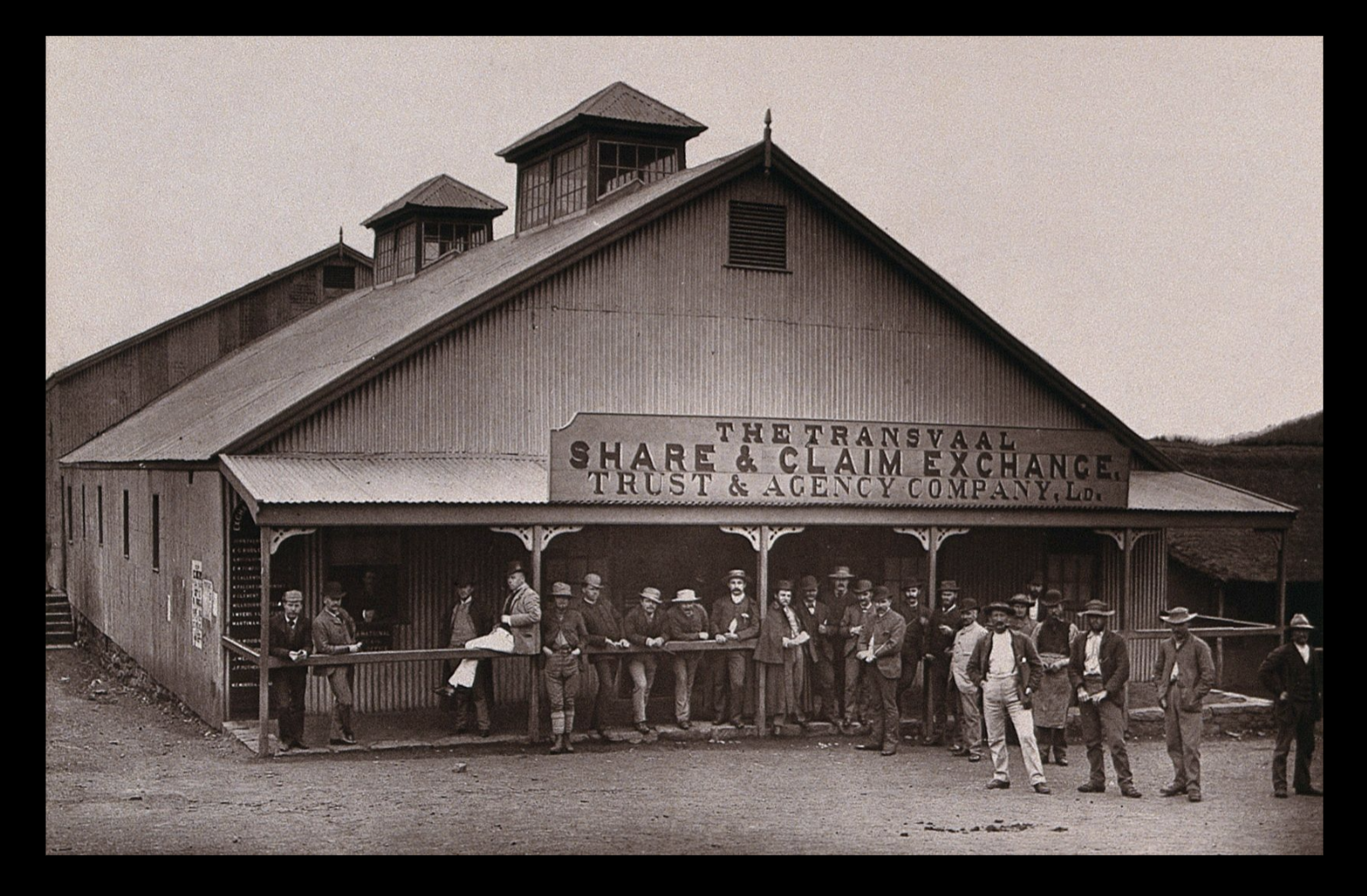
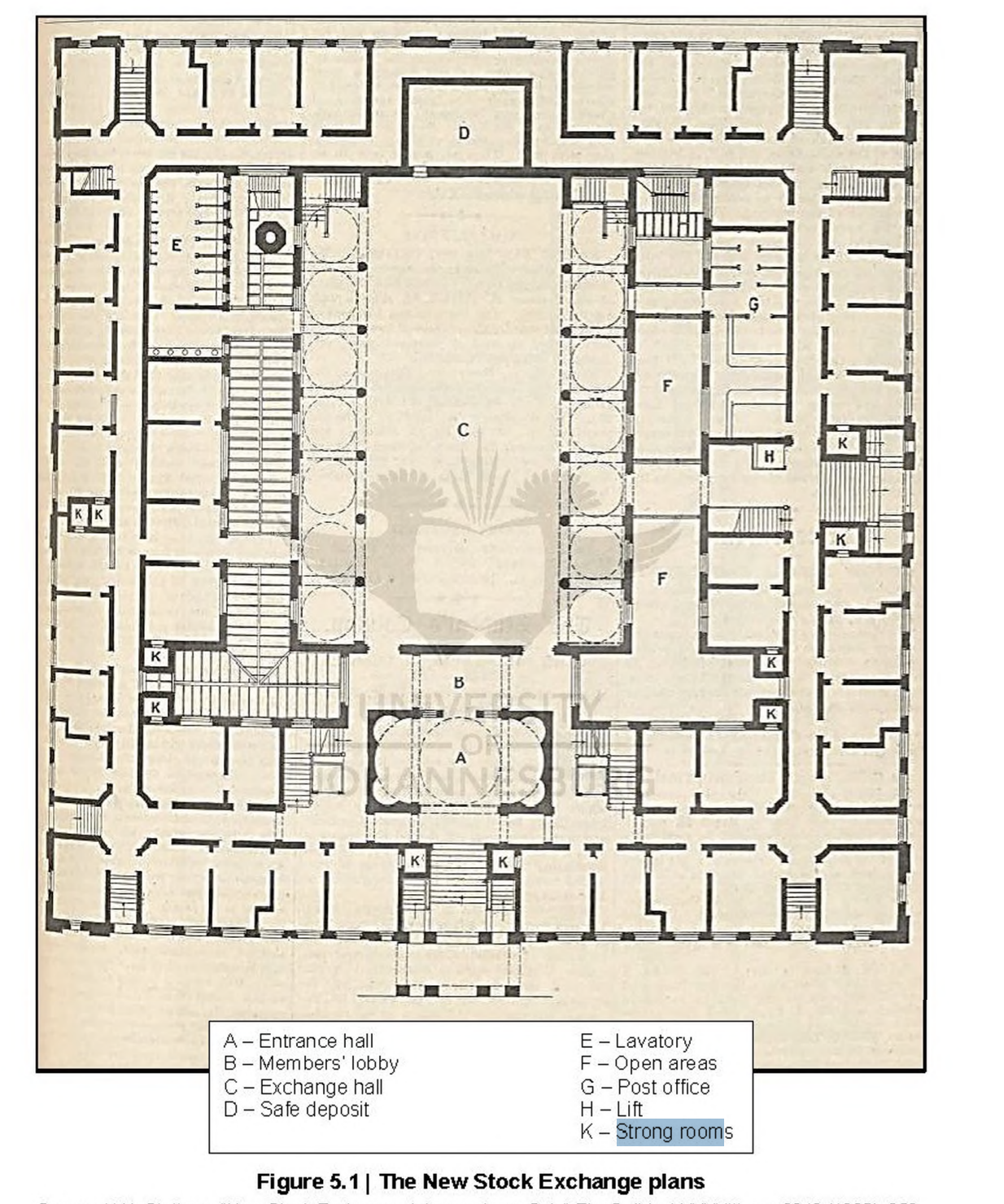
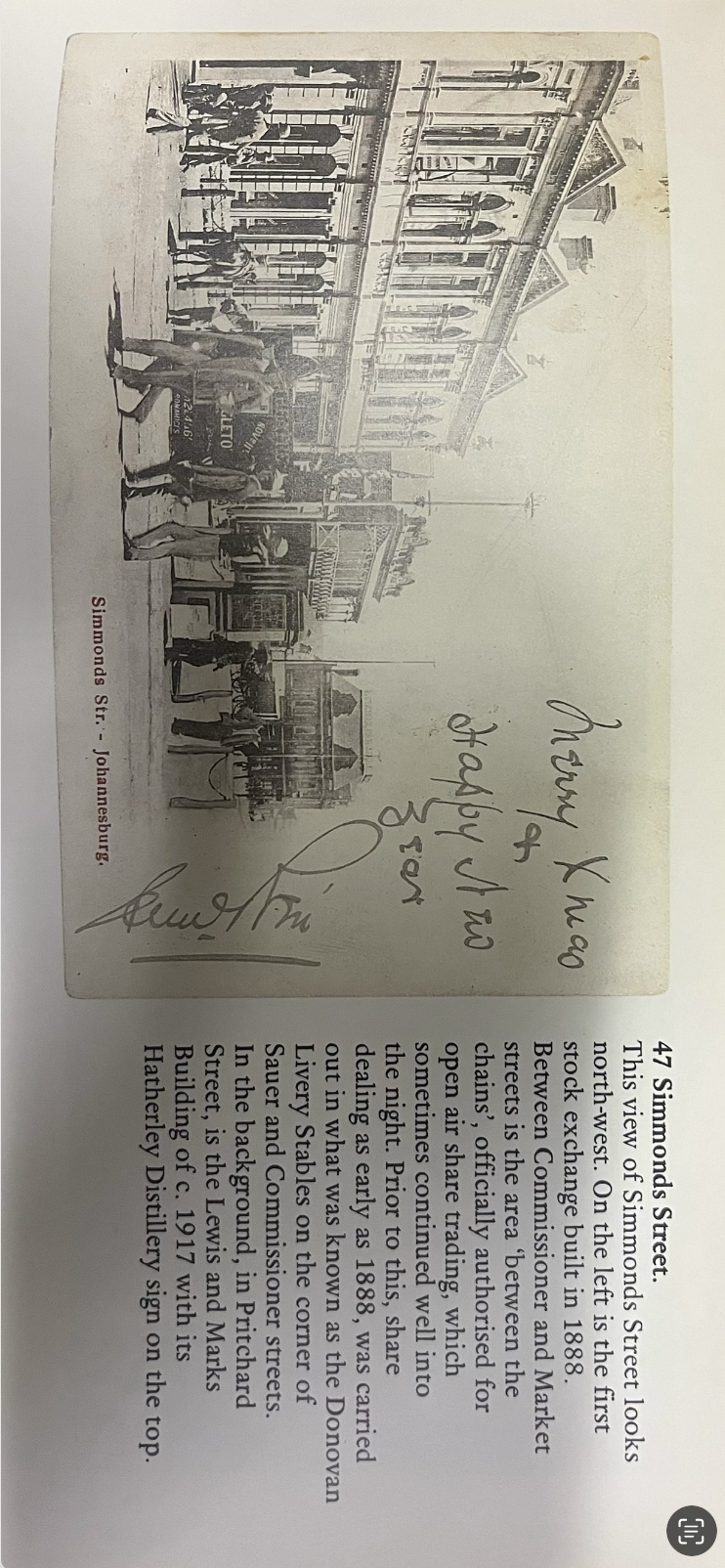
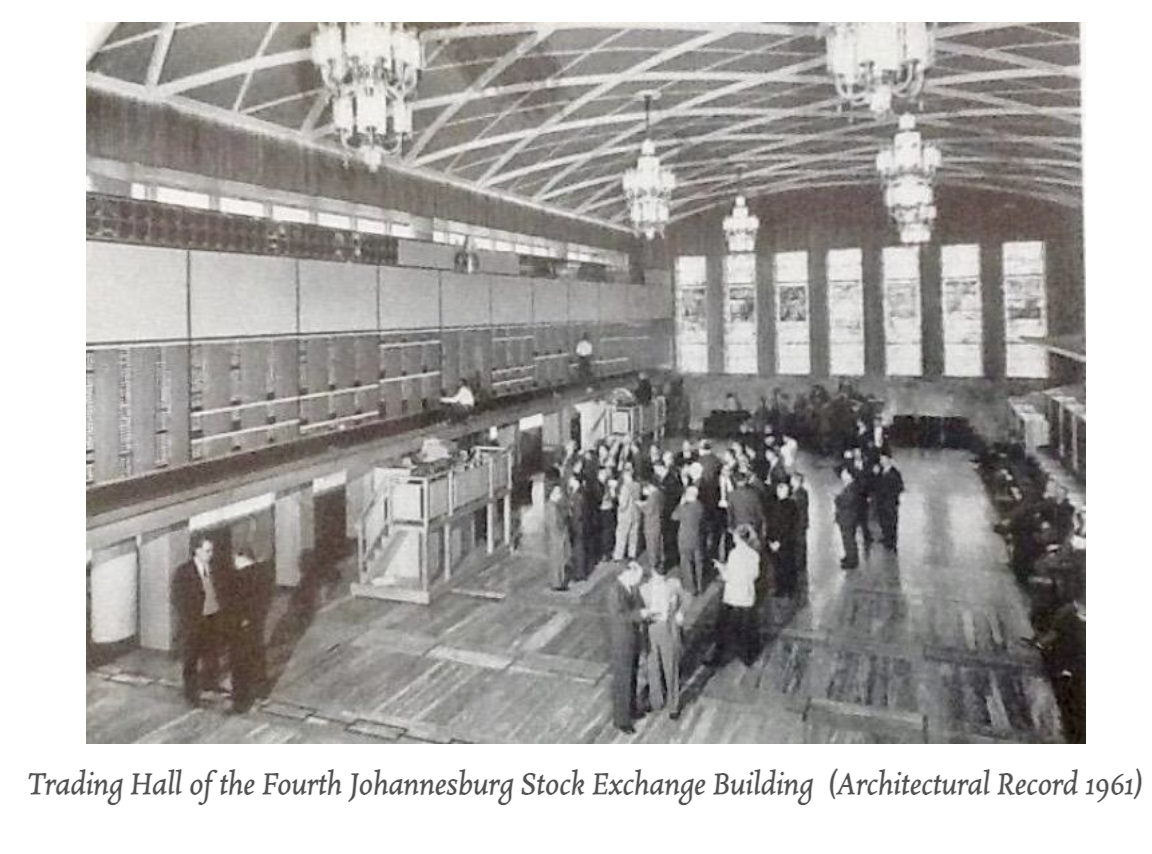
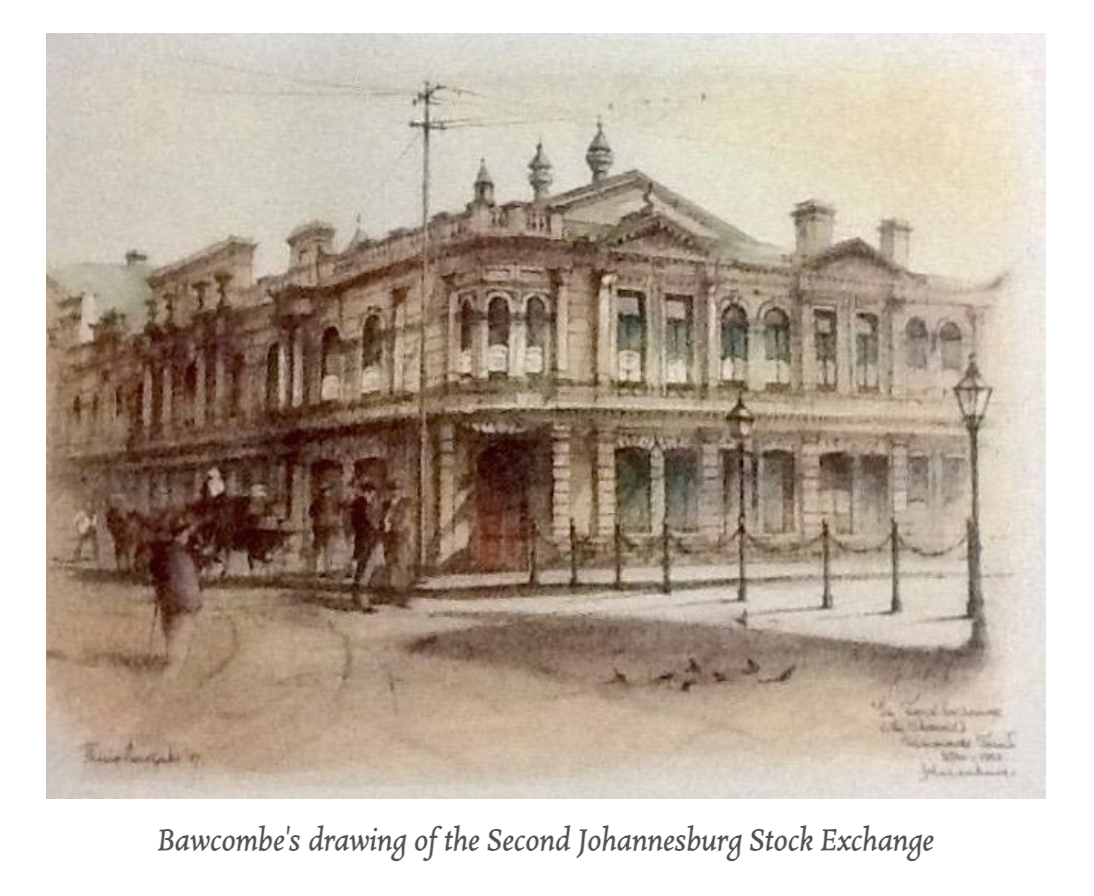
The Johannesburg Stock Exchange has occupied six successive buildings since its founding in 1887, each reflecting the city’s volatile trajectory from mining camp to African financial capital. The first exchange was little more than a corrugated-iron structure erected by Fred Holman on Simmonds Street at Commissioner Street, where the mining commissioner Carl von Brandis blocked off a section of roadway with iron chains so that brokers could trade outdoors in what became known as “Between the Chains.” A second, more substantial building designed by Lennox Canning and Goad rose on Simmonds Street by 1890, with an eastern extension by A. H. Reid added in 1893 to accommodate the surge in mining company listings. The third exchange, completed in 1904 on Hollard Street by the architectural firm Leck and Emley, was the first purpose-built monumental exchange: a classical Edwardian structure with a temple portico, arched pediments, rusticated stonework, and cornices fronting 210 offices and a double-height main hall measuring 28.3 by 22 meters. The Heritage Portal describes it as “unmatched on the Rand in size and magnificence, rivalled only by the Corner House.” Demolished in 1958, the third exchange gave way to the fourth building on the same Hollard Street site, designed by Gordon Summerley of Nurcombe, Summerley, Ringrose and Todd and completed in 1961. Summerley travelled to exchanges in London, New York, Paris, and Frankfurt to synthesize ideas, and the resulting modernist tower, constructed largely from prefabricated structural components, featured a majestic trading floor spanning the seventh to ninth stories, an exhibition hall, a committee dining room, and a cinema projection room. In 1978 the JSE moved to its fifth building at 17 Diagonal Street, designed by Monty Sack — one of the first atrium buildings in Johannesburg, whose central void brought daylight into the heart of the trading complex. When the open outcry floor was abolished in 1996, the physical trading hall was preserved for ceremonial functions. In September 2000, the exchange relocated to One Exchange Square in Sandton, designed by TPC Architects at the corner of Gwen Lane and Maude Street — a contemporary glass-and-steel structure that became an instant landmark in South Africa’s new financial district.
The decorative programs of the JSE’s successive buildings chart the evolution from Edwardian civic grandeur through mid-century modernism to contemporary corporate art. The third exchange on Hollard Street (1904) by Leck and Emley announced the exchange’s ambitions through a full classical vocabulary — a pedimented temple portico, Corinthian pilasters, carved cornices, and arched window surrounds that conveyed the permanence and gravity associated with established European bourses. When the fourth building replaced it in 1961, architect Gordon Summerley stripped back the ornament in favor of modernist severity, but the trading floor itself, rising through three stories from the seventh to the ninth floor, became a theatrical space defined by tiered galleries, electronic price boards, and the spectacle of open outcry. A preserved closing-prices board dated 7 December 1978 — the last day of trading on Hollard Street — remains as an artifact of that era. The precinct around the fourth building was transformed into Hollard Gardens, a pedestrianized financial plaza adorned with public sculpture, most notably the bronze Bull and Bear by the Italian-South African sculptor Edoardo Villa, whose abstract-figurative style became synonymous with Johannesburg’s corporate spaces from the 1960s onward. Mosaic strips by the artist Marco Cianfanelli were later set into the square, depicting scenes of Johannesburg’s everyday life — minibus taxis, bowls of fruit, and the face of Nelson Mandela — weaving post-apartheid identity into the financial district’s fabric. At the current Sandton headquarters, a bronze bull and bear sculpture greets visitors in the lobby of One Exchange Square, continuing the tradition of emblematic financial statuary that links the JSE to the iconographic conventions of exchanges worldwide.
Johannesburg owes its existence to the Witwatersrand gold reef, and the stock exchange has been the institutional anchor around which the city’s financial geography has repeatedly reorganized. The first two exchanges sat at the corner of Simmonds and Commissioner Streets, in the heart of the original mining camp where prospectors, financiers, and speculators converged. When the third exchange moved to Hollard Street in 1904, it drew banks, mining finance houses, and insurance companies westward, transforming Hollard Street into what contemporaries called “the Wall Street of Johannesburg” for more than seven decades. The nearby Corner House, headquarters of the mining finance group of Hermann Eckstein, Julius Wernher, and Alfred Beit, anchored the adjacent Commissioner and Simmonds corner. Main Street Mall became the mining district’s ceremonial spine, lined with the offices of Consolidated Gold Fields, Rand Mines, Anglo American, and other mining conglomerates. The 1978 move to Diagonal Street shifted the financial center slightly but kept it within the inner city; however, by the late 1990s, the decline of the Johannesburg central business district — driven by suburbanization, crime, and capital flight northward — made relocation unavoidable. In September 2000, the JSE moved to Sandton, roughly fifteen kilometers north of its origins. The Heritage Portal records that “whenever the Stock Exchange has moved, major banks and companies have followed, creating new financial districts and leaving old ones to reinvent themselves.” Sandton Central, anchored by the JSE at One Exchange Square and framed by Nelson Mandela Square, rapidly became the most prestigious corporate address in sub-Saharan Africa, concentrating banking headquarters, law firms, and multinational offices in a dense precinct of glass towers that contrasts sharply with the low-rise mining camp from which the exchange sprang.
The Johannesburg Stock Exchange was founded on 8 November 1887 by Benjamin Woollan, a London-born, Kimberley-trained mining speculator, barely thirteen months after the discovery of the Witwatersrand gold reef in 1886. Woollan established the Johannesburg Exchange and Chambers Company, formally registered on 28 February 1888, to provide a regulated venue for trading the shares of the joint-stock mining companies proliferating across the reef. Mariusz Lukasiewicz, in “From Diamonds to Gold: The Making of the Johannesburg Stock Exchange, 1880–1890” (Journal of Southern African Studies, 2017), traces how Kimberley diamond-market practices and personnel migrated to the Witwatersrand, giving the new exchange its initial regulatory norms and speculative culture. By January 1890, over two hundred companies appeared on the Official List; by 1891 the number stabilized around one hundred and fifty as deep-level mining replaced the easily worked outcrops. The Randlords — Cecil Rhodes, Barney Barnato, Alfred Beit, Julius Wernher, and the Eckstein group — dominated the exchange through interlocking mining finance houses that raised capital in London and Paris for Witwatersrand operations. In April 1889, Barnato’s Johannesburg Estate Company assumed physical control of the exchange premises, creating ongoing tension between the interests of the property owner and those of the trading membership. The failed Jameson Raid of December 1895, plotted in part by Randlord reformers seeking to overthrow the Transvaal government of Paul Kruger, sent listed companies plunging from around one hundred and fifty to barely fifty. The South African War (1899–1902) shut the exchange entirely; a temporary stock exchange opened in Cape Town in 1901 to absorb displaced trading. After the war, reconstruction and the development of deep-level mining brought a sustained boom. Lukasiewicz’s 2017 Business History Conference paper, “Gold, Finance and Speculation: The Making of the Johannesburg Stock Exchange, 1887–1899,” emphasizes the JSE’s role as an alternative capital market to London during the classical gold standard era. The 1947 Stock Exchange Control Act brought the JSE under statutory regulation for the first time. During the apartheid era, international sanctions and disinvestment campaigns progressively isolated the exchange; yet the lifting of sanctions in 1993 and the democratic elections of 1994 triggered a surge of foreign capital. The JSE abandoned open outcry on 7 June 1996, adopting the electronic Johannesburg Equities Trading (JET) system, later replaced by the London Stock Exchange’s SETS platform in 2002. In 2001 the JSE acquired the South African Futures Exchange (SAFEX), and in 2009 it absorbed the Bond Exchange of South Africa (BESA), becoming a multi-asset-class exchange. The JSE demutualised and listed on its own exchange in 2005, completing a transformation from a members’ club born of a gold rush into a publicly traded, electronically driven marketplace — the largest in Africa by market capitalization.
From its inception, the Johannesburg Stock Exchange was overwhelmingly a market in gold mining equities. The initial sixty-nine listed companies were almost exclusively gold mining ventures formed to exploit the Witwatersrand reef, and between 1887 and 1934 an estimated two hundred million pounds was invested in the gold industry through the exchange, more than half from foreign sources. DRDGOLD, which listed in 1895, remains the oldest continuously listed company on the JSE; South African Breweries (now part of AB InBev) followed in 1897, signaling the early diversification beyond mining. Diamond mining securities featured prominently once the discoveries at Lichtenburg and Alexander Bay were consolidated under Anglo American and De Beers. Coal, platinum, and base-metal shares expanded the mining sector through the twentieth century. Industrial shares grew after the Second World War as the South African economy diversified: manufacturing, retail, financial services, and telecommunications companies joined the listings. Government bonds circulated alongside equities from an early date; the Bond Exchange of South Africa operated independently until the JSE absorbed it in 2009, integrating fixed-income instruments into the same platform. The acquisition of the South African Futures Exchange (SAFEX) in 2001 added equity-index futures, single-stock futures, agricultural commodity derivatives (notably white and yellow maize, wheat, sunflower seeds, and soybeans), and interest-rate products. By the twenty-first century the JSE listed over four hundred companies across sectors including mining, banking, telecommunications, retail, and real estate, and offered exchange-traded funds (the first, Satrix40, launched in 2000), warrants, and structured products. Ernest Oppenheimer’s Anglo American Corporation, founded in 1917 with J. P. Morgan backing, grew by the 1980s into a conglomerate controlling the majority of all stocks traded on the JSE — a concentration of corporate power with few parallels in global exchange history.