Jakarta Stock Exchange
Jakarta, Indonesia · Established 1912
This site requires authorization to access.
To request access, contact
william.goetzmann@yale.edu
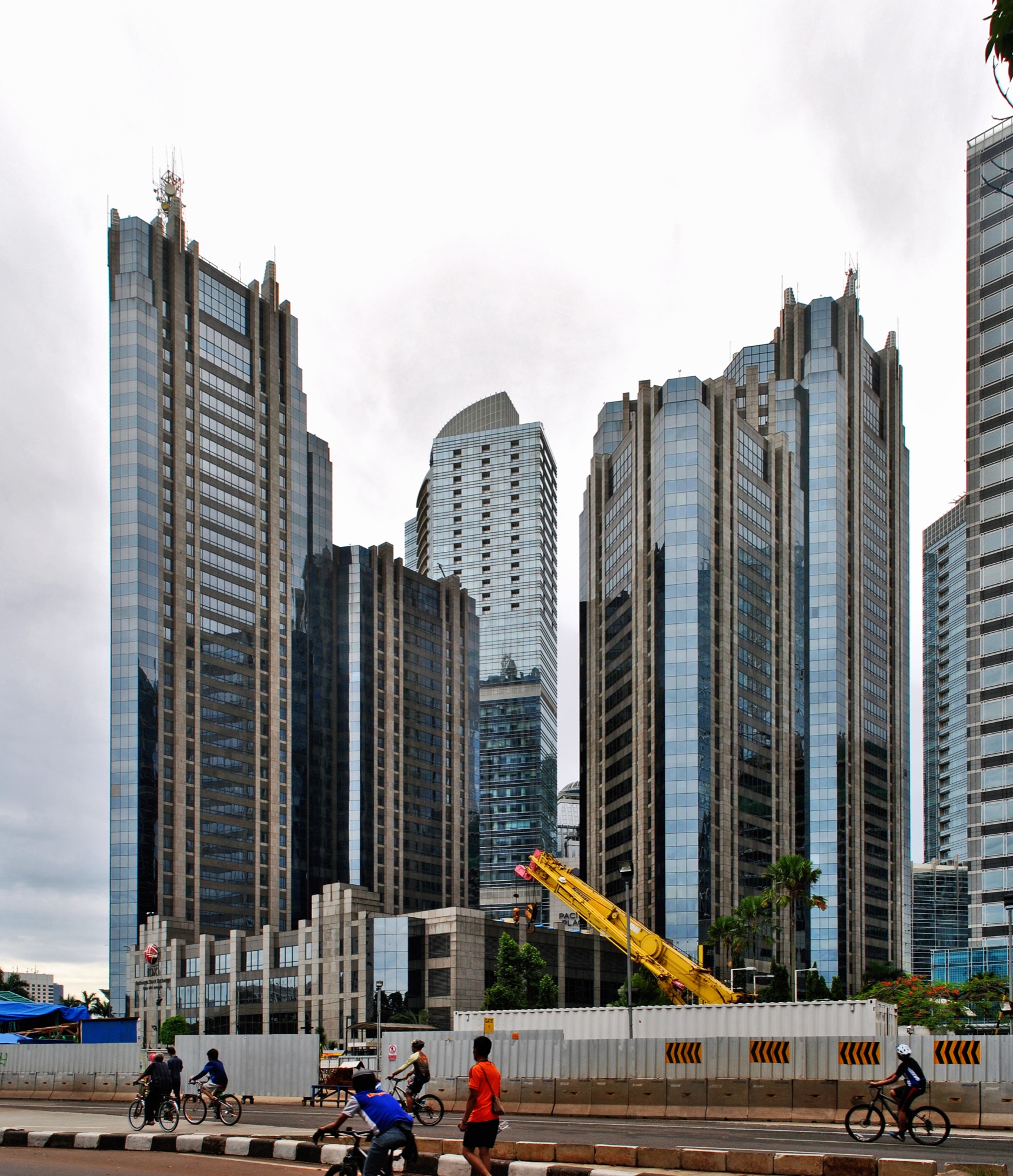
The Indonesia Stock Exchange Building (Gedung Bursa Efek Indonesia) is a twin-tower complex rising thirty-two stories and 140 meters above Jalan Jenderal Sudirman Kavling 52–53, at the heart of the Sudirman Central Business District (SCBD) in South Jakarta. The complex was designed by the New York–based firm Brennan Beer Gorman (now BBGM) in collaboration with a local consortium comprising Arkonin, Atelier 6, and Encona Engineering, after the international team won a design competition against entries from Australia, Hong Kong, and Japan. Construction was carried out by Nusa Konstruksi Engineering and the Korean firm Ssangyong Engineering and Construction; Tower I was completed and officially opened on 3 October 1995, while Tower II followed in 1997, just before the onset of the Asian financial crisis. The towers are owned by PT First Jakarta International, a subsidiary within the Artha Graha Network, and managed by PT Cushman & Wakefield Indonesia. Each tower provides a semi-gross leasable area totaling approximately 137,000 square meters across the complex. The façade is clad in grey-silver reflective glass panels set within charcoal-colored aluminum mullions and accented with imported granite from Canada and Spain, lending the building a distinctive late-twentieth-century corporate modernism. In January 2018, a suspended mezzanine walkway in the Tower I lobby collapsed under the concentrated weight of approximately one hundred visiting university students, injuring seventy-seven people; a Public Works Ministry investigation attributed the failure to loose or corroded bolts in the suspension cables, a finding analyzed in the International Code Council’s Building Safety Journal. Following repairs, the building achieved LEED Gold certification from the U.S. Green Building Council in December 2023, affirming a commitment to sustainable retrofit. In September 2023, a curved corner-wrap LED video display manufactured by Daktronics was installed on the building’s exterior, measuring 13.44 meters high by 13.44 meters wide with 8-millimeter pixel spacing, used for forced-perspective three-dimensional content and real-time market information.
The decorative program of the Indonesia Stock Exchange Building reflects the visual language of late-twentieth-century global finance rather than the vernacular ornamental traditions of Java. The twin towers’ façades present a curtain wall of grey-silver reflective glass framed by charcoal aluminum mullions and polished granite panels imported from Canada and Spain, a material palette characteristic of Brennan Beer Gorman’s corporate modernism that conveys the transparency and sobriety associated with international capital markets. The ground-floor lobby of Tower I originally featured a dramatic multi-story atrium crossed by suspended mezzanine walkways—cantilevered steel-and-concrete structures whose engineering aesthetic doubled as spatial theater, creating a sense of vertical openness intended to evoke the dynamism of the trading floor. This spatial composition was disrupted by the January 2018 walkway collapse, after which the lobby was reconstructed with reinforced connections. In 2023, the most significant addition to the building’s visual identity was the installation of a Daktronics curved corner-wrap LED display on the building’s exterior corner, measuring over thirteen meters on each side, which projects forced-perspective three-dimensional content visible from the Sudirman corridor—a contemporary form of architectural decoration that transforms the building envelope into a dynamic media surface. Inside, the IDX trading hall features large electronic display boards streaming real-time stock prices and composite index data, serving the same communicative function that chalkboards and ticker tapes performed in earlier exchange buildings. The IDX also operates an Investment Gallery (Galeri Investasi) on the lower floors, which functions as both an educational center and a curated exhibition space featuring historical artifacts of the Indonesian capital market, including reproductions of colonial-era share certificates (Bewijs van Aandeel) such as those issued by N.V. Handel-Maatschappij Thong, a Chinese trading company whose shares were denominated in guilders, as documented in the Effectengids publications cataloguing securities traded in the Dutch East Indies from the 1880s onward.
The Indonesia Stock Exchange Building occupies a pivotal site within Jakarta’s Golden Triangle (Segitiga Emas), the roughly triangular central business district bounded by Jalan M.H. Thamrin and Jalan Jenderal Sudirman to the northwest, Jalan H.R. Rasuna Said to the northeast, and Jalan Jenderal Gatot Subroto to the south. The Sudirman Central Business District (SCBD), a forty-five-hectare master-planned development conceived by PT Danayasa Arthatama between 1987 and 1992, transformed what had been a kampung settlement into one of Southeast Asia’s densest clusters of commercial high-rises. The IDX towers stand within walking distance of Pacific Place Jakarta and Plaza Semanggi, flanked by such prominent structures as Wisma 46, the Sinarmas MSIG Tower, and the International Financial Center Jakarta. This commercial corridor owes its form to decisions made during the New Order period under President Suharto, when the 1985–2005 Jakarta Spatial Master Plan introduced mixed-use zoning regulations that redirected development from the colonial-era Kota Tua (Old Town) in the north toward the Thamrin–Sudirman axis in the center and south. The Semanggi Interchange, a cloverleaf bridge completed in 1962 connecting Sudirman Road with Gatot Subroto Road, was a critical infrastructure milestone that enabled the corridor’s growth. The geographic shift from the old commercial center along Kali Besar—the canal-side quarter where the VOC established its headquarters in 1619 and where colonial-era trading houses operated through the 1960s—to the modernist towers of the Golden Triangle represents one of the most dramatic spatial transformations in Southeast Asian urban history. As Abidin Kusno argued in “Behind the Postcolonial: Architecture, Urban Space and Political Cultures in Indonesia” (Routledge, 2000), Jakarta’s postcolonial urbanism systematically displaced the colonial spatial order, replacing the canal-oriented mercantile city with a highway-oriented corporate one.
The history of the Jakarta Stock Exchange extends over more than a century, from the colonial Batavia Effectenbeurs to the modern Bursa Efek Indonesia. On 14 December 1912, the Dutch East Indies government established the Vereniging voor de Effectenhandel in Batavia, creating the first formal securities exchange in Southeast Asia. Stock transactions in the Dutch East Indies predated this foundation: the earliest recorded trade occurred in 1892, when the plantation company Cultuur Maatschappij Goalpara sold 400 shares at 500 guilders each, as the Effectengids publications documented. The exchange listed shares and bonds of Dutch companies and plantations operating in the Indies, along with bonds issued by provincial and municipal governments and securities of other Dutch firms. The Batavia exchange was closed during World War I (1914–1918), reopened briefly, then shuttered again during World War II when Japanese forces occupied the archipelago. After Indonesian independence in 1945, the capital market remained dormant for three decades. On 10 August 1977, President Suharto reactivated the exchange under the newly created Capital Market Supervisory Agency (Badan Pengawas Pasar Modal, or Bapepam), with PT Semen Cibinong becoming Indonesia’s first post-independence publicly traded company. As Miranda S. Goeltom documented in “Indonesia’s Financial Liberalization” (Institute of Southeast Asian Studies, 1995), the market languished through the early 1980s with minimal participation. The December 1987 deregulation package (PAKDES 87) and the December 1988 package (PAKDES 88) transformed the landscape by easing requirements for public offerings and opening the market to foreign investors. The Surabaya Stock Exchange (Bursa Efek Surabaya) opened in 1989 to handle bond and derivative trading. As Engagement Dwi Arieani and Ignatius Roni Setyawan analyzed in the Bulletin of Indonesian Economic Studies (Vol. 46, No. 3, 2010), the stock market’s contribution to Indonesian development grew markedly after these reforms, with market activity surpassing banking-sector significance by 2004. On 30 November 2007, the Jakarta Stock Exchange and the Surabaya Stock Exchange merged to form the Indonesia Stock Exchange (Bursa Efek Indonesia, or IDX). The Financial Sector Omnibus Law, signed on 13 January 2023, introduced further reforms to deepen institutional investor participation and strengthen market infrastructure.
The securities traded on the Jakarta Stock Exchange and its predecessors reflect the evolving structure of the Indonesian economy across colonial, post-independence, and modern periods. In the colonial era, the Batavia Effectenbeurs listed shares of Dutch plantation companies (cultuurmaatschappijen) operating sugar, rubber, coffee, tea, tobacco, and cinchona (quinine) estates across Java and Sumatra—commodities that made the Dutch East Indies one of the world’s richest colonial territories. As J. Thomas Lindblad documented in “Bridges to New Business: The Economic Decolonization of Indonesia” (KITLV Press, 2008), the colony produced most of the world’s quinine and pepper, over a third of its rubber, a quarter of its coconut products, and a fifth of its tea, sugar, coffee, and oil by the early twentieth century. Petroleum securities from companies like Koninklijke Nederlandsche Petroleum Maatschappij (later Royal Dutch Shell) were also actively traded. Municipal bonds issued by Batavia and other colonial cities, along with debentures of the Nederlandsch-Indische Spoorweg Maatschappij (Dutch East Indies Railway Company), broadened the fixed-income market. When the exchange reopened in 1977, PT Semen Cibinong (cement manufacturing) was the inaugural listing, reflecting the New Order government’s emphasis on industrialization. Through the 1990s and 2000s, the IDX expanded to encompass banking and financial services (Bank Central Asia, Bank Rakyat Indonesia), telecommunications (Telkom Indonesia), consumer goods (Unilever Indonesia, Indofood Sukses Makmur), mining and natural resources (Freeport Indonesia, Bumi Resources), and palm oil (Astra Agro Lestari). By 2023, the IDX listed over 860 companies with a combined market capitalization that made it one of the largest exchanges in the ASEAN region. The Jakarta Composite Index (IHSG—Indeks Harga Saham Gabungan) tracks all listed equities and has become a benchmark indicator of Indonesian economic health, while sectoral indices cover mining, agriculture, infrastructure, finance, and consumer goods—categories that trace a direct lineage from the plantation shares and commodity securities of the colonial Effectenbeurs.
Images will be added as the project develops. Photographs by Larry Ng and from research sources.