Houston Cotton Exchange
Houston, USA · Established 1874
This site requires authorization to access.
To request access, contact
william.goetzmann@yale.edu
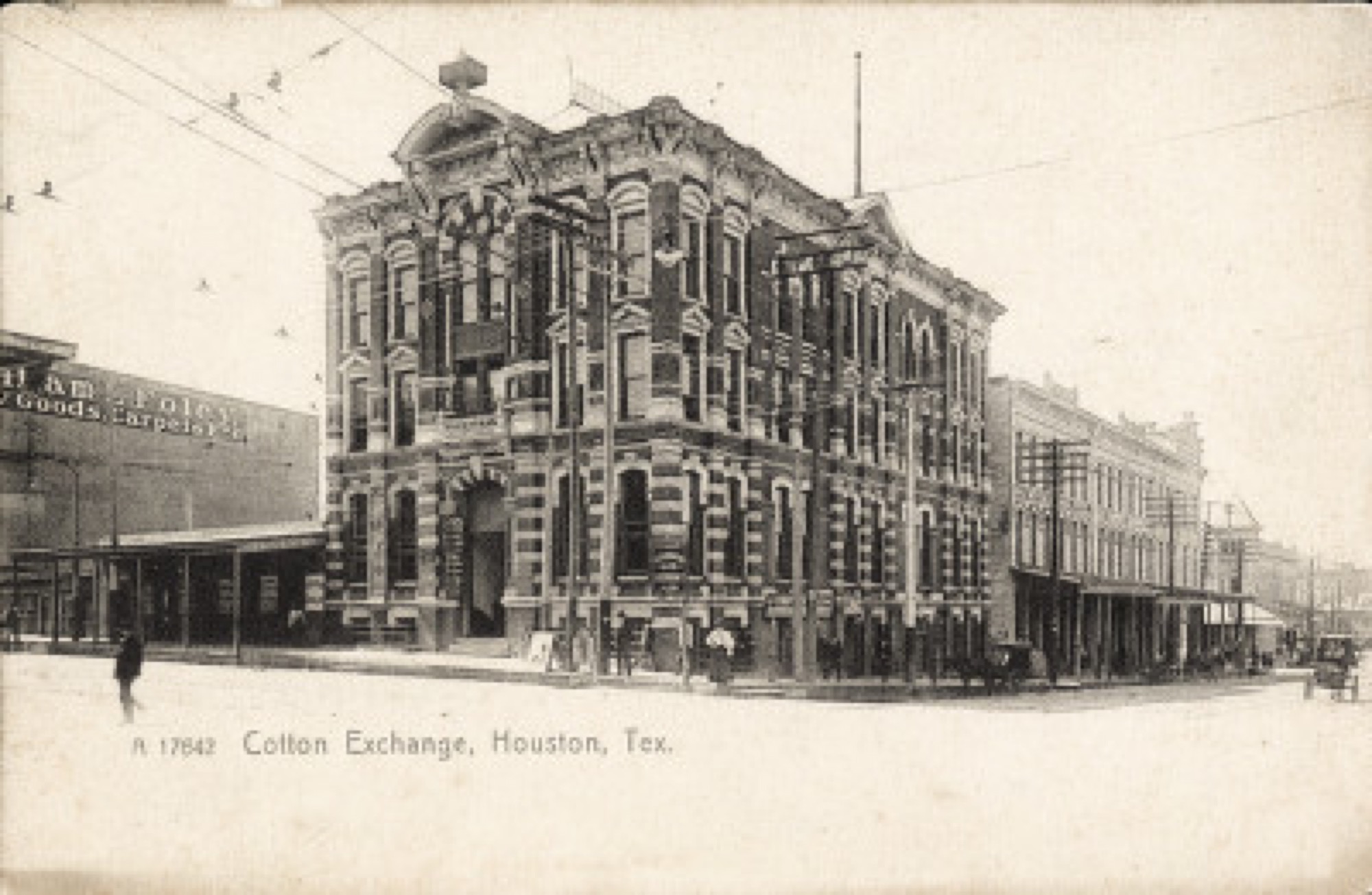
The Houston Cotton Exchange and Board of Trade Building, located at 202 Travis Street at the corner of Franklin Avenue, stands as one of the finest surviving examples of Victorian Renaissance Revival commercial architecture in Texas. Designed by the prolific German-American architect Eugene T. Heiner—a New York native who apprenticed in Chicago at age thirteen before relocating to Houston in 1878, as documented in the Handbook of Texas—the three-story structure was erected in 1884–1885 by contractors Max Kosse and James S. Lucas. Heiner, a founding member of the Texas State Association of Architects in 1886, rendered the building in red Philadelphia pressed brick faced with Texas limestone, producing a distinctive polychromatic facade enlivened by intricate stonework, arched windows, and ornamental detailing characteristic of American High Victorian design. The Society of Architectural Historians Archipedia notes that the building occupies a strategic site just two blocks from the public wharf at the foot of Main Street and the cotton transit sheds lining both banks of Buffalo Bayou. Originally crowned by a decorative zinc bale of cotton, the structure housed exchange rooms and galleries on the second and third floors, offices and the exclusive Houston Club on the first floor, and a saloon in the basement. By 1907 the building had been enlarged to four stories in a major remodeling program that installed the ornate trading room still visible today. When the Exchange relocated to larger quarters at Prairie and Caroline streets in 1924, the original cornerstone was ceremonially transferred. Listed on the National Register of Historic Places in 1971 and designated a Recorded Texas Historic Landmark in 1974, the Travis Street building underwent a comprehensive restoration in 1973 that earned Preservation Houston’s Good Brick Award in 1979.
The decorative program of the Houston Cotton Exchange Building reflects the ambitions of a young commercial city seeking to project solidity and refinement through architectural ornament. Heiner’s original 1884 facade employed the manneristic renditions of detail typical of American High Victorian architecture, as the Handbook of Texas observes of his broader body of work: deep-set limestone stringcourses, voussoirs over arched window bays, and carved foliate capitals that lent the red-brick elevation a layered, textural quality unusual for frontier-era Houston. The building’s most celebrated decorative features date to the 1907 expansion, when the addition of a fourth floor occasioned a thorough interior renovation. The ornate trading room installed at that time featured ceiling murals, wood-paneled wainscot walls, and gilded gold lacework—elements that survived largely untouched into the modern era. The exchange room was designed to convey institutional authority to the cotton merchants and factors who gathered there to negotiate grades and prices, with the elevated galleries permitting spectators and clerks to observe the trading floor below. The building’s original zinc bale-of-cotton finial, mounted atop the roofline, served as a three-dimensional trade sign legible from the nearby wharves and rail sidings, broadcasting the building’s commercial purpose across Houston’s low-rise skyline. Library of Congress photographic holdings from the Farm Security Administration document the broader visual culture of Houston’s cotton industry in this period. The 1973 restoration preserved the interior decorative scheme, allowing the trading room’s gilded ornament and painted ceilings to remain as testimony to the aesthetic aspirations of Texas cotton commerce at the height of its influence.
Houston’s emergence as a cotton metropolis was inseparable from its strategic inland position at the head of navigation on Buffalo Bayou. The Allen brothers founded the city in 1836 precisely at the point where steamboat traffic could penetrate farthest from the Gulf, and as Marilyn McAdams Sibley chronicles in The Port of Houston: A History (University of Texas Press, 1968), the bayou served as the city’s commercial lifeline for decades. The Cotton Exchange Building sat within the Main Street Market Square Historic District—the only commercial historic district in Houston, as the City of Houston Historic Preservation Manual records—surrounded by allied structures including Heiner’s own W. L. Foley Dry Goods Company Building (1889) and the Henry Brashear Building (1882). Roughly half the district’s structures were erected between 1858 and 1900, forming a dense Victorian commercial quarter oriented toward the Buffalo Bayou wharves and cotton transit sheds just two blocks north. The completion of the Houston and Texas Central Railroad in 1871, connecting Austin and the Brazos Valley cotton lands to Houston, transformed the city into a railroad hub funneling agricultural goods to tidewater. The Galveston Hurricane of 1900 devastated the rival island port and alarmed investors, redirecting capital and commerce toward Houston. Congressman Thomas H. Ball championed the deepwater channel that became the Houston Ship Channel, opened on November 10, 1914, when President Woodrow Wilson ceremonially fired a cannon by remote telegraph. The discovery of oil at Spindletop in 1901 further accelerated the city’s transformation, and by the 1930s petroleum products eclipsed cotton as the port’s dominant commodity.
The institutional origins of the Houston Cotton Exchange trace to the Houston Board of Trade, established in 1867 to bring order to an expanding post-Civil War cotton market. The organization received its first state charter in 1874 as the Houston Board of Trade and Cotton Exchange, renamed in an 1877 revision to the Houston Cotton Exchange and Board of Trade, a title reflecting the primacy of cotton in the regional economy. As the Handbook of Texas records, the charter’s stated purposes included providing rooms for the exchange, inculcating just and equitable principles of trade, establishing rules and standards of classification, and promoting the commercial interests of Houston. Exports from the city had surpassed 100,000 bales by 1860, and after the Missouri Pacific Railroad reached Houston in 1873, the exchange adopted cotton quotations from the St. Louis Board of Trade, linking local prices to national markets. The Exchange’s own archives, preserved as Manuscript Collection MC005 at the Harris County Archives, document its governance from 1880 through 1933 in 150 volumes of board minutes, correspondence, membership rolls, and financial reports. As early as 1885 the organization publicly advocated for a deepwater channel to the Gulf, a project realized three decades later. William Marsh Rice, the commission merchant and cotton factor whose wealth later endowed Rice University, exemplified the generation of Houston businessmen whose fortunes flowed through the exchange’s networks. Jesse H. Jones, crowned King Nottoc—cotton spelled backward—at the 1902 No-Tsu-Oh Festival, rose from the cotton-era establishment to become Houston’s greatest builder and, as Reconstruction Finance Corporation chairman under Franklin Roosevelt, one of the most powerful men in Washington.
Texas cotton, the commodity that animated the Houston Cotton Exchange for half a century, arrived in the city by rail from the rich bottomlands of the Brazos Valley, the plantations of East Texas, and the blackland prairies of the interior. The completion of the Buffalo Bayou, Brazos and Colorado Railway in 1853 initiated the flow; by 1871, the Houston and Texas Central Railroad connected the state capital to the Gulf, and cotton bales converged on Houston from dozens of gin towns along expanding branch lines. As the Handbook of Texas entry on the cotton compress industry explains, cotton compresses reduced 500-pound gin bales to roughly half their former size, making long-distance rail transport economically feasible. Houston’s own compress yards employed classers who graded cotton under controlled daylight conditions, evaluating fiber by length of staple, color, and trash content according to the federal grade hierarchy codified under the United States Cotton Futures Act of 1914. Standard designations ranged from Middling Fair at the top through Strict Good Middling, Good Middling, Strict Middling, Middling, Strict Low Middling, and Low Middling, with Middling serving as the benchmark for futures pricing. Houston’s share of the American cotton export market grew steadily: exports had exceeded 100,000 bales by 1860, and Texas statewide production reached 3.5 million bales by 1900. After the 1914 opening of the Ship Channel, the Merry Mount in 1919 carried the first direct cotton shipment from Houston to an international buyer, and within a decade Houston had displaced Galveston as the nation’s leading cotton port. Yet the Spindletop gusher of 1901 had already signaled cotton’s eventual displacement; by the 1930s petroleum products dominated the Ship Channel’s tonnage.
Images will be added as the project develops. Photographs by Larry Ng and from research sources.