Honolulu Stock Exchange
Honolulu, USA · Established 1898
This site requires authorization to access.
To request access, contact
william.goetzmann@yale.edu
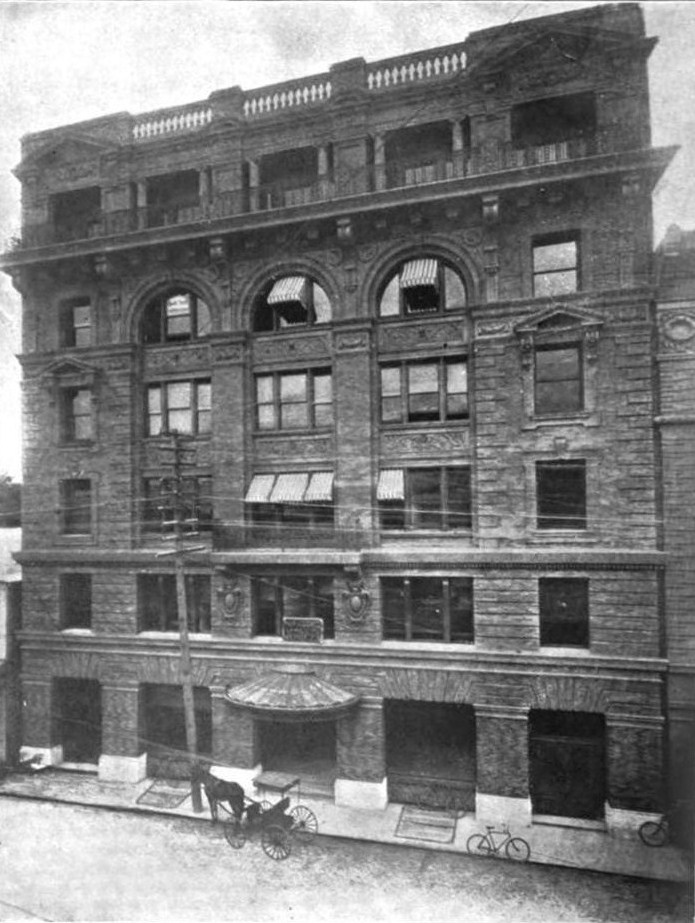
The Honolulu Stock Exchange occupied the Judd Building, erected in 1899 at the prominent corner of Fort and Merchant Streets in downtown Honolulu. Designed by architect Oliver G. Traphagen—who arrived in Hawaiʻi from Duluth, Minnesota, in 1897 and would also design the Moana Hotel in Waikīkī—the Judd Block was his first major commission in the islands. Don Hibbard, in Buildings of Hawaiʻi (University of Virginia Press, 2011), identifies it as a Renaissance Revival structure that “presaged the rebuilding of downtown Honolulu following the Beaux-Arts dictates of America’s City Beautiful movement.” The iron-and-steel-framed building is clad in Hawaiʻi bluestone at the first story, with yellow-tinted Roman brick on the upper floors, and features polished granite Ionic columns framing the Fort Street entrance. Terra-cotta wreaths and swags ornament the fourth story, constituting what the SAH Archipedia entry describes as “the earliest known use of terra-cotta in Hawaii.” Originally four stories, it was Honolulu’s first purpose-built office block and the first building in the Pacific to house an electric passenger elevator. A fifth floor was added between 1914 and 1925. The building’s chamfered corner at the Merchant–Fort intersection creates a distinctive parallelogram plan, while small string courses above the first and third floors establish a classical tripartite façade crowned by a projecting cornice. The Judd Building was listed on the National Register of Historic Places as a contributing structure in the Merchant Street Commercial and Civic Historic District (listed 1973; amended nomination 2022).
The decorative program of the Judd Building reflects the aspirations of Honolulu’s planter-merchant elite at the moment of American annexation. The most celebrated interior ornament is the pair of etched brass elevator doors, beautifully restored and depicting scenes of early commercial seaplanes arriving in Hawaiʻi—a motif added during the building’s mid-twentieth-century renovation that links the exchange’s commercial purpose to the era of trans-Pacific aviation (Davis Levin Livingston, “Historic Davis Levin Livingston Place,” 2000). On the fourth floor, where the stock exchange’s trading room operated from 1898 to 1977, original oak seating survives: six ornate chairs and a clerk’s desk that were purchased at auction and remain in situ, tangible relics of the call-market era (Historic Hawaiʻi Foundation, “My Tour of the Historic Judd Building,” 2022). The exterior displays Traphagen’s Italianate decorative vocabulary: fourth-story terra-cotta wreaths and floral swags, simulated keystones above arched windows, and the polished granite Ionic columns at the Fort Street entrance that lend what Hibbard calls “classical dignity” to the commercial façade. The iron-pattern frames of the main entrance doors and a skylight in the stairwell add further period detail. In the basement, two masonry vaults originally built for the Bank of Hawaiʻi and Alexander & Baldwin testify to the building’s layered financial history. These decorative and functional elements collectively embody the visual culture of Pacific capital formation, linking European architectural ornament to the commodity wealth of the sugar trade.
The Judd Building stands at the intersection of Fort Street and Merchant Street, the historic commercial heart of Honolulu. Gavan Daws, in “Honolulu in the 19th Century: Notes on the Emergence of Urban Society in Hawaii” (Journal of Pacific History, 1967), traces how Honolulu’s harbor—the only protected deep-water anchorage in the central North Pacific—drew successive waves of commerce: ship provisioning, the sandalwood trade, whaling, and finally sugar marketing. By the 1890s, Merchant Street had become “Honolulu’s Wall Street,” concentrating the offices of banks, insurance firms, sugar factors, and commission agents. The amended National Register nomination for the Merchant Street Commercial and Civic Historic District (2022) notes that four of the five members of the “Big Five” plantation conglomerates—Castle & Cooke, Alexander & Baldwin, C. Brewer, and American Factors—maintained headquarters within the district. Fort Street, running mauka (inland) from the waterfront, served as the principal retail and financial corridor, linking the harbor wharves to the governmental precinct around ʻIolani Palace. The Judd Building’s chamfered corner addressed this pivotal crossroads, placing the stock exchange at the nexus of commodity shipping and capital intermediation. Nearby structures—the Stangenwald Building (1901), the Yokohama Specie Bank, and the Bishop Bank Building—formed a dense cluster of financial architecture that the Historic Hawaiʻi Foundation describes as “an open-air, human-scale architectural museum” of commercial development from the 1850s through the 1930s.
The Honolulu Stock Exchange was founded in 1898, approximately one month after the Joint Resolution of Annexation formally incorporated the Hawaiian Islands into the United States on August 12 of that year. As the Honolulu Civil Beat recounts (“Is Hawaii Ready for a Stock Exchange?” 2011), the exchange’s formation coincided with the consolidation of American economic and political power in the islands, a process that Carol MacLennan’s Sovereign Sugar: Industry and Environment in Hawaiʻi (University of Hawaiʻi Press, 2014) traces to the Reciprocity Treaty of 1875, which granted Hawaiian sugar duty-free access to U.S. markets and triggered an explosion of plantation investment. The exchange listed securities of companies formed under the Kingdom and Republic of Hawaiʻi, including C. Brewer (1883), Castle & Cooke (1894), Hawaiian Electric (1891), and Hawaiian Telephone (1883). Edward Greaney, former financial editor of the Honolulu Advertiser and Wharton School graduate, chronicled in “Hawaii’s Big Six: A Cyclical Saga” how the Big Five sugar factors—controlling 96 percent of the sugar crop by 1933—dominated the exchange’s listings. In its early decades, before the 1901 cable connection to the mainland, trades were relayed by ship, imposing weeks-long settlement delays. The exchange operated from the fourth floor of the Judd Building for nearly eight decades. By the 1970s, however, major listed firms had migrated to the NYSE and NASDAQ, and the Honolulu Stock Exchange closed in 1977–1978 due to insufficient trading volume. An attempt to revive the exchange in the 1980s, targeting international securities for trading during off-hours, ultimately failed to materialize.
The securities listed on the Honolulu Stock Exchange reflected the plantation economy that shaped Hawaiʻi from the mid-nineteenth century through statehood. The dominant category was sugar-plantation equities: companies such as Ewa Plantation, Honokaa Sugar, McBryde Sugar, Oahu Sugar, Olaa Sugar, Onomea Sugar, Paauhau Sugar, Pioneer Mill, and Wailuku Sugar appeared on quotation sheets alongside the Big Five agency houses—Castle & Cooke, Alexander & Baldwin, C. Brewer, Theo H. Davies, and American Factors (Amfac)—which served as both factors and holding companies. The Hawaiian Sugar Planters’ Association (HSPA), founded in 1895, coordinated production standards and labor recruitment across these firms, whose corporate records—including stockholder minutes, stock certificates, and bond indentures—are preserved in the HSPA Plantation Archives at the University of Hawaiʻi at Mānoa (donated 1995). Pineapple stocks also traded, notably Hawaiian Canneries and Hawaiian Pineapple Company, reflecting the diversification of island agriculture in the early twentieth century. Philippine-linked securities such as Hawaiian-Philippine Company and San Carlos Milling Company appeared on the board, attesting to Honolulu’s role as a capital intermediary across the Pacific. Utility and infrastructure shares—Hawaiian Electric Company (1891) and Hawaiian Telephone Company (1883)—rounded out the listings. The exchange’s market structure was characteristic of small regional boards: a call-auction format with limited daily volume, dominated by closely held plantation stocks whose prices moved on harvest reports, tariff legislation, and labor availability rather than the broad macroeconomic currents driving mainland exchanges.
Images will be added as the project develops. Photographs by Larry Ng and from research sources.