Hong Kong Stock Exchange (HKEX)
Hong Kong, China · Established 1891

This site requires authorization to access.
To request access, contact
william.goetzmann@yale.edu
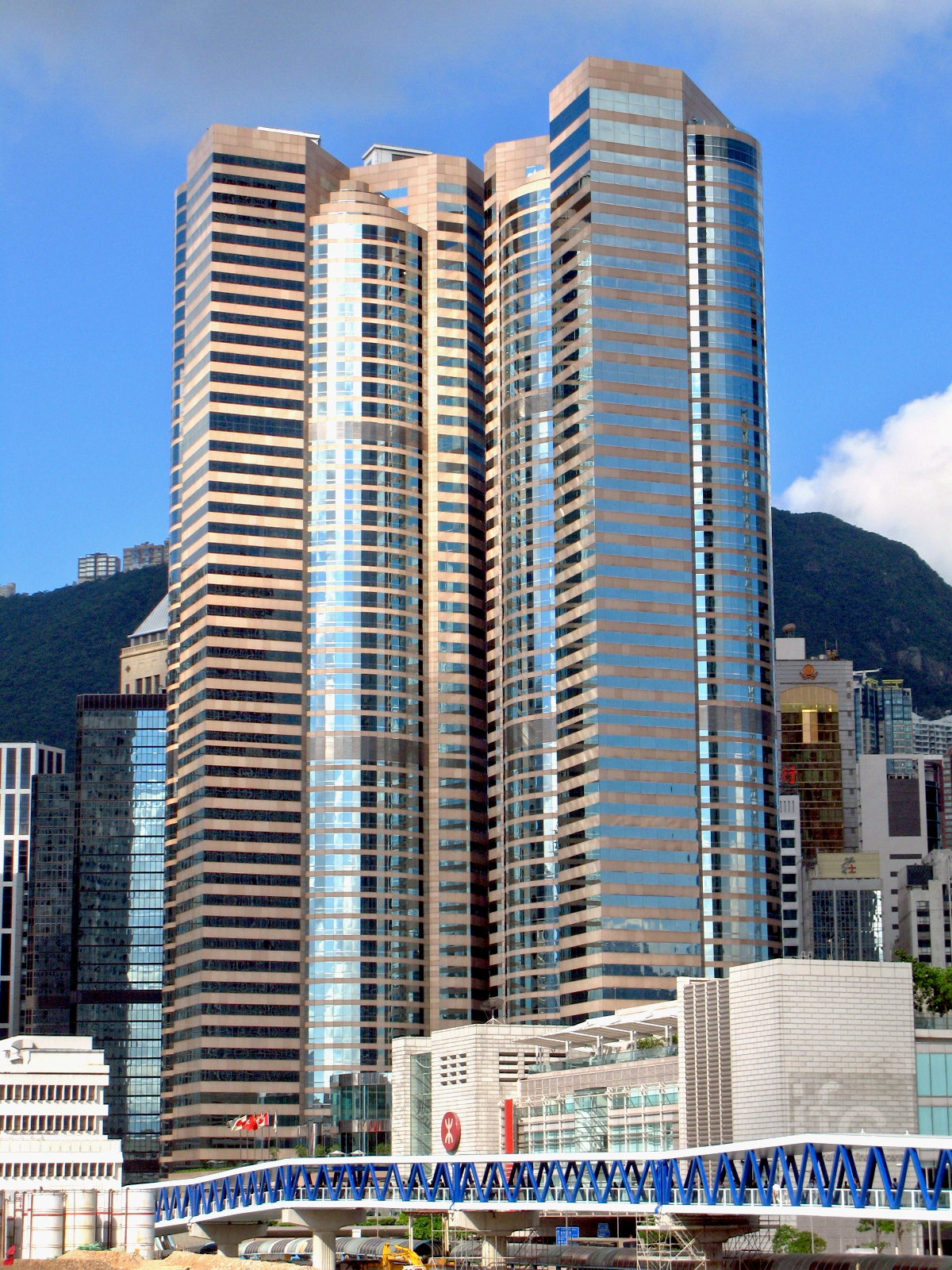
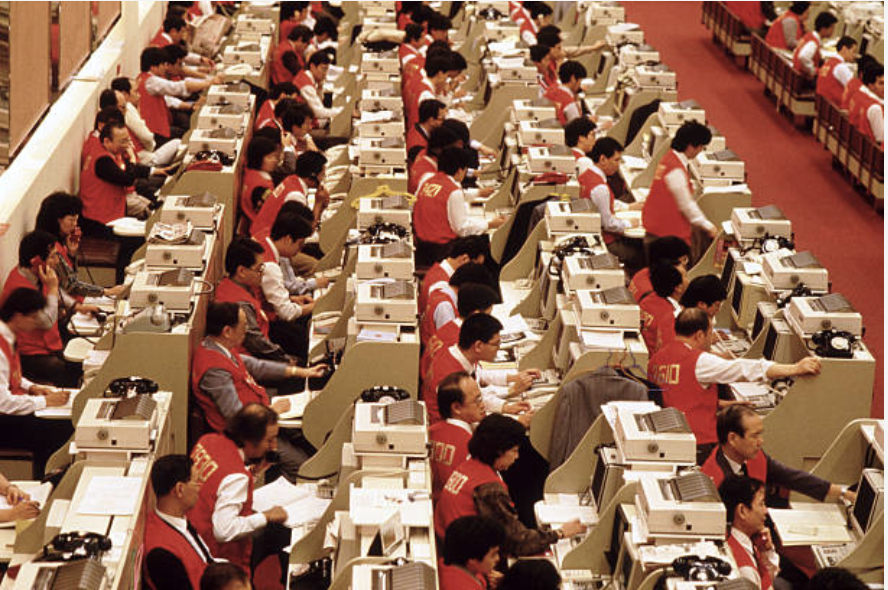
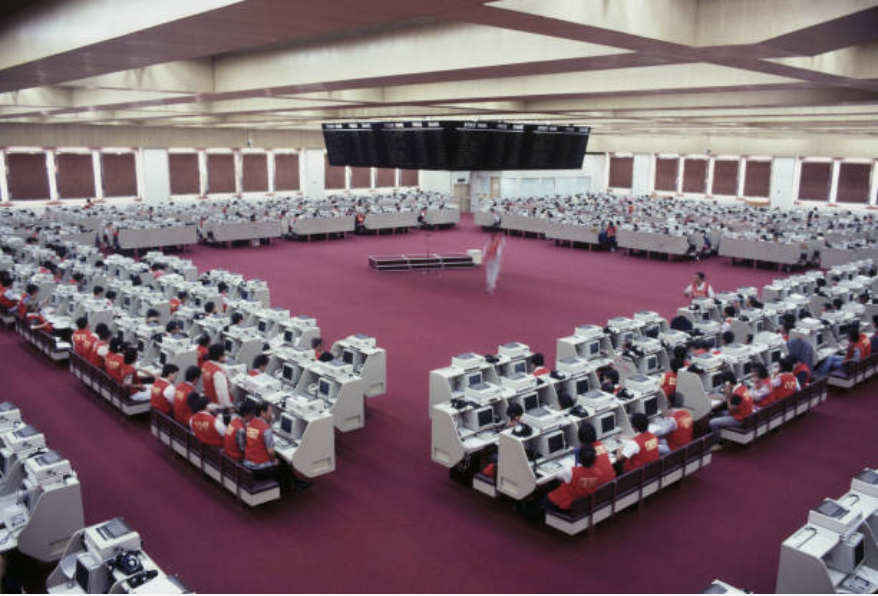
The physical history of the Hong Kong Stock Exchange traces a path from informal colonial-era gathering places to one of Asia’s most architecturally distinguished financial complexes. Before formal exchange buildings existed, brokers reportedly congregated beneath a banyan tree near Queen’s Road, conducting share transactions in the open air of the young colony. The founding of the Association of Stockbrokers in Hong Kong in 1891, and its renaming as the Hong Kong Stock Exchange in 1914, brought trading indoors to modest premises along Des Voeux Road Central—itself a product of the Praya Reclamation Scheme that Sir Catchick Paul Chater and James Johnstone Keswick had driven forward from the 1890s, extending Hong Kong Island’s shoreline northward into Victoria Harbour. The modern architectural landmark arrived with Exchange Square, designed by Remo Riva of Palmer & Turner (P&T Group) and completed in phases between 1985 and 1988 on land created during the Central Reclamation Phase I project. As documented in the M+ museum’s archival collection of Riva’s original drawings, the complex comprises three towers—One and Two Exchange Square at 52 and 51 stories respectively, and the shorter 33-story Three Exchange Square—clad in a postmodern palette of polished granite and silver reflective glass curtain walls. The trading hall itself was a windowless, double-height room exceeding 4,000 square metres, its floors swathed in red carpet and its walls hung with red sound-deadening fabric. After the trading floor closed on 27 October 2017, HKEX unveiled the Connect Hall in February 2018—a renovated ceremonial and event space reflecting the exchange’s transition from open-outcry to fully electronic trading.
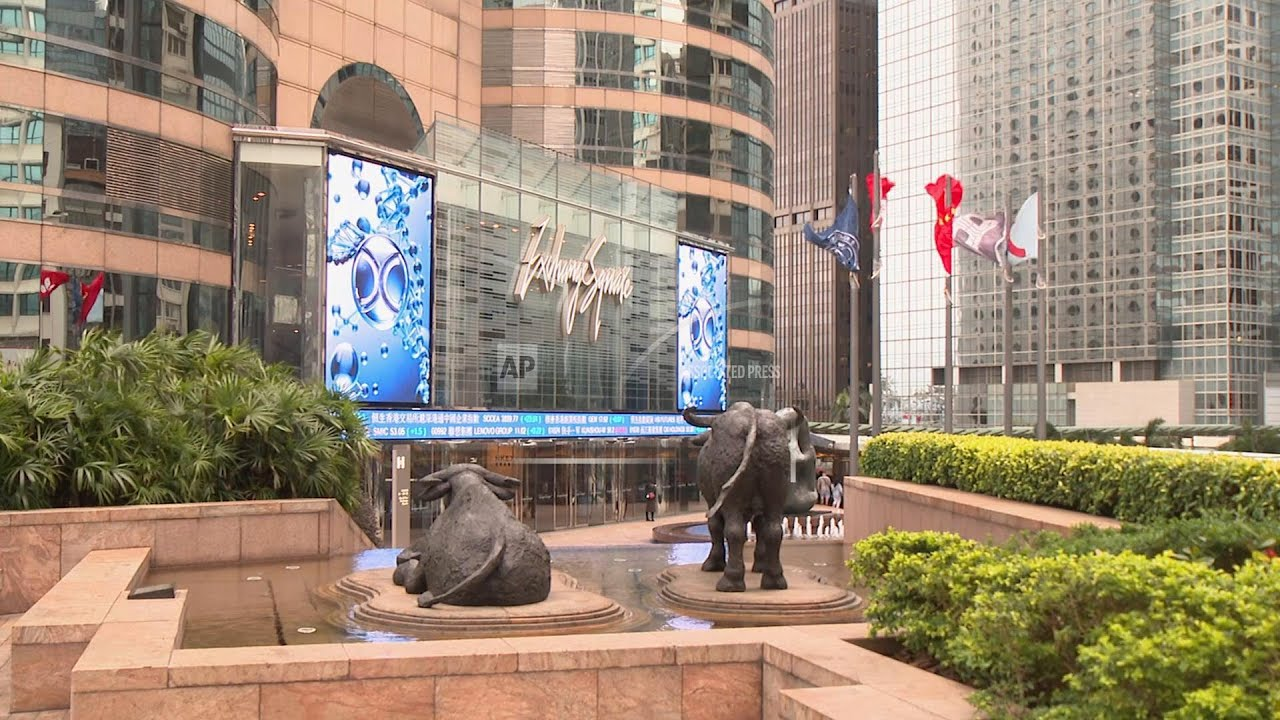
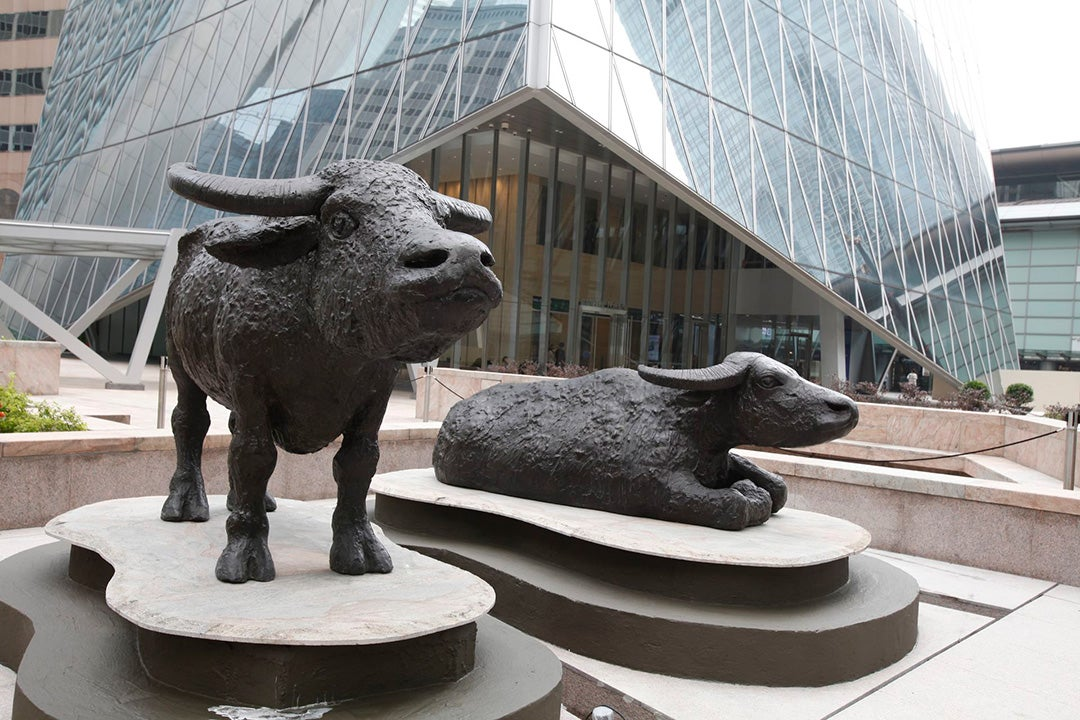
The decorative program of Exchange Square represents one of Hong Kong’s most significant ensembles of public sculpture integrated into a commercial financial space. Dominating the elevated plaza is Henry Moore’s “Oval with Points” (1969), a monumental bronze from edition 3/7, owned by Hongkong Land and installed at the complex’s opening in the mid-1980s. As catalogued by the Henry Moore Foundation, the sculpture’s flattened oval form, pierced by a void from which two sharp protrusions rise to nearly meet at center, creates a field of dynamic tension—possibly inspired by an elephant skull given to Moore by Sir Julian Huxley. The work sits within an integrated fountain, its organic abstraction counterpointing the geometric precision of Riva’s granite-and-glass towers. Complementing Moore’s piece are Taiwanese sculptor Ju Ming’s bronze Taichi works: “Single Whip Dip” (1986) and the smaller “Tai Chi” (1991), both acquired by Hongkong Land. Ju Ming, often called the father of modern Chinese sculpture, began his Taichi series in 1976 after studying the martial art on the advice of his mentor Yuyu Yang. The figures’ rough-hewn, monumental physicality provides a striking dialogue with the sleek modernism of the financial precinct. Inside, the trading hall’s aesthetic was deliberately functional: the red fabric panels and carpet created a visually unified environment for the frenetic activity of open-outcry trading, while electronic ticker displays and quote boards constituted their own form of commercial visual culture, translating market data into the kinetic art of capital flows.
Exchange Square’s position in Hong Kong’s Central district encapsulates the colony-turned-metropolis’s centuries-long project of wresting buildable land from Victoria Harbour. The site itself stands on reclaimed ground—part of a continuum stretching back to the Praya Reclamation Scheme of the 1890s, when Chater and Keswick added some 59–65 acres to the Central waterfront, as documented in the Hong Kong Memory Project’s archival records. What was once the harbour’s edge at Queen’s Road became, through successive reclamations, an inland thoroughfare; Des Voeux Road marked a new shoreline that would itself be superseded. Exchange Square occupies land from the Central Reclamation Phase I of the early 1980s, positioned at the intersection of Connaught Road Central and Man Yiu Street. The complex connects seamlessly to the Central Elevated Walkway—an extensive footbridge network analyzed in Sancia Wan’s SSRN working paper “The Role of the Skywalk System in the Development of Hong Kong’s Central Business District” (2010). This elevated pedestrian infrastructure, unique to Hong Kong’s constrained geography, allows one to traverse from Exchange Square to the Star Ferry piers, the International Finance Centre towers (completed 1998–2003, designed by César Pelli), and the Central–Mid-Levels escalator system without touching street level. Hong Kong’s scarcity of flat, developable land—hemmed between Victoria Peak and the harbour—drove the vertical intensification that defines the Central skyline, making Exchange Square’s three towers an expression of the geographic imperatives that shaped Asia’s preeminent financial district.
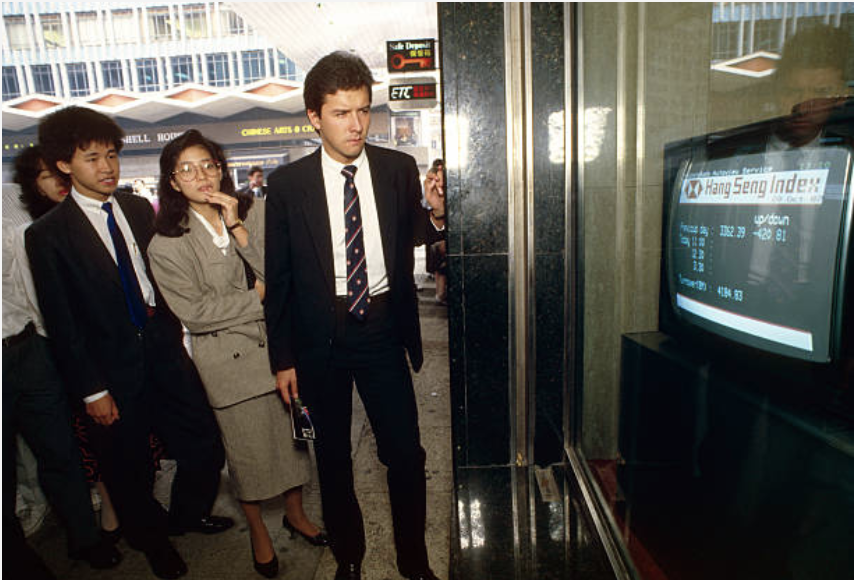
Formal securities trading in Hong Kong dates to 1891, when twenty-one brokers established the Association of Stockbrokers in Hong Kong, regularizing transactions in the shares of colonial trading houses and shipping firms. Renamed the Hong Kong Stock Exchange in 1914, it merged with the rival Hong Kong Stockbrokers’ Association (incorporated 1921) in 1947. The postwar decades saw a proliferation of competing venues: the Far East Exchange (1969), the Kam Ngan Stock Exchange (1971), and the Kowloon Stock Exchange (1972) emerged to serve a rapidly expanding market. As Robert Fell documented in Crisis and Change: The Maturing of Hong Kong’s Financial Markets (Longman, 1992), the four exchanges ceased trading on 27 March 1986 and were unified as the Stock Exchange of Hong Kong (SEHK), which commenced computer-assisted trading on 2 April 1986. The euphoria was short-lived: in October 1987, following Black Monday, the exchange controversially closed for four days—a decision scrutinized by the Ian Hay Davison-chaired Securities Review Committee, whose May 1988 report led to the creation of the Securities and Futures Commission in 1989, as examined in “Moving the Goalposts: Financial Market Regulation in Hong Kong and the Crash of October 1987” (Law & Social Inquiry, Vol. 15, No. 1). The 1997–98 Asian financial crisis saw the Hang Seng Index plummet from 16,673 to 6,660. In March 2000, the SEHK, Hong Kong Futures Exchange, and Hong Kong Securities Clearing Company demutualized and merged into Hong Kong Exchanges and Clearing Limited (HKEX). The Shanghai–Hong Kong Stock Connect (November 2014) and Shenzhen–Hong Kong Stock Connect (December 2016) established unprecedented cross-border trading channels between mainland Chinese and international capital markets.
The securities traded on the Hong Kong exchange mirror the territory’s transformation from a colonial entrepôt to a global financial gateway for China. In the nineteenth century, the Association of Stockbrokers facilitated transactions in shares of the great trading houses—the hongs—that dominated East Asian commerce: Jardine, Matheson & Co., founded in 1832 by William Jardine and James Matheson and built initially on the opium and tea trades; the Hongkong and Shanghai Banking Corporation, established in 1865 to finance the colony’s burgeoning trade; and the shipping and trading conglomerate Swire. The Hang Seng Index, conceived by Ho Sin Hang and Lee Quo-wei of the Hang Seng Bank and first compiled by Stanley Kwan in 1964 (publicly launched 24 November 1969), codified the market’s blue-chip universe, initially tracking 33 constituent stocks. A transformative moment arrived on 15 July 1993, when Tsingtao Brewery became the first mainland Chinese state enterprise to list H-shares in Hong Kong; its HK$889 million IPO was oversubscribed 110 times. Since then, hundreds of H-share listings have raised over HK$2 trillion, making Hong Kong the primary offshore capital-raising venue for Chinese enterprises. The modern HKEX marketplace encompasses Main Board and GEM Board equities, exchange-traded funds, real estate investment trusts, derivative warrants, callable bull/bear contracts, and inline warrants. The Stock Connect programs have added cross-border access to Shanghai and Shenzhen A-shares for international investors and to Hong Kong-listed securities for mainland participants.