Ho Chi Minh Stock Exchange (HOSE)
Ho Chi Minh City, Vietnam · Established 2000
This site requires authorization to access.
To request access, contact
william.goetzmann@yale.edu
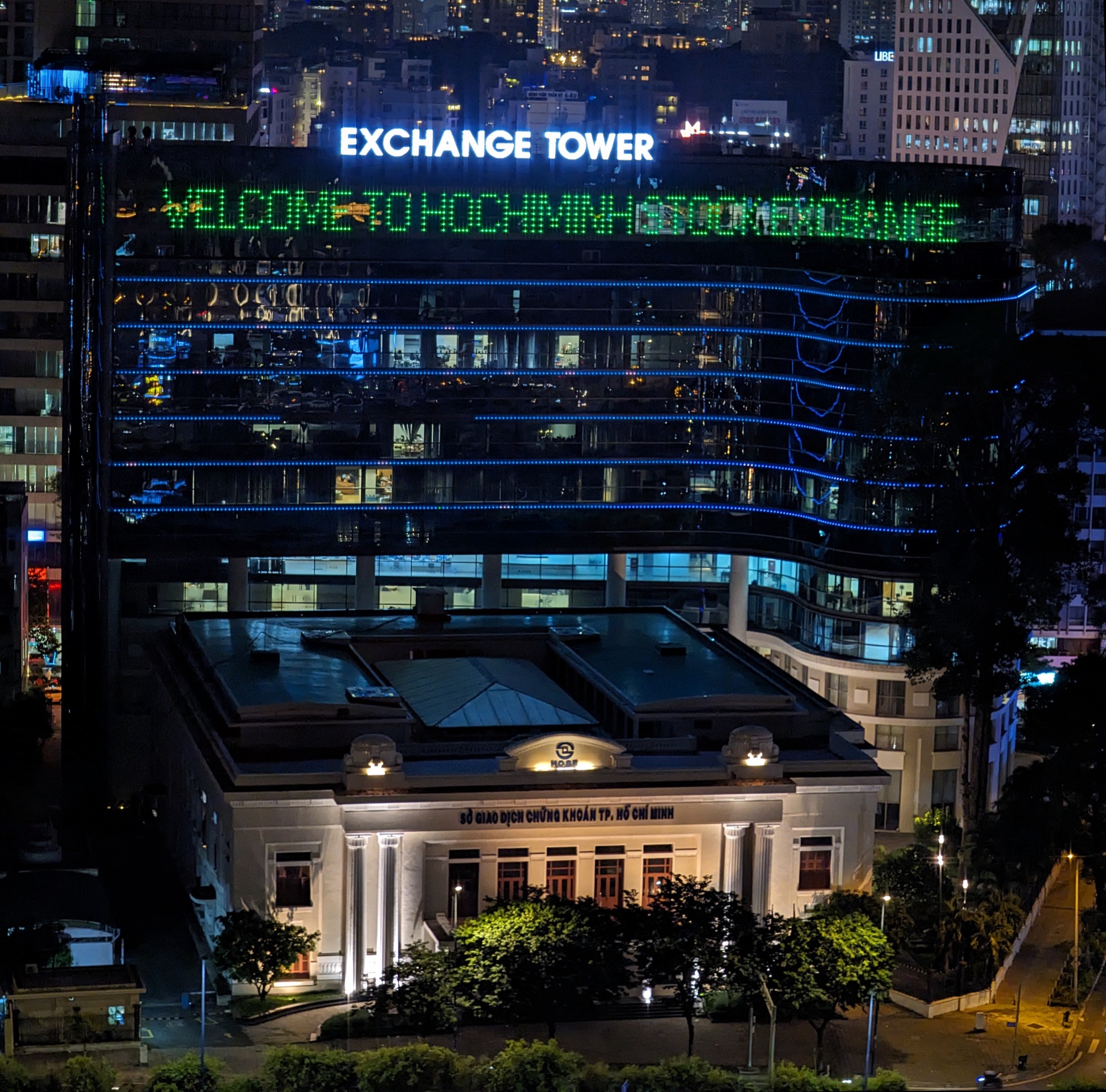
The Ho Chi Minh Stock Exchange occupies one of Saigon’s most historically layered colonial structures, the former Chambre de Commerce building at 16 Võ Văn Kiệt Street (formerly Ben Chương Dương) in District 1. As Tim Doling documents in his “Old Saigon Building of the Week” series on Historic Vietnam (2015), the decision to construct a “larger and more imposing seat” for the Chambre de Commerce was taken in 1927, and the building was inaugurated on 24 March 1928 at a grand reception attended by the Governor of Cochinchina. The structure’s eclectic design blends Neo-Classical and Art Deco elements with indigenous Cham and Khmer decorative references—a hallmark of the “Indochine style” that emerged in French colonial architecture during the 1920s, as discussed in William S. Logan’s study Hanoi: Biography of a City (University of Washington Press, 2000). Sited beside the Bến Nghé Creek in the heart of what was once Saigon’s “gold and silver quarter,” the building originally served as the meeting place for all businessmen—regardless of nationality—operating in Saigon and Cochinchina. During World War II, the Japanese military commandeered the premises. After the Geneva Accords, the building was transformed in 1955 into Diên Hồng Hall, a national conference facility named after the legendary 1284 assembly convened by Trần kings to rally resistance against the Mongol invasion. In 1957 it hosted the ninth annual session of the Colombo Plan Consultative Committee. From 1967 to 1975, constitutional changes converted it into the upper house (Senate) of the Republic of Vietnam’s National Assembly. After reunification in 1975, various local government agencies occupied the building until the State Securities Commission took possession in 1996 and refurbished it for its current role as Vietnam’s flagship stock exchange, opening in July 2000.
The building’s decorative program reflects the distinctive “Indochine style” that French colonial architects developed in Southeast Asia during the interwar period, blending European academic classicism with indigenous ornamental traditions. As Doling notes on Historic Vietnam, the façade incorporates several Cham and Khmer decorative motifs alongside Neo-Classical pilasters and Art Deco geometric patterns—an approach that paralleled contemporaneous experiments at the École française d’Extrême-Orient and the work of architect Ernest Hébrard elsewhere in Indochina. The wrought-iron entrance doors, which survived successive changes of use, retained the initials “DH” (Diên Hồng) from the building’s 1955–1967 incarnation as a national conference hall. When the State Securities Commission refurbished the interior in the late 1990s for use as a securities trading center, the colonial-era exterior ornamentation was preserved while the interior was fitted with electronic trading infrastructure. The architectural historian Annabel Jackson Villanova, writing in the context of Saigon’s heritage preservation debates, has observed that the Chambre de Commerce building represents one of the city’s increasingly rare intact examples of interwar public architecture, where the decorative arts of the colonial period remain legible despite decades of institutional transformation. No significant stand-alone artworks are known to adorn the current trading floors, but the building itself—with its synthesis of European and Southeast Asian ornamental vocabularies—constitutes the primary artistic statement.
The exchange sits at the geographic and symbolic center of Saigon’s historic financial district, a compact quarter formed in the late nineteenth century between the Bến Nghé Creek, Hàm Nghi Boulevard, and the Saigon River waterfront. As the Vietnam.vn portal’s feature on “Saigon Wall Street” (2023) documents, this “gold and silver quarter” was strategically located adjacent to both the commercial port and Bến Thành Market, the city’s largest marketplace. The completion of Mông Bridge in 1894 and Khánh Hội Quay Bridge in 1904 reduced the transit time between the port and the financial quarter to mere seconds. Hàm Nghi Boulevard itself, as Doling recounts in Historic Vietnam, originated as a waterway called rạch Cầu Sấu (“Crocodile Bridge Creek”) used by merchants to access the old city market; the French filled it in during 1867–1868 to create a 56-meter-wide thoroughfare. By the mid-twentieth century, 32 banks—including 18 Vietnamese and 14 foreign institutions—were headquartered along Hàm Nghi and adjacent avenues. The neighboring Banque de l’Indochine building (1929–1930), now the State Bank of Vietnam’s Ho Chi Minh City headquarters, featured its own Khmer-inspired reliefs of Naga serpents and lotus flowers, underscoring how the entire quarter developed a coherent architectural vocabulary linking commerce to Southeast Asian visual culture. Today the exchange anchors a financial corridor that extends along Đồng Khởi Street—the old Rue Catinat—past the Continental Hotel and Opera House, connecting the riverside wharves to the Notre-Dame Cathedral precinct, a linear geography that traces the path Nguyễn Dynasty rulers once took from the Gia Định Citadel to the Saigon River.
Vietnam’s first stock exchange emerged from one of the most dramatic economic transformations of the late twentieth century. After reunification in 1975, the Socialist Republic of Vietnam nationalized all private enterprise and operated a centrally planned economy. By the mid-1980s, facing severe inflation and economic stagnation, the Communist Party’s Sixth National Congress launched the Đổi Mới (“Renovation”) reforms in December 1986, introducing market mechanisms while retaining single-party governance—a process analyzed in depth by Adam Fforde and Stefan de Vylder in From Plan to Market: The Economic Transition in Vietnam (Westview Press, 1996). The reform program included the “equitization” of state-owned enterprises (SOEs)—a Vietnamese alternative to outright privatization in which enterprises were converted into joint-stock companies with shares distributed among the state, workers, and private investors. As the UNDP’s report The State as Investor (2006) and the Asian Development Bank Institute’s working paper on SOE reform (Vo Tri Thanh, 2019) document, the first equitization took place in 1992, and approximately 4,000 SOEs were equitized between 1998 and 2010. To provide a secondary market for these newly issued shares, the government established the Ho Chi Minh City Securities Trading Center (HoSTC), which officially opened on 20 July 2000. The first trading session occurred on 28 July 2000, with just two listed stocks—Refrigeration Electrical Engineering Corporation (REE) and Saigon Cable and Telecommunication Material Corporation (SAM)—six member securities companies, and a total listed value of 270 billion VND. Quan-Hoang Vuong, in Financial Markets in Vietnam’s Transition Economy (VDM Verlag, 2010), provides a comprehensive analysis of these early years, noting the policy anomalies and market disequilibria that characterized the 2000–2006 period. On 8 August 2007, HoSTC was formally upgraded and renamed the Ho Chi Minh Stock Exchange (HOSE). In December 2020, Prime Minister’s Decision No. 37/2020/QD-TTg established the Vietnam Stock Exchange (VNX) as a unified national entity, with HOSE and the Hanoi Stock Exchange (HNX) becoming its wholly owned subsidiaries.
HOSE is Vietnam’s principal securities market, listing approximately 400 companies that represent the largest capitalization tier of the national economy. The exchange trades equities, closed-end fund certificates, exchange-traded fund (ETF) certificates, and covered warrants. Its benchmark VN-Index, established with a base value of 100 on 28 July 2000, tracks all listed shares and has become the primary barometer of Vietnamese market sentiment, analyzed daily by securities industry professionals as documented in the Baker McKenzie Cross-Border Listings Guide (2023). Among the most prominent constituents are Vinamilk (VNM), the dominant dairy producer whose equitization in 2003 became a landmark of SOE reform; Vietcombank (VCB), the country’s leading state-owned commercial bank; and PetroVietnam Gas (GAS), a subsidiary of the national oil and gas corporation rated by Fitch Ratings. The VN30 Index, introduced to capture the thirty most liquid large-cap stocks, includes Vinhomes, Hoa Phat Group, and Vingroup. Foreign investor participation has been shaped by ownership limits (FOLs), typically capped at 49 percent for most sectors, as detailed in VinaCapital’s 2022 briefing on foreign ownership regulations. When a company’s foreign ownership limit is reached, new international buyers must purchase from existing foreign holders at a premium, creating a distinctive two-tier pricing dynamic. Trading evolved from initial manual order-matching to a fully electronic continuous auction system. The exchange has played a central role in channeling capital into Vietnam’s post-Đổi Mới economy: from 2,997 investor accounts at the end of 2000, the number exceeded 10 million by 2025, a figure cited by HOSE in its twenty-fifth anniversary review. Government bonds are traded on the Hanoi Stock Exchange rather than HOSE, but HOSE’s equity platform has been the primary vehicle through which the equitization program has connected state enterprises to domestic and international capital.
Images will be added as the project develops. Photographs by Larry Ng and from research sources.