Helsinki Stock Exchange (Helsingin Pörssi)
Helsinki, Finland · Established 1912
This site requires authorization to access.
To request access, contact
william.goetzmann@yale.edu
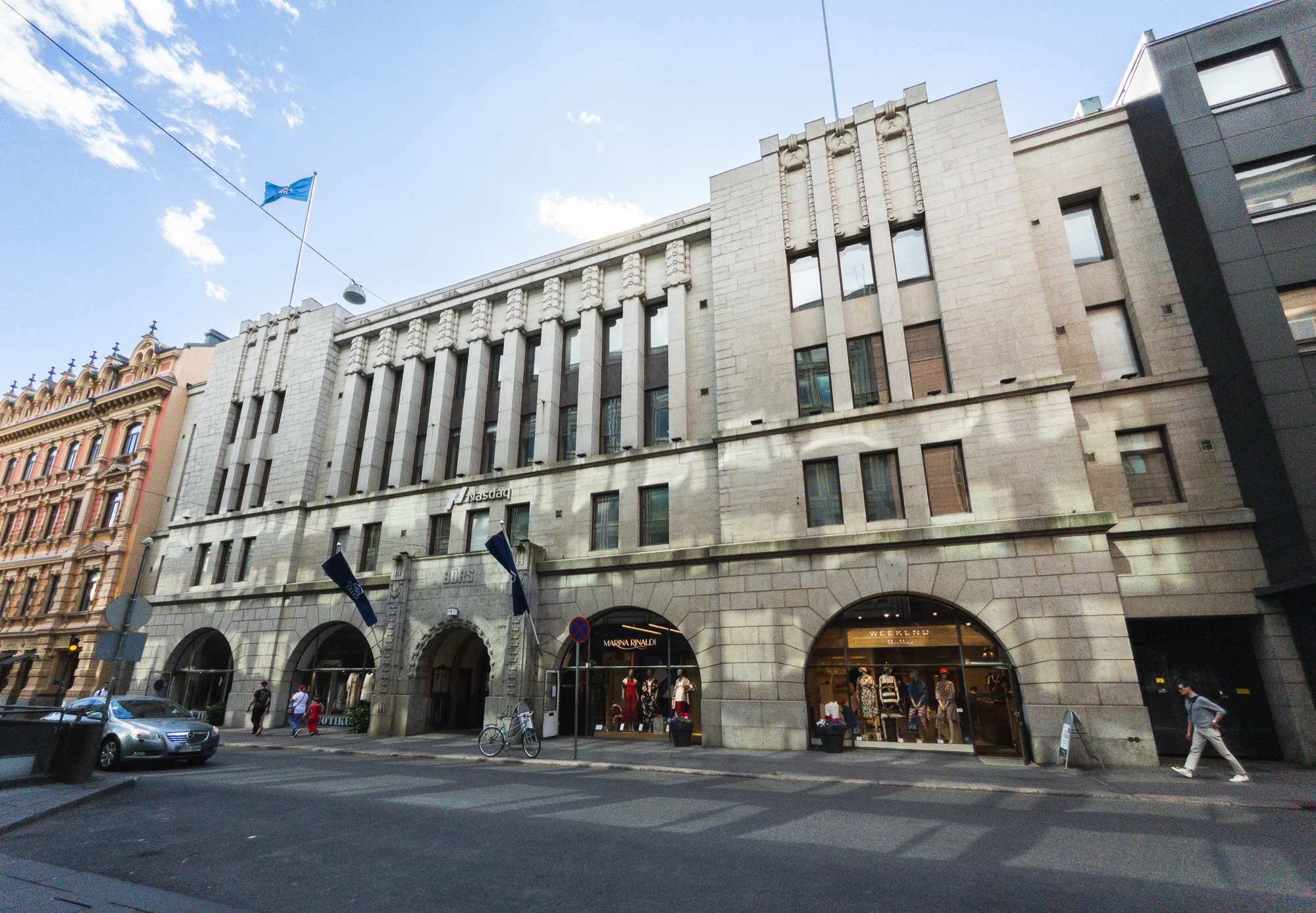
The Helsinki Stock Exchange building, known as Pörssitalo, was designed by architect Lars Sonck (1870–1956) and completed in 1911, with the Helsinki Bourse Club commencing operations in February 1912. Commissioned in 1907 by Helsinki merchants Julius Tallberg and Viktor Ek, the building occupies a long, narrow plot in the Kluuvi district, a constraint that Sonck turned to dramatic advantage. The smooth-faced granite facade is characterized by an austere, disciplined symmetry in which traditional columns have been transformed into rectangular pilasters that emphasize structural function rather than ornament—an approach even more ascetic than Sonck's nearby Mortgage Society of Finland building (Eteläesplanadi 16, completed 1908). The main entrance leads through a vaulted corridor into the heart of the building: a regal, glass-roofed interior courtyard around which offices open through loggias, windows, and balconies, with a gallery running along the top-floor wall. The interior walls of red brick, together with carefully composed stairs and alternating open and semi-open passages, create a spatial sequence of exceptional quality. A restaurant occupies the rear of the courtyard at ground level, with the exchange hall situated above it and the Helsinki Bourse Club on the fourth floor. The building's interior and exterior have been protected under the Helsinki city plan since April 8, 1994, and a comprehensive renovation began in 2002.
Unlike some of Sonck's earlier National Romantic works, the Stock Exchange building is distinguished by its material austerity rather than elaborate sculptural programs. The clearest surviving Art Nouveau element is the expressive use of authentic materials themselves—the smooth granite of the facade and the warm red brick of the interior courtyard walls—which function as the primary decorative vocabulary. Sonck also designed custom furnishings for the building, including purpose-built work stools dating to 1912, reflecting the Art Nouveau ideal of the architect controlling the total design environment. The fourth-floor Bourse Club premises retain much of their original interior, which was ordered from England at the time of the building's completion and has mostly remained intact through subsequent decades. The glass-roofed courtyard, with its interplay of loggias, balconies, and the top-floor gallery, constitutes the building's most significant artistic achievement—an architectural composition of light and space that relies on spatial drama rather than applied ornament.
The Pörssitalo stands at Fabianinkatu 14 in Helsinki's Kluuvi district, within the city block historically known as Yksisarvinen (Unicorn), placing it at the heart of Finland's governmental and commercial center. The building is situated just a few dozen meters from the Esplanadi Park and the Market Square (Kauppatori), and within close walking distance of Senate Square, where Carl Ludvig Engel's neoclassical ensemble—Helsinki Cathedral, the Government Palace, the University of Helsinki, and the National Library—defines the monumental civic core of the capital. The Bank of Finland's headquarters and the Presidential Palace are also nearby. Fabianinkatu itself runs through a corridor of significant institutional and commercial buildings, connecting the Esplanadi to the broader business district. In commissioning the Stock Exchange on this site in 1907, Tallberg and Ek chose a location that mirrored the precedent of Stockholm's stock exchange and deliberately anchored Finland's nascent securities market within Helsinki's most prestigious commercial and administrative quarter.
The institutional history of the Helsinki Stock Exchange dates to November 1862, when the Helsingfors Börsförening (Helsinki Stock Exchange Association) was established as the first formal securities trading entity in Helsinki, conducting twice-weekly trades in stocks, currencies, and bonds at informal venues. However, limited liquidity and few available securities led to the association's discontinuation in 1869. The modern Helsinki Stock Exchange was officially founded on October 7, 1912, when the first transaction took place at the newly completed Pörssitalo on Fabianinkatu, with initial listings comprising 34 stock series from 30 companies. The exchange grew dramatically during World War I as Russian wartime demand spurred Finnish industrial expansion. In December 1917, the building hosted a welcome reception for the Finnish statesman P. E. Svinhufvud upon his return from Siberian exile, coinciding with Finland's declaration of independence—a symbolically charged event in the building's history. The exchange remained a free-form financial association until 1984, when it was reorganized as a cooperative. An electromechanical trading board introduced in 1935 was replaced in 1990 by the HETI electronic trading system. A 2003 merger with Sweden's OM AB created OMX, and Nasdaq's acquisition of OMX in February 2008 brought the exchange into its current form as Nasdaq Helsinki. The Pörssitalo itself continues to house Nasdaq Helsinki's offices, the Helsinki Bourse Club, and Restaurant Pörssi.
From the exchange's founding in 1912, the Helsinki Stock Exchange primarily facilitated trading in equities and bonds, opening with 34 stock series from 30 companies and a market capitalization of approximately 277.9 million Finnish markkas, representing about one-fifth of Finland's GDP. Its predecessor, the 1862 Helsingfors Börsförening, had traded stocks, government bonds, and currencies on a limited basis. Throughout most of the twentieth century, the two dominant sectors represented on the exchange were metal and manufacturing, and pulp and paper—industries reflecting Finland's resource-based economy. Listings expanded rapidly during World War I, peaking at 96 stock series by 1920, before contracting to 38 series by the late 1930s due to mergers, bankruptcies, and economic volatility. A revival in the 1970s, driven by the removal of stamp duties and the end of index-linked government bonds, redirected Finnish investment toward equities. The exchange achieved global prominence in the 1990s with Nokia's meteoric rise, which at its peak around 2000 accounted for over 70 percent of total market capitalization. The absorption of Finland's derivative exchanges in 1997–1998 brought options and futures trading under the same institutional roof.
Images will be added as the project develops. Photographs by Larry Ng and from research sources.