Havana Stock Exchange (Bolsa de La Habana)
Havana, Cuba · Established 1910
This site requires authorization to access.
To request access, contact
william.goetzmann@yale.edu
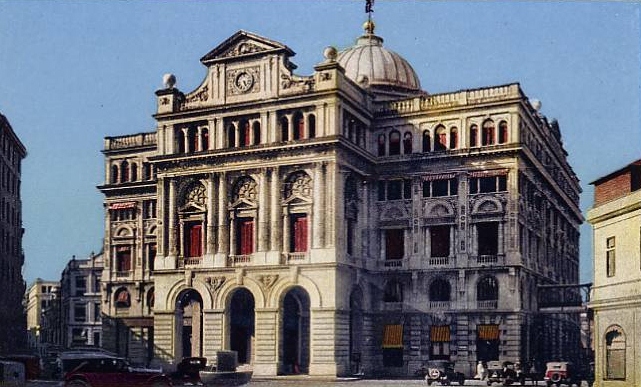
The Lonja del Comercio de La Habana, Havana’s commodities exchange, rises at the northern edge of the Plaza de San Francisco de Asís in the heart of Old Havana. Construction began in 1907 and was completed in March 1909, replacing an earlier commercial hall that had occupied the site. The building was designed by the Spanish-trained architects Tomás Mur y Agramonte and José Toraya, with structural engineering provided by the American firm Purdy & Henderson, whose Havana branch—established in 1899—would go on to build the National Capitol and the Hotel Nacional, executing projects valued at roughly 120 million pesos over three decades, as documented in the Columbia University GSAPP exhibition catalogue Purdy and Henderson in La Habana (2020). The five-story building employs a steel frame clad in stone facing, a construction method that Purdy & Henderson introduced to Cuba during the founding years of the Republic. The plan follows a perfect square organized around a central courtyard, with classical arches, columns, and pilasters articulating both the façade and the interior arcades. The ground floor originally housed the commodities trading hall and warehousing functions; the second and third floors provided office space for commercial firms; and the upper floors were leased to customs brokers and trading companies. In 1939, an additional sixth floor was added to accommodate growing demand for commercial offices. The crowning feature is the copper-clad dome, surmounted by a four-meter-tall bronze statue of Mercury, the Roman god of commerce, which serves as a weather vane and has been visible across the Havana skyline for over a century. The building’s eclectic style blends Spanish Renaissance motifs with Beaux-Arts grandeur, reflecting the cosmopolitan aspirations of early Republican Cuba. In the 1990s, under the direction of Eusebio Leal Spengler and the Oficina del Historiador de la Ciudad de La Habana, the Lonja underwent a comprehensive renovation beginning in 1995 through the Cuban-Spanish joint venture Aurea SA, completed in 1996. As Joseph Scarpaci, Roberto Segre, and Mario Coyula describe in Havana: Two Faces of the Antillean Metropolis (University of North Carolina Press, 2002), the interior was extensively modernized with contemporary materials including stainless steel and glass, while the exterior façade and classical structural elements were carefully preserved. Today the building houses offices for foreign companies with joint ventures in Cuba, the Brazilian Embassy, the CNN Havana Bureau, and the Habana Radio station.
The decorative program of the Lonja del Comercio centers on the monumental bronze statue of Mercury that crowns its dome—a faithful replica of Giambologna’s celebrated Flying Mercury (c. 1580), the original of which resides in the Museo Nazionale del Bargello in Florence. The Havana replica, cast in hollow copper and bronze, stands approximately four meters tall and depicts the messenger god poised on the breath of Zephyr, one arm raised toward the heavens in a gesture of dynamic ascent. As the Encyclopaedia Britannica entry on Giambologna’s Mercury notes, the original is one of the defining masterworks of Mannerist sculpture, and replicas adorn commercial buildings in Florence, Vienna, and Toulouse—making the Lonja’s version part of a pan-European tradition of associating Mercury with exchange and commerce. The statue was restored in 1999 and again in 2002 to repair damage from Havana’s corrosive salt air and tropical climate. The building’s façade features a richly ornamented Renaissance-style decorative scheme with carved stone pilasters, Corinthian-influenced capitals, and ornamental cornices that frame the arched windows on each story. The interior, before its 1990s renovation, displayed splendid inlaid marble floors, grand colonnaded hallways, and the central courtyard lit by skylights set into the upper dome—elements that recall the spatial traditions of Spanish lonjas, as Carlos Venegas Fornias explored in his studies of Havana’s colonial and Republican-era architecture. The Artstor Digital Library holds photographic records of the building’s architectural details (accession 32587999), documenting the classical arches, stone carvings, and spatial rhythms of the original interior before its modernization. The café-restaurant El Mercurio, named after the crowning statue, now occupies the ground floor, preserving at least nominally the building’s identity as a temple of commerce.
The Lonja del Comercio commands the northern side of the Plaza de San Francisco de Asís, one of the five great plazas that define the urban morphology of Old Havana—a UNESCO World Heritage Site since 1982. Founded in 1628, the Plaza de San Francisco was Havana’s primary commercial square, facing directly onto the harbor where Spanish galleons once gathered. As the UNESCO inscription for “Old Havana and its Fortification System” (1982) states, the city was founded as a colonial military and commercial outpost, and by the late sixteenth century its harbor served as the rendezvous point for the Flota de Indias, the treasure fleet system linking Spain to its American empire. The plaza’s eastern side is occupied by the Aduana del Puerto (Customs House), built in 1914 by the North American Port of Havana Docks Company, which housed customs offices, the Maritime Police, and the Port Authority. The southern side features the Basilica of San Francisco de Asís, a Franciscan convent dating to 1575–1591. This dense clustering of religious, commercial, and governmental functions around a single square embodies the layered urbanism that Scarpaci, Segre, and Coyula analyze in Havana: Two Faces of the Antillean Metropolis (2002). Havana’s deep natural bay—defended by the fortresses of El Morro, La Punta, and La Cabaña—made it, in the words of colonial administrators, “the key and gateway of the Americas.” By the 1790s it was the Caribbean’s busiest port, funneling sugar, tobacco, and other commodities toward Spain and, after the opening of free trade in 1818, increasingly toward the United States. Carlos Venegas Fornias, in La urbanización de las murallas: dependencia y modernidad (Letras Cubanas, 1990), traces how the demolition of Havana’s city walls in the nineteenth century unleashed commercial development that ultimately produced the Lonja and its neighboring commercial buildings. The Lonja’s placement on the plaza thus represents the culmination of four centuries of mercantile activity in this specific waterfront location, where sugar warehouses, customs facilities, and shipping offices converged at the point of embarkation for the Atlantic trade.
The institutional history of commercial exchange in Havana predates the Lonja del Comercio building by more than a century. In 1794, the Real Consulado de Agricultura, Industria y Comercio de La Habana was established by royal cédula, owing much to Captain General Luis de las Casas and the visionary planter-economist Francisco de Arango y Parreño. This body, drawing its membership predominantly from the Creole plantocracy rather than the Peninsular merchant class, functioned as a commercial court and a proto-ministry of industry, promoting technology transfer and infrastructure development—including Cuba’s pioneering railroad, opened in 1837 between Havana and Bejucal, seven years before Spain itself had railways. The Lonja del Comercio building opened in March 1909 as a commodities exchange for the young Cuban Republic, which had achieved formal independence in 1902. The Bolsa de Valores de La Habana (Havana Stock Exchange) was formally established around 1910, becoming one of the largest stock exchanges in Latin America. As Javier Moreno Lázaro demonstrated in his landmark article “La Bolsa de La Habana, el mercado mundial de azúcar y las fluctuaciones de la economía cubana, 1910–1959” (Revista de Historia Económica / Journal of Iberian and Latin American Economic History, Cambridge University Press, 2013), the exchange’s fortunes were inextricably linked to the global sugar market. The “Dance of the Millions” (Danza de los Millones) of 1920 epitomized this dependency: sugar prices soared to 22.5 cents per pound on May 20, 1920, only to plummet to under 4 cents by November, triggering the collapse of twenty Cuban banks and devastating the island’s financial system. As Louis A. Pérez Jr. documents in Cuba: Between Reform and Revolution (Oxford University Press, 5th ed., 2015), the number of banks in Cuba fell from 394 in 1920 to just 39 by 1932, with foreign—primarily American—institutions filling the vacuum. Market capitalization of Cuban companies listed in New York fell from $135 million in 1926 to barely $2 million by 1932, according to data compiled by Global Financial Data. Moreno Lázaro’s research further highlights the institutional weakness of the Bolsa, characterizing it as an instrument of speculative enrichment rather than genuine capital formation, whose evolution revealed the fragility of the Cuban economy and the poor development of its capital markets. Following the triumph of the Cuban Revolution in January 1959, the government of Fidel Castro launched a sweeping nationalization campaign. The Agrarian Reform Law of June 1959 was followed by the expropriation of American oil refineries in June 1960 and, on August 6, 1960, the nationalization of all remaining U.S. and foreign properties—utilities, mines, sugar mills, and manufacturing firms—totaling over $1 billion in assets. The stock exchange ceased operations, and the Lonja del Comercio was repurposed for government administrative functions, standing for decades as an empty monument to pre-revolutionary capitalism before its restoration in the 1990s.
The Havana exchange functioned primarily as a commodities market dominated by sugar, the commodity that Manuel Moreno Fraginals, in his pathbreaking El Ingenio: el complejo económico social cubano del azúcar (1964; English translation The Sugarmill, Monthly Review Press, 1976), called the foundation of Cuba’s entire socioeconomic order. Raw and refined sugar, molasses, and rum were the principal commodities traded, with sugar prices set in reference to the New York market and the world price. Tobacco—Cuba’s second great export commodity, freed from the colonial Real Factoría monopoly only in 1817—was also actively traded, and by the 1850s Havana had over 300 cigar factories, with annual exports reaching 356.5 million cigars. As Oscar Zanetti and Alejandro García documented in Sugar and Railroads: A Cuban History, 1837–1959 (University of North Carolina Press, 1998), the railroad network built to service the sugar plantations simultaneously created the physical infrastructure for commodity distribution and commercial exchange in Havana. The Bolsa de Valores listed shares of sugar companies, railroad companies, banks, utilities, and insurance firms. Global Financial Data identified seven Cuban companies trading on the London Stock Exchange between 1838 and 1932—including El Compañía Consolidada de Minas del Cobre, the Western Railway of Havana, and the United Railways of Havana—and twenty Cuban companies on the New York Stock Exchange, among them eleven sugar producers, two tobacco firms, the Banco Nacional de Cuba, and the Havana Electric Railway Light and Power Corporation. The Cuba Cane Sugar Corporation, which by 1918 was the world’s largest sugar enterprise accounting for 16.7 percent of total Cuban production, saw its $110 million in assets placed in receivership by a New York federal court on October 1, 1929. Bonds issued by the Cuban government and by sugar companies circulated both domestically and on international markets. Trading on the Havana exchange followed the open-outcry system common to Latin American bolsas, with authorized brokers (corredores de comercio) conducting transactions on the ground-floor hall of the Lonja del Comercio. Moreno Lázaro’s (2013) stock index for the Bolsa de La Habana demonstrates that share prices tracked sugar export revenues with remarkable fidelity, confirming the exchange’s character as essentially a barometer of the monoculture economy.
Images will be added as the project develops. Photographs by Larry Ng and from research sources.