Hamburg Stock Exchange (Hamburger Börse)
Hamburg, Germany · Established 1558

This site requires authorization to access.
To request access, contact
william.goetzmann@yale.edu
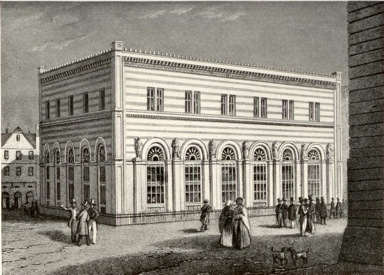
The Hamburg exchange has occupied three distinct buildings over nearly five centuries. The first permanent structure, erected between 1577 and 1583 at the Trostbrücke overlooking the Nikolaifleet, was designed by the Amsterdam architect Jan Andresen and financed by the wealthy cloth merchants’ guild (Gewandschneidergilde). This timber-frame building—considered the first Renaissance commercial structure in Hamburg—featured an open hall on the ground floor for trading, while its upper story rested partly on wooden piles driven into the waterway. The building served merchants for over 250 years, with an expansion over the Nikolaifleet added in 1666, but by the early nineteenth century it was widely considered inadequate. After decades of planning involving some thirty competing proposals (as documented in the Stiftung Historische Museen Hamburg’s journal “Operationen am Herzen der Stadt”), the Senate selected Adolphsplatz—the site of the demolished medieval Maria-Magdalena convent—for a new exchange. Architects Carl Ludwig Wimmel and Franz Gustav Forsmann designed the replacement in a restrained classicist style; construction lasted from 1839 to 1841, and the building was inaugurated on 2 December 1841. The structure was built entirely of Obernkirchener Sandstein, a dense Weser sandstone prized for its durability and fire resistance (as documented by the Obernkirchener Sandstein company’s historical records). The centerpiece was a grand central hall—the Börsenhalle—spanning both stories without interior supports and crowned by a continuous row of large round-arched windows. Just six months after opening, the Great Fire of May 1842 consumed much of Hamburg’s Altstadt, yet the new exchange survived through the tireless efforts of citizens who controlled sparks and protected the roof while their own homes burned—making it virtually the only undamaged building in the area. The English engineer William Lindley directed an extension in 1859. Between 1880 and 1884, architects Bernhard Hanssen and Emil Meerwein added a western wing with a third trading hall at the Alten Wall. Building inspector Albert Erbe designed an eastern annex with another hall on Große Johannisstraße between 1909 and 1912, while a unified sandstone façade was applied to harmonize the ensemble. Allied bombing raids in May 1943 severely damaged the central section and western wing; the postwar reconstruction under architect Georg Wellhausen deliberately avoided full period-accurate restoration, introducing modern elements such as the Albert-Schäfer-Saal while preserving the spatial character of the original Börsenhalle. A comprehensive renovation in 1991 marked the building’s 150th anniversary. In 2007, the Stuttgart firm Behnisch Architekten completed the “Haus im Haus”—a bold, $8.2 million glass-and-steel insertion of five transparent levels within the historic Börsenhalle, creating approximately 1,000 square meters of new space for a startup center, exhibition galleries, and the Commerzbibliothek. The structure, which was the first building in the world lit exclusively by LED lamps, respects the historic fabric while inserting what Behnisch described as layers of “lightness, immateriality, and reflection” contrasting the “solid, elaborate walls” of Forsmann and Wimmel’s original hall.
The decorative program of the Hamburg Börse has evolved through destruction and renewal across nearly two centuries. When the classicist exchange opened in 1841, the Berlin sculptor August Carl Kiss—known for his monumental allegorical bronzes—created two figural groups for the attic zone crowning the Adolphsplatz façade. One group featured Minerva, goddess of wisdom, surrounded by allegories of art and science; the other depicted Hammonia, the personification of Hamburg, flanked by figures representing trade and shipbuilding. Each group originally comprised three figures and served as a programmatic declaration of the exchange’s civic mission: the union of learning and commerce. These sculptures were severely damaged by Allied bombing in 1943 and were finally destroyed in the 1950s when the weakened figures fell from the attic. For more than fifty years the roofline stood bare. In 2005, the sculptor Waldemar Otto of Worpswede was commissioned by the Hamburg Chamber of Commerce—with financial support from prominent Hamburg merchants—to create replacement groups during the redesign of Adolphsplatz. Otto expanded each group from three to five bronze figures, each ensemble weighing approximately three tons. On the south side, “Hammonia versöhnt Theorie und Praxis” (“Hammonia Reconciles Theory and Practice”) shows the city goddess embracing a theorist alongside three figures engaged in practical work—a statement about Hamburg’s self-understanding as a city where intellectual ambition and mercantile pragmatism converge. On the north side, Diana, goddess of the hunt, gathers representatives of art, culture, and the sciences around her, symbolizing competition and the pursuit of excellence. The Obernkirchener Sandstein façade itself, with its classical pilasters, cornices, and round-arched window bays, constitutes an important element of the decorative program, expressing the dignity and permanence that nineteenth-century merchant culture sought to project. Inside, the Börsenhalle’s vaulted construction, arched clerestory windows, and elaborate wall articulation formed a spatial envelope designed to dignify the act of commercial exchange. The 1991 renovation included ornamental reconstruction with careful color differentiation. Behnisch Architekten’s 2007 “Haus im Haus” insertion introduced translucent components and mirror slats that create trompe-l’oeil effects within the historic hall—a contemporary dialogue between luminous, reflective modernity and the solid classicist surfaces of the original trading space.
The Hamburg Börse occupies a position at the geographic and symbolic heart of the city, on the Adolphsplatz immediately behind the Hamburg Rathaus (City Hall, built 1886–1897 under Martin Haller in the Neo-Renaissance style). The building complex of Rathaus and Börse, standing back to back, was conceived as an architectural representation of Hamburg’s constitution: the union of political sovereignty and mercantile enterprise in a single civic ensemble. The Adolphsplatz functions as a forecourt linking the Börse to the surrounding banks and the Rathausmarkt, which opens onto the Kleine Alster and the Binnenalster lake beyond. This ensemble—lake, market square, Rathaus, and exchange—forms what urban historians have called Hamburg’s “state forum,” a spatial expression of the free Hanseatic city’s identity. The original 1558 exchange stood at the Trostbrücke on the Nikolaifleet, the canal that had served as Hamburg’s commercial artery since the medieval period. The 1841 relocation to Adolphsplatz placed the exchange closer to the Alster basin while maintaining proximity to the harbor. Southeast of the exchange lies the Speicherstadt, the vast warehouse district built between 1885 and 1927 on narrow islands in the Elbe as a duty-free zone for goods transshipment. Inscribed as a UNESCO World Heritage Site in 2015 alongside the adjacent Kontorhaus district, the Speicherstadt represents what the UNESCO nomination describes as “the most modern goods handling and logistics centre in the world” at the time of its completion. The Kontorhaus district, developed primarily in the 1920s, features monumental office complexes built to house port-related businesses, most famously Fritz Höger’s Chilehaus (1922–1924), a Brick Expressionist masterpiece whose ship’s-prow profile evokes Hamburg’s maritime identity. Together, the exchange building, the Rathaus, the Speicherstadt warehouses, and the Kontorhaus offices trace a continuous commercial geography from the medieval Nikolaifleet through the nineteenth-century civic center to the twentieth-century port infrastructure—a landscape shaped by Hamburg’s enduring role as northern Europe’s gateway to global trade. As Richard J. Evans documented in *Death in Hamburg: Society and Politics in the Cholera Years 1830–1910* (1987), the city’s commercial ambitions repeatedly drove urban transformation, from the post-1842 fire rebuilding to the razing of medieval neighborhoods for the Speicherstadt free port in the 1880s.
The Hamburg exchange was founded in 1558, when the “Honourable Council of this Good City of Hamburg” (Ehrbarer Rat dieser guten Stadt Hamburg) entrusted merchants with a central location at the Trostbrücke for their daily commercial meetings—making it the oldest stock exchange in Germany. The city’s trading traditions ran far deeper: Hamburg had received imperial duty-free privileges from Emperor Barbarossa in 1189, joined the Hanseatic League in 1358, and by the sixteenth century maintained commercial networks spanning from London to the Baltic. In 1611, the English Merchant Adventurers—the incorporated society holding a monopoly on the export of undyed English cloth to northern Europe—permanently fixed their continental staple at Hamburg, bringing a flood of Anglo-German textile commerce to the exchange. The founding of the Hamburger Bank in 1619 marked a watershed. Established by the city council in direct response to the Kipper und Wipper monetary crisis—the catastrophic coin-debasement episode analyzed by Martha White Paas in *The Kipper und Wipper Inflation, 1619–23* (Yale University Press, 2012)—the bank was modeled on the Bank of Amsterdam (founded 1609). Depositors exchanged debased silver and gold coins for transferable ledger entries denominated in Mark Banco, a unit of account backed by silver at the rate of approximately 27.585 grams per thaler. As Stephen Quinn and William Roberds demonstrated in “Responding to a Shadow Banking Crisis: The Lessons of 1763” (*Journal of Money, Credit and Banking*, 2015), the Hamburg Bank’s giro system proved critical during the financial panic of August 1763, when the collapse of the Amsterdam firm de Neufville triggered a chain of failures that threatened Hamburg’s bill market with virtual collapse. In 1665, merchants founded the Commerz-Deputation—Germany’s oldest chamber of commerce—initially tasked with collecting a “convoy toll” to fund warships against piracy; it was formally recognized by the Senate in 1674 and became a permanent institution in the 1712 Hauptrezess. The Great Fire of 5–8 May 1842 destroyed a third of the Altstadt and left 20,000 citizens homeless, but the newly completed exchange survived. The English civil engineer William Lindley led the reconstruction of Hamburg’s infrastructure, introducing modern sewerage, gas lighting, and widened streets. Regular securities trading began in 1815, and the exchange evolved into a diversified marketplace. The Hamburger Bank operated independently until 31 December 1875, when it was absorbed into the newly created Reichsbank following German unification. By the late nineteenth century, four specialized sub-exchanges operated under the Börse’s umbrella: the General Exchange, the Grain Exchange, the Coffee Exchange (established 1887), and the Insurance Exchange. Allied bombing in May 1943 destroyed the central trading hall, and postwar reconstruction continued into the 1950s. Floor trading ended in 2002 with the transition to electronic platforms, closing the era of physical exchange in a building that had hosted merchants’ meetings for over four centuries.
From its founding in 1558, the Hamburg exchange was a marketplace for physical commodities rooted in the city’s Hanseatic trading tradition. The Hanseatic League’s staple goods—grain, timber, beeswax, furs, flax, and honey flowing westward; English broadcloth and manufactured goods flowing eastward—formed the exchange’s earliest commerce. After the English Merchant Adventurers established their permanent staple at Hamburg in 1611, the cloth trade became central to the exchange’s activity. The founding of the Hamburger Bank in 1619 added a sophisticated monetary dimension: merchants settled transactions through giro transfers of Mark Banco, a ledger-based unit of account backed by silver deposits, which facilitated secure bill-of-exchange settlements without reliance on debased physical currency. As Markus A. Denzel documented in *Handbook of World Exchange Rates, 1590–1914* (Ashgate, 2010), Hamburg became one of Europe’s principal exchange-rate quotation centers, with its price currents listing rates against Amsterdam, London, Paris, and dozens of other cities. Bills of exchange—the fundamental credit instrument of early modern commerce—were a staple of the Hamburg market. Maritime insurance emerged as another critical line of business; as Denzel further demonstrated in *The Hamburg Marine Insurance, 1736–1859* (Brill, 2022), Hamburg’s price current began listing marine insurance premiums from 1736, providing an almost unique record (comparable only to Amsterdam and London) of the risk pricing that underpinned intercontinental trade. Coffee became the exchange’s signature commodity: Hamburg’s first coffeehouse opened in 1677, and by the late nineteenth century the city dominated Central European coffee distribution. In 1887 the specialized Coffee Exchange opened at Sandtorkai, and an astonishing 24 million bags of coffee were traded in its first eighteen months—establishing Hamburg as, in the words of the Stiftung Historische Museen Hamburg, the hub through which “14% of global coffee trade was conducted.” The Speicherstadt warehouses, opened in 1888, stored coffee, tea, tobacco, spices, and oriental rugs under specialized climate-controlled conditions. By the turn of the twentieth century, four distinct sub-exchanges operated within the Börse: the General Exchange for securities and bonds, the Grain Exchange for cereals and agricultural products, the Coffee Exchange for futures and physical coffee, and the Insurance Exchange for maritime and commercial risk. Sugar, another colonial commodity, was traded extensively alongside cocoa and tropical produce. Regular securities trading had begun in 1815, and by the later nineteenth century the Hamburg exchange listed shares in shipping lines, insurance companies, and the great Hanseatic trading houses, including Berenberg Bank (founded c. 1590), one of the oldest continuously operating banks in the world.