Gympie Stock Exchange (former Australian Joint Stock Bank, Stock Exchange Offices & Club)
Gympie, Australia · Established 1884 (Gympie Stock Exchange founded); occupied this 1882 AJSB building 1902-1923
This site requires authorization to access.
To request access, contact
william.goetzmann@yale.edu
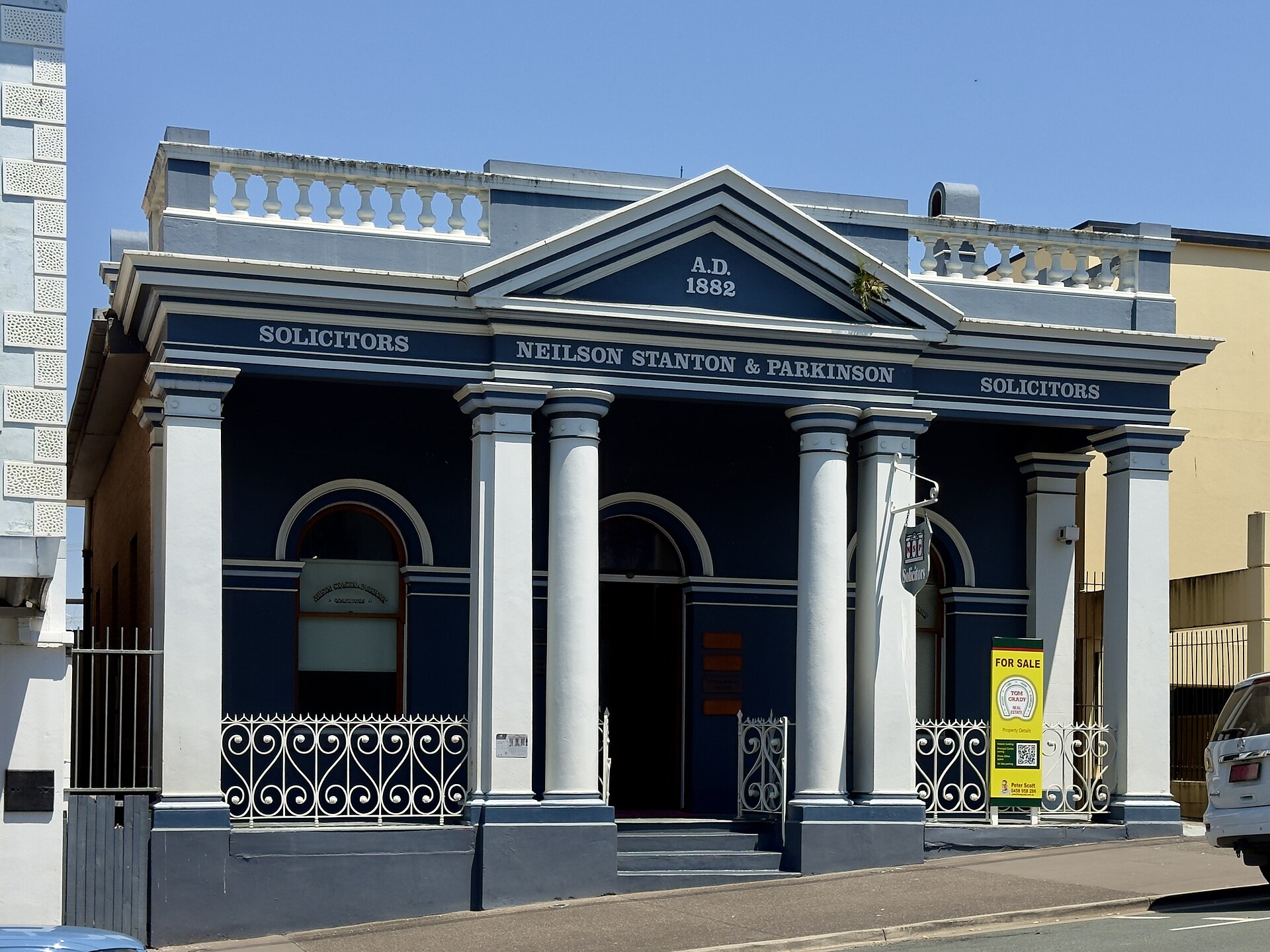
The building at 236 Mary Street, Gympie, was designed by Francis Drummond Greville Stanley -- Queensland's most prolific colonial architect -- and erected in 1881-82 by the builder Andrew Collins at a cost of about 1,400 pounds, as the permanent Gympie branch of the Australian Joint Stock Bank. Its single-storey rendered-brick form is given monumental civic dignity by a Doric temple front: an entrance colonnade of moulded square columns in an implied Doric order screens a timber-floored porch, above which a pediment carries the inscription 'A.D. 1882', while a balustraded parapet masks the hipped, metal-sheeted roof behind. As the Queensland Heritage Register citation (entry 602772, listed 15 April 2011) records, the principal elevation is composed of three arched openings -- a central entrance flanked by tall double-hung sash windows -- and the interior retains its original bank fabric, including a vault roofed with a concrete arch, brass hardware, fanlight doors, and a manager's office with a cast-iron fireplace and decorated timber mantelpiece. The work belongs to the assured, eclectic classicism that Stanley, Edinburgh-trained and appointed Colonial Architect in 1873, brought to Queensland's gold-era towns, as discussed in the Art and Architecture Queensland biography of the architect and in scholarly treatments such as 'Eclecticism in the Work of Queensland Colonial Architect F. D. G. Stanley, 1871-1881'.
The building is, by design, an exercise in restrained civic classicism rather than a vehicle for fine art, and its decorative interest lies almost wholly in its architecture: the implied Doric order of the colonnade, the moulded pediment with its raised date, the rhythm of arched openings, and the balustraded parapet. The one explicitly ornamental survival of note is the manager's office, where, as the Queensland Heritage Register citation (602772) describes, a cast-iron fireplace is dressed with a decorated timber mantelpiece -- a modest domestic flourish within an otherwise austere commercial interior. The honest plainness of the scheme reflects both the practical purposes of a goldfield bank and, later, a stock exchange, and the temper of provincial colonial building, in which dignity was sought through proportion and the classical vocabulary rather than through sculpture or painting.
The building stands in upper Mary Street, the spine of Gympie's historic commercial district, within the gold-era streetscape that the Queensland Heritage Register treats as a significant precinct and that the state's 'Gympie City' heritage trail interprets for visitors. Mary Street follows the contours of the goldfield rather than a surveyor's grid, and the former bank sits among banks, hotels and exchange premises that grew up to service the mines; the Gympie Stock Exchange had originally operated from a building on the opposite side of upper Mary Street, adjacent to the Mining Exchange Hotel (later the RSL Club), before acquiring this more imposing address. After the exchange's day, the building passed in 1923 to the solicitor Sykes family and from 1976 to the firm Neilson, Stanton and Parkinson, whose name it still bears across the entablature, so that the structure remains a working part of Gympie's professional quarter and a tangible anchor of the town's gold-rush identity.
Gold discovered at Gympie in October 1867 turned the settlement into one of colonial Queensland's principal producers, and the shift to deep reef mining from the 1870s demanded capital on a scale that bred both banks and a share market. The Gympie Stock Exchange was founded on 10 July 1884 with 127 members and some 60 listed companies, opening the same month as its Brisbane rival; sited in the heart of the goldfield, it kept local mining shares circulating locally and encouraged the formation of Gympie companies. The Australian Joint Stock Bank had built the 1882 premises as its branch, operating there until it failed in the colonial banking crisis and closed its Gympie doors on 17 January 1902. Shortly afterwards the building was sold to the Gympie Stock Exchange, which from 1902 until 1923 used it as its offices and club, erecting a separate timber call room at the rear. The exchange's fortunes tracked the goldfield's: Queensland gold output peaked in 1903 on a last surge from Gympie, then fell by some 60 per cent by 1913 as Gympie, Charters Towers and Mount Morgan declined together. The building survives as the most substantial physical remnant of the four Queensland gold-era exchanges (Brisbane, Gympie, Charters Towers and Ravenswood).
The Gympie Stock Exchange dealt almost exclusively in the shares of gold-mining companies working the local reefs -- the financial counterpart of a field that at its height supplied between roughly a fifth and a third of Queensland's export income. Trading was conducted on the 'call' system characteristic of Australian mining exchanges: members gathered for calls at which each listed stock was named in turn and bids and offers were shouted, a function for which the exchange built a dedicated timber call room behind the Mary Street premises. The companies listed were overwhelmingly the deep-reef ventures whose names fill the Gympie mining records, and the proximity of the exchange to the mines, as the Queensland Heritage Register citation (602772) and local histories such as the Gympie Regional Memories account stress, allowed speculation and company promotion to flourish on the field itself rather than ceding all of that business to Brisbane. In its first life the same building had served the trade differently, as the AJSB branch that converted the field's gold into cash.
Images will be added as the project develops. Photographs by Larry Ng and from research sources.