Thirteen Factories of Canton (廣州十三行)
Guangzhou (Canton), China · Established c. 1684 (rose to monopoly under the Canton System, 1757–1842)
This site requires authorization to access.
To request access, contact
william.goetzmann@yale.edu
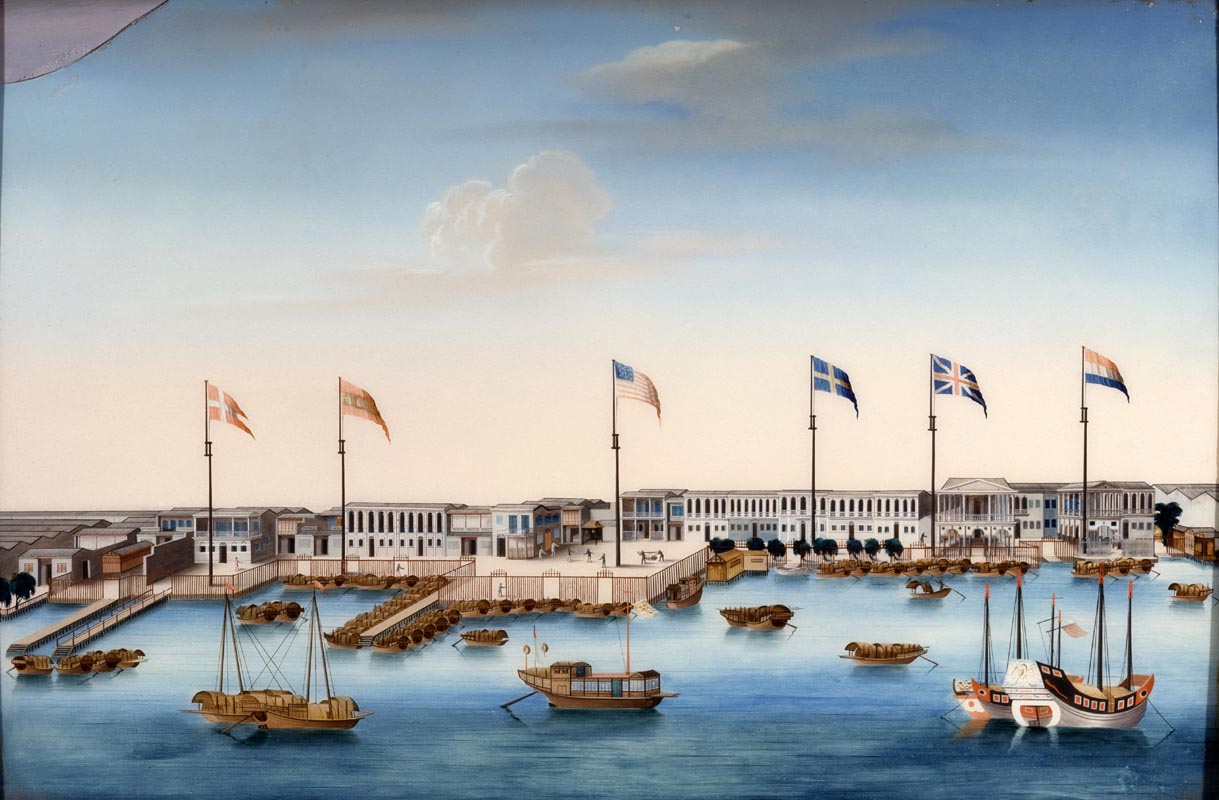
The Thirteen Factories were not a single designed edifice but a riverfront row of warehouse-residences—the 'factories' or feitorias, after the resident factor or agent—strung for roughly 300 metres along the north bank of the Pearl River in the southwestern suburbs of Guangzhou. As Johnathan Farris demonstrates in 'Thirteen Factories of Canton: An Architecture of Sino-Western Collaboration and Confrontation' (Buildings & Landscapes, vol. 14, 2007) and in his book 'Enclave to Urbanity' (Hong Kong University Press, 2016), the structures began as ordinary Cantonese 'hang' houses—narrow-fronted, deep brick-and-tile buildings with ground-floor godowns for goods and living quarters above—which Western tenants leased from Chinese hong merchants and progressively dressed in European garb. By the late eighteenth century their river façades had acquired applied Neoclassical columns, arcades, colonnades and triangular pediments and were flagged with the national colours of the trading companies, while behind these screens the plan remained Chinese: courtyards, narrow passages and flanking rooms, lacking wells or running water so that Chinese servants carried water and emptied chamber pots. The number of factories fluctuated but stabilised at about seventeen or eighteen compounds—British, American, French, Dutch, Swedish, Danish, Spanish, Austrian and others. Built largely of local brick with imported British windows and joinery, the highly combustible row burned and was rebuilt repeatedly, most destructively in 1822, again during the First Opium War in 1841, and finally in 1856 at the outset of the Second Opium War, after which the foreign community removed to Honam and then to the made-ground island of Shamian.
As a working commercial quarter the factories held little fixed monumental art, but the district became one of the most intensively depicted commercial landscapes of the early-modern world through the Chinese export-painting trade that flourished a few steps away on Old China Street and New China Street. Cantonese studio painters—the best known working under the trade name Spoilum and later Lamqua—produced reverse-glass paintings, gouaches and oils of the 'hong row' for sale to departing supercargoes and captains, and these images, with the square of national flags in the foreground, survive in great numbers in Western museum and library collections. The reverse-glass 'View of the Foreign Factories at Canton' of about 1805, copies of which are held by the Rijksmuseum and the British Library and which serves as the principal image here, is a characteristic example; Patrick Conner's 'The Hongs of Canton' (2009) and the Peabody Essex Museum's holdings catalogue this distinctive school. Beyond the export paintings, the visual interest of the place lay in its applied architectural ornament—the rhythm of borrowed Western columns and pediments fronting Chinese masonry—and in the bunting of European flags that gave the riverfront its unmistakable silhouette.
The factories occupied a tightly bounded enclave wedged between the Pearl River to the south and the densely populated Chinese western suburbs to the north, in the area near present-day Sai Kwan in Liwan District, roughly where Shisanhang ('Thirteen Hong') Road and Guangzhou's Cultural Park now stand. The compounds backed onto Thirteen Factory Street and were fronted by a fenced open square—the 'square of the flags'—from which most Chinese were excluded and beyond which, under the Eight Regulations of the Canton System, foreigners were forbidden to roam, barred from the walled city, from bringing women or firearms, and confined to the trading season before retreating to Macau. Three commercial lanes—Old China Street, New China Street and the disreputable Hog Lane—threaded retail shops, money-changers and the American medical missionary Peter Parker's ophthalmic hospital at 3 Hog Lane into the enclave. The historian Jacques Downs famously called this confined but lucrative world the 'golden ghetto': a porous frontier of intense Sino-Western contact pressed against an otherwise closed empire, whose tensions repeatedly spilled into the riots and fires that punctuated its history.
From 1684 the newly consolidated Qing state permitted maritime trade and foreign vessels increasingly concentrated at Guangzhou; in 1757 the Qianlong emperor restricted nearly all Western seaborne commerce to this single port, inaugurating the 'Canton System' that endured until 1842. To manage the trade and guarantee foreign good conduct and customs payment, the licensed Chinese merchants were obliged from 1760 to act collectively through a guild Westerners called the Cohong, whose members—among them the immensely wealthy Howqua (Wu Bingjian), Puankhequa and Mowqua—monopolised dealings with the 'supercargoes' and 'tai-pans' of the foreign companies under the watchful eye of the imperial customs superintendent, the Hoppo. Paul Van Dyke, in 'The Canton Trade: Life and Enterprise on the China Coast, 1700–1845' (Hong Kong University Press, 2005), shows how sophisticated and revenue-rich this managed system was, accommodating the booming British East India Company tea trade and the later American houses. The arrangement collapsed under the strain of the opium traffic and Western gunboats: the First Opium War ended with the 1842 Treaty of Nanking, which ceded Hong Kong and opened Shanghai, Ningbo, Xiamen and Fuzhou, breaking Canton's monopoly. The factories burned for the last time in 1856, and the foreign settlement migrated to Shamian Island.
The factories were the choke-point through which the great China trade passed: tea above all—green and black, whose surging consumption in Britain and North America drove the whole system—together with silk, nankeen cloth, porcelain, rhubarb, cassia and lacquerware flowing outward, exchanged chiefly for silver flowing in. Because Europe produced little the Qing market wanted, the trade ran a chronic deficit settled in vast quantities of Spanish silver dollars, a bullion drain that the British East India Company and private 'country' traders sought to reverse by smuggling Indian opium into the coastal waters beyond Canton—the commerce that ultimately provoked war. Goods were not sold on an open exchange but negotiated bilaterally: each foreign agent dealt through a designated Cohong 'security merchant' who guaranteed his ship, advanced credit, set prices and exchange rates, and brokered the cargoes, so that figures such as Howqua became among the richest private individuals in the world. The seasonal rhythm—ships arriving on the summer monsoon, teas weighed and chopped, accounts settled before the winter departure—made this riverbank, for nearly a century, the single most important meeting point of the Chinese and Western economies.
Images will be added as the project develops. Photographs by Larry Ng and from research sources.