Gothenburg Bourse (Börsen)
Gothenburg, Sweden · Established 1849 (opened); cornerstone 1844
This site requires authorization to access.
To request access, contact
william.goetzmann@yale.edu
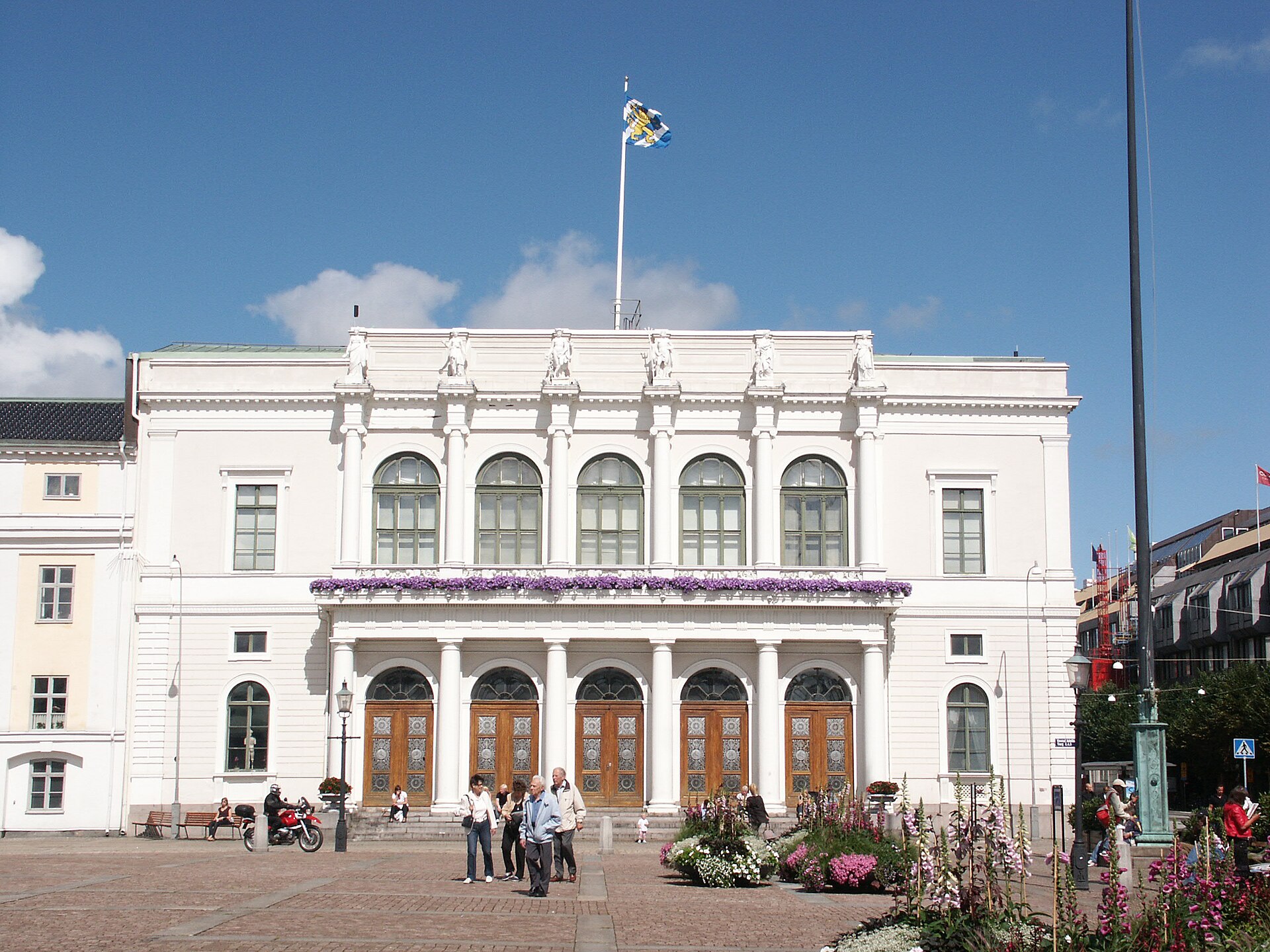
The Gothenburg Bourse (Borsen) was designed by the architect Pehr Johan Ekman (1816-1884), a Stockholm-trained pupil of Fredrik Blom at the Royal Academy of Fine Arts who had served as city architect of Gavle before settling in Gothenburg. After the committee charged with selecting a design rejected all the submitted proposals, Ekman was commissioned to prepare new drawings himself, and the cornerstone was laid by King Oscar I on 1 June 1844; the building opened on 1 December 1849 (Bourse (Gothenburg), Wikipedia; Svenskt biografiskt lexikon, 'Pehr Johan Ekman'). It rose on the site of the demolished Kaulbarska House, once owned by Baron Johan von Kaulbars, a general under Charles XII. The structure is a restrained essay in the late Empire (sengustaviansk/Empire) phase of neoclassicism, its principal facade on the north side of Gustaf Adolfs Torg organized around a pedimented centerpiece. Contemporary accounts record that roughly two million bricks were used and that the cement was imported from England, while the facade carries six allegorical zinc sculptures cast at the Finspong foundry representing industry, commerce, prosperity, diligence, fortune and maritime trade (Borsen, Svenska Wikipedia; gamlagoteborg.se). When completed it was reputedly the most expensive building in Sweden, costing some 450,000 riksdaler, and it remains a protected state architectural monument (byggnadsminne), designated 24 October 1968 and 21 December 1973.
For a mercantile exchange the Bourse is unusually richly ornamented, and its interior decoration was entrusted to specialists brought from abroad: the German decorative painter F. Hagedorn and the Italian stuccatore Antonio Detoma executed the elaborate stucco, marbling and painted schemes (Higab, 'Borsen'; Borsen, Svenska Wikipedia). The principal trading room, the Borssalen, was finished with walls of red stucco-marble and ranks of green marbled columns, and against its western wall stood a marble statue of King Oscar I by the Gothenburg-born sculptor Johan Peter Molin, best known for his Charles XII monument in Stockholm and his Bois fountain. The festival hall (Borssalongen) is the building's decorative climax, with a Munich-parquet floor laid in polygonal patterns of contrasting woods, mirror-lined arcades that create an illusion of infinite space, white porcelain tiled stoves crowned by gypsum figures of the Muses (Clio, Melpomene, Euterpe) and a figure of Truth, and bronze chandeliers imported from Paris (Borsen, Svenska Wikipedia). A later meeting room added in the 1904-1905 renovation following fire damage was fitted out in a classicizing Art Nouveau idiom with mahogany panelling and bronze detailing, layering a second generation of craftsmanship over Ekman's original interiors.
The Bourse occupies the commanding north side of Gustaf Adolfs Torg, the ceremonial square at the heart of Gothenburg's seventeenth-century planned town within the canal-girt fortified center laid out by Dutch engineers from 1621. The square, dominated by Bengt Erland Fogelberg's bronze statue of Gustavus Adolphus, gathers the city's principal civic monuments, and the Bourse stands alongside the City Hall (Radhuset) wing remodelled by Gunnar Asplund and the older town offices, making this the symbolic seat of municipal power. Its placement was deliberate: a mercantile exchange for Sweden's leading west-coast trading and shipping port deserved pride of place in the formal heart of the merchant city, facing the harbour-bound canals that carried Gothenburg's commerce. The building's transition from exchange to council chamber only reinforced this centrality, and it remains the city's official representation building, where the Gothenburg City Council still meets (Goteborgs Stad, 'Borsen').
Gothenburg's commercial life had been organized well before the Bourse was built: a merchant society, the Borssallskapet, was founded in 1781, and the city's standing as Sweden's great Atlantic-facing entrepot had been secured during the eighteenth century by the Swedish East India Company (1731-1813), whose China voyages all departed from and returned to Gothenburg and whose cargoes were auctioned there (Swedish East India Company, Wikipedia). By 1844 the city's merchants had subscribed enough capital to erect a permanent exchange and assembly building, and the Borssallskapet took possession in 1849. The Swedish name Borsen, from the French 'la bourse', is often mistranslated as 'stock exchange', but the institution functioned as a commercial or mercantile exchange and assembly rather than a securities market, and it operated without the royal charter that underpinned the contemporaneous exchanges of London, Dublin and Edinburgh (Bourse (Gothenburg), Wikipedia). From 5 January 1863 the newly constituted municipal council and its predecessor body began meeting in the building, and over time its civic role eclipsed its mercantile one. After fire damage in 1895 it was renovated in 1904-1905; since 1991 it has been managed by the municipal property company Higab, which carried out a comprehensive foundation-reinforcement and restoration campaign between 2016 and 2019, after which the council returned to its historic chamber.
The Bourse served the merchants of a port whose prosperity rested on shipping, timber, iron and the re-export of colonial goods. As an exchange and assembly it provided a place where Gothenburg's trading houses met to transact business, settle accounts, arrange marine insurance and charters, and conduct the commodity auctions that were the lifeblood of the city's commerce. Gothenburg's eighteenth-century fortune had been made in the East India trade, whose tea, porcelain, silk and spices were sold at public auctions held in the city between July and October (gotheborg.com; Swedish East India Company, Wikipedia), and the nineteenth-century exchange continued this auction-and-assembly culture across the staples of a west-coast shipping economy: timber and forest products, iron, herring and other fisheries, grain, and the goods of an expanding maritime carrying trade. In character it was, as its English-language description notes, closer to a modern commodities exchange than to a stock market, a clearing-house for the mercantile community of Sweden's foremost commercial port rather than a venue for formal securities quotation.
Images will be added as the project develops. Photographs by Larry Ng and from research sources.