Glasgow Stock Exchange
Glasgow, Scotland · Established 1844
This site requires authorization to access.
To request access, contact
william.goetzmann@yale.edu
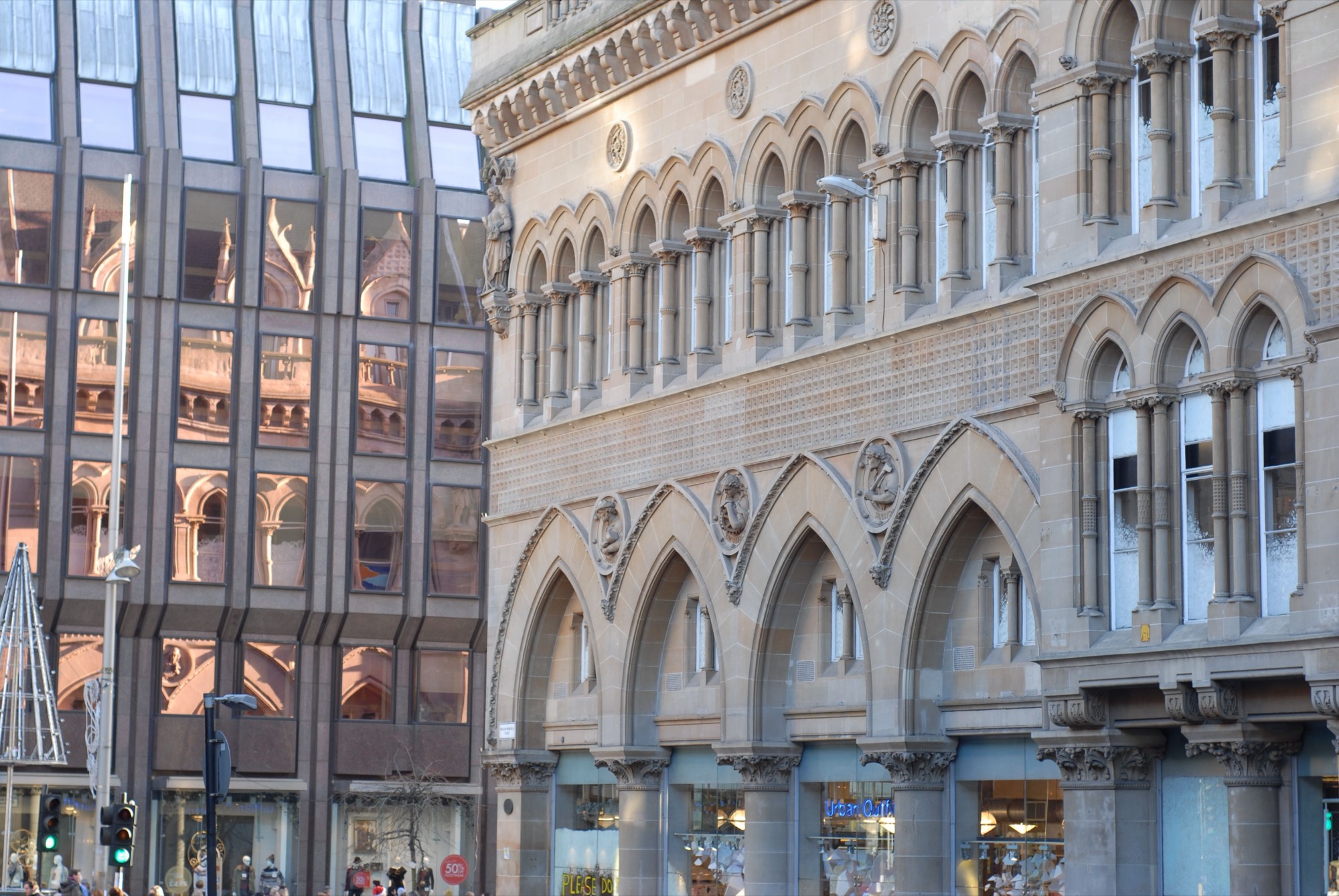
The Glasgow Stock Exchange building, erected between 1875 and 1877 at the corner of Buchanan Street and St George’s Place (renamed Nelson Mandela Place in 1986), stands as one of the finest surviving examples of Venetian Gothic commercial architecture in Scotland. The architect John Burnet (1814–1901), a largely self-taught designer who rose to prominence in mid-Victorian Glasgow, drew inspiration from William Burges’s competition entry for the Royal Courts of Justice in London, transposing its exuberant Gothic idiom to a four-storey commercial palazzo. As the architectural historian Andor Gomme and David Walker note in their “Architecture of Glasgow” (1987), Burnet exploited “Venetian Gothic with a freedom and panache rivalling the best English work of the period.” The building was constructed by the firm of Morrison & Mason using cream-coloured Carboniferous freestone quarried at Overwood in Lanarkshire—a sandstone noted by the British Geological Survey for its lack of visible bedding planes, which permitted precise cutting in all directions and made it ideal for the elaborate carved ornament the design demanded. The facade is composed of polished ashlar with bold arcading at ground and first floors, stylised columns and corner pilasters, a deep geometric frieze at first-floor level, and sculpted colonnettes at the second storey. The roofline is crowned by an elaborate bracketed cornice and a pierced parapet with three bipartite arched dormers bearing stone finials along Buchanan Street. In 1894–1898, Burnet’s son Sir John James Burnet (1857–1938), who had trained at the École des Beaux-Arts in Paris, extended the building westward along St George’s Place, adding a four-bay block that harmonised with the original composition. A further extension followed in 1906. Between 1969 and 1971 the interior was gutted and rebuilt to provide a modern trading floor for the newly constituted Scottish Stock Exchange, while the ornate exterior was preserved intact. Historic Environment Scotland designated the building Category A (listed 1970), its highest classification, recognising it as an outstanding example of a particular period and style.
The sculptural programme of the Glasgow Stock Exchange is among the most ambitious on any Victorian commercial building in Scotland, and it was executed almost entirely by John Mossman (1817–1890), the sculptor whom contemporaries called “The Father of Glasgow Sculpture.” Born in Pimlico, London, the son of sculptor William Mossman I, John Mossman moved to Glasgow around 1830 and trained under Sir Francis Chantrey and Carlo Marochetti before dominating the city’s architectural sculpture for half a century. For the Stock Exchange, Mossman carved three large allegorical statues representing Industry, Commerce, and Agriculture—the pillars of Glasgow’s Victorian prosperity—which are set at prominent positions on the facade. He also produced four figure-statues at the capitals along the Buchanan Street elevation, each personifying one of the four continents with which Glasgow’s merchants traded: Europe, Asia, Africa, and the Americas. These continent figures symbolised the global reach of the city’s commercial networks, from Clydeside shipyards to colonial plantations. In the spandrels of the ground-floor arches, Mossman carved five sculpted roundels depicting Science, Art, Building, Engineering, and Mining—emblems of the industries whose shares were exchanged within. Griffons surmount the building at key points along the roofline, their traditional heraldic role as guardians of treasure recast here as protectors of financial wealth. The entrance bays feature corbel-arched balconies with sculpted figure stops, and additional figure sculpture adorns the northeast corner where the building turns from Buchanan Street toward St George’s Place. The facade’s middle storeys display textured stonework panels set within blank friezes, providing a visual rhythm that complements the sculptural accents. As Ray McKenzie documents in “Public Sculpture of Glasgow” (2002), Mossman’s work on the Stock Exchange belongs to his most productive decade, contemporaneous with his statues of David Livingstone and Thomas Campbell for nearby George Square (both 1875–1879) and his architectural sculpture for St Andrew’s Halls (1873–1877). The programme as a whole constitutes a Victorian iconographic statement: the decorative arts of commerce rendered in stone as an advertisement for the prosperity that the exchange both served and symbolised.
The Stock Exchange occupies a pivotal site at the intersection of Buchanan Street and St George’s Place (now Nelson Mandela Place), placing it at the heart of Glasgow’s Victorian commercial and financial district. Buchanan Street, first laid out in 1777 on land acquired by the tobacco merchant Andrew Buchanan in 1763, evolved from a row of Palladian townhouses into the city’s premier shopping and banking thoroughfare over the course of the nineteenth century, as described in Frank Worsdall’s “The City That Disappeared: Glasgow’s Demolished Architecture” (1981). To the immediate south stood the Western Club (1840–41), designed by David and James Hamilton in an Italian palazzo style for the city’s merchant elite. A short walk east along St George’s Place led to George Square, Glasgow’s principal civic space, flanked on its east side by the magnificent City Chambers (1883–1889, architect William Young) and on its west by the Merchants’ House, seat of the guildry that had regulated Glasgow’s trade since 1603. Just south of George Square, Royal Exchange Square housed the former Royal Exchange (1829, architect David Hamilton), where merchants had traded in cotton, coal, iron, and other commodities before the Stock Exchange formalised securities dealing. The Stock Exchange thus stood at the geographical convergence of Glasgow’s civic, mercantile, and financial institutions—a spatial arrangement that reinforced the interlocking networks of commerce, law, and municipal governance. St George’s Tron Church (1808, architect William Stark), immediately adjacent on Buchanan Street, and the Athenaeum literary club further north contributed to the district’s character as a centre of bourgeois cultural and economic life. In 1986, when the city council renamed St George’s Place as Nelson Mandela Place—deliberately targeting the South African consulate located there—the Stock Exchange building gained an additional layer of political symbolism. In 2008, Buchanan Street received the Academy of Urbanism’s Great Street Award, in recognition of its combination of Victorian commercial architecture and contemporary urban design, beating both O’Connell Street in Dublin and Regent Street in London.
The Glasgow Stock Exchange Association was formally constituted in June 1844, when a group of brokers convened at the Exchange Sale Room of the Royal Exchange at the initiative of Peter Wilson Dixon, a broker active since 1842. As W. A. Thomas details in “The Provincial Stock Exchanges” (1973), Glasgow’s first stockbroker was James Watson, who in 1830 added share dealing to his existing accountancy business; by 1844 the number of brokers in the city had risen to eighteen, and the new association commenced trading in early July at No. 3, North Court, Royal Exchange, with twenty-eight founding members. The exchange was one of three Scottish exchanges—alongside Edinburgh and Aberdeen—established during the railway mania of 1844–1845, which generated intense demand for share dealing in railway promotion companies such as the Caledonian Railway (incorporated 1845, initial capital £1.8 million) and the Edinburgh and Glasgow Railway. Membership grew rapidly with Glasgow’s industrial expansion: from 49 members in 1845 to 114 by 1880 and 277 by 1930. The catastrophic failure of the City of Glasgow Bank in October 1878—which revealed net liabilities of over £6 million, ruined all but 254 of its 1,200 shareholders under unlimited liability, and triggered scores of business failures—was a defining crisis. As Graeme Acheson and John Turner argue in “The Death Blow to Unlimited Liability” (“Explorations in Economic History,” 2008), the disaster led directly to the Companies Act 1879, which enabled reserve liability and accelerated the adoption of limited liability across British banking. Having outgrown several temporary premises, the exchange moved into Burnet’s purpose-built Buchanan Street headquarters in 1877. On 2 January 1964, the Glasgow, Edinburgh, Aberdeen, and Dundee exchanges merged to form the Scottish Stock Exchange, with its main secretariat in Glasgow. The building was gutted and rebuilt internally between 1969 and 1971 to create a modern trading floor. In 1973, the Scottish Stock Exchange merged into the London Stock Exchange, closing its Scottish trading floors. The archival records of the Glasgow Stock Exchange—thirty-eight metres of bound daily stock lists spanning 1845 to 1963—were gifted to the University of Strathclyde in 1968, where they remain an important resource for economic historians.
From its founding in 1844, the Glasgow Stock Exchange served as the principal marketplace for securities linked to Scotland’s industrial economy. The earliest listings were dominated by railway shares—above all the Caledonian Railway, the Edinburgh and Glasgow Railway, and the Glasgow and South Western Railway—reflecting the railway mania that had prompted the exchange’s creation. Scottish banking stocks formed another core category: shares in the Bank of Scotland, Clydesdale Bank, Royal Bank of Scotland, and the ill-fated City of Glasgow Bank were actively traded. As Glasgow became the world’s leading centre for shipbuilding—by the 1890s, Clydeside yards produced two-thirds of Britain’s shipping tonnage, as Anthony Slaven documents in “The Development of the West of Scotland, 1750–1960” (1975)—the exchange listed shares in major Clyde shipbuilding and marine engineering firms. Iron and steel companies, coal mining concerns, and heavy engineering enterprises were well represented, mirroring Glasgow’s industrial base in the Lanarkshire coalfields and Monklands ironworks. The petroleum sector arrived with the Burmah Oil Company, incorporated in Glasgow in 1886 by David Cargill to exploit Burmese oil concessions, which grew into one of the world’s major independent oil companies and a significant Glasgow listing. Tea plantation companies also featured prominently: in 1882, the merchant John Muir floated the North Sylhet and South Sylhet tea companies on the Glasgow exchange, and by the 1890s he had consolidated his plantation interests into four holding companies offered to the Glasgow public. Scottish investment trusts—pioneered in the 1870s and 1880s to channel domestic savings into overseas railways, mining ventures, rubber plantations, and government bonds in the Americas, Australasia, and Asia—became a distinctive feature of the Glasgow and Edinburgh markets. Municipal corporation stocks, gas and water utility shares, and insurance company securities rounded out the list. The University of Strathclyde’s archive of daily stock lists from 1845 to 1963, supplemented by the “Stock Exchange Ten-Year Record of Prices and Dividends” compiled by Mathieson and Sons (covering 1907–1957), documents the evolution of these listings across more than a century of Scottish financial history.
Images will be added as the project develops. Photographs by Larry Ng and from research sources.