Ghent Stock Exchange / Handelsbeurs (Handelsbeurs van Gent)
Ghent, Belgium · Established 1900
This site requires authorization to access.
To request access, contact
william.goetzmann@yale.edu
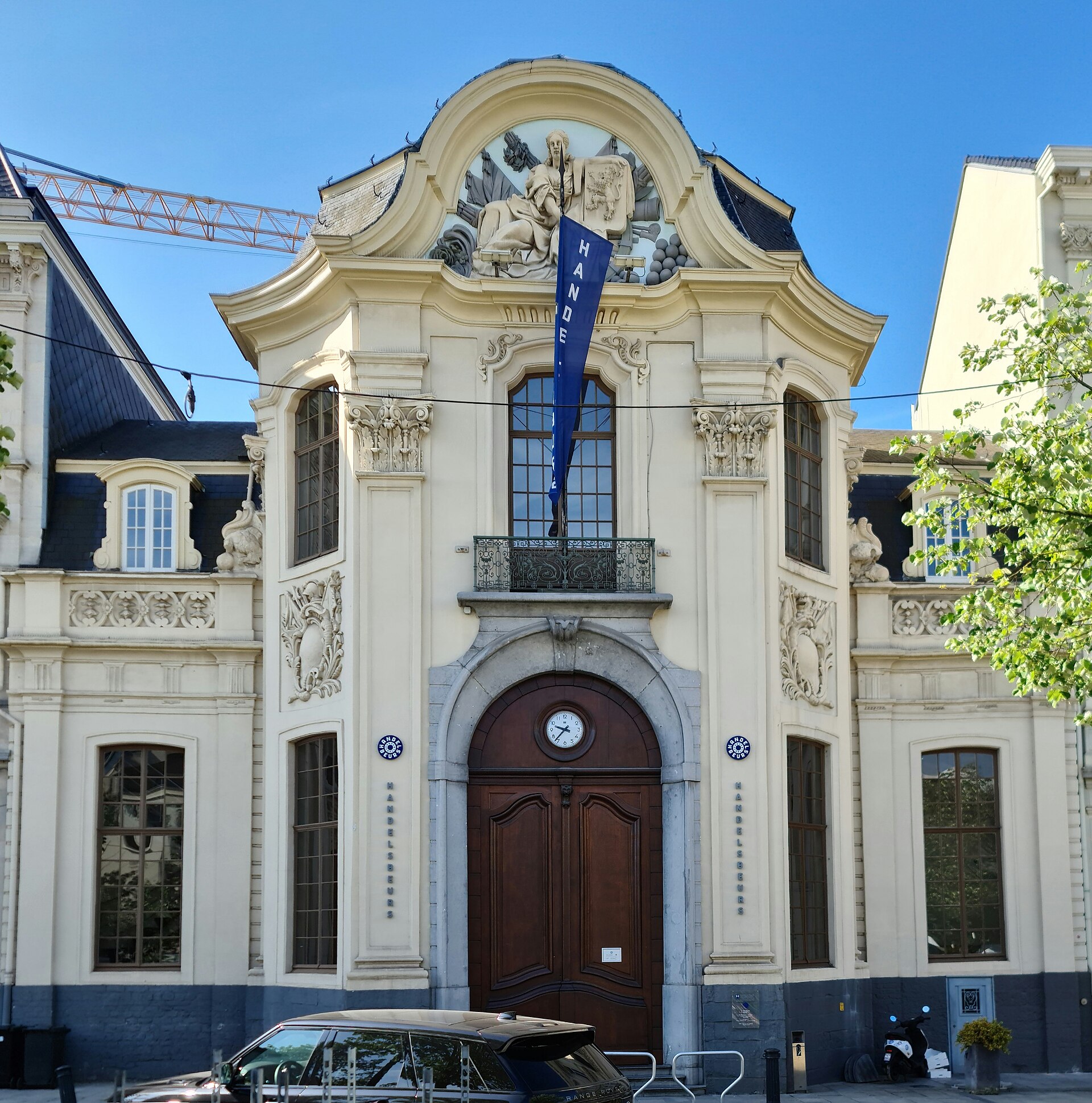
The Handelsbeurs occupies one of the most distinguished pieces of architecture on Ghent's Kouter, a building whose monumental Rococo core was raised in 1738-39 as the city's Corps de Garde or Hoofdwacht (main guard house) for the imperial Austrian garrison. It was designed by David 't Kindt (1699-1770), whom architectural historians regard as 'the central figure of Ghent Rococo' and who, with his contemporary Bernard de Wilde, pioneered the style in the city (per the heritage entry of the Inventaris Onroerend Erfgoed, erfgoedobject 25213, and the David 't Kindt biography on Wikipedia). The guard house is generally cited as the earliest fully Rococo work in Ghent. Built of brick dressed with natural stone beneath a mansard roof with dormer windows, its facade is dominated by a strongly emphasised central risalit, articulated by four Corinthian pilasters and crowned by an exuberant curved pediment; the round-arched central doorway carries blocked moulding and a corniced pediment with a relief of the Maiden of Ghent, seated on a cannon and bearing the Austrian coat of arms (the badly weathered bas-relief was restored by the sculptor Gerard Thienpont in 2001). When the city decided to install a municipal commercial exchange here, the long-serving city architect Charles Van Rysselberghe (1850-1920) was charged in 1899 with merging the old guard house with the adjoining l'Union banquet hall into a single building; his moderately eclectic remodelling, completed for the opening in 1901, introduced large glazed light-bridges in the ceilings to illuminate the new trading hall. The right wing, in a more classical idiom with composite capitals and pilasters, had been added in 1874-75. The structure has been a protected monument since 1943 and was re-confirmed as designated heritage in 2023.
The building's artistic interest is concentrated in two campaigns separated by more than a century and a half. The first is the sculptural ornament of 't Kindt's Rococo facade itself - the rocaille-framed central bay and above all the pedimental relief of the Maiden of Ghent astride a cannon, an allegory of civic and imperial authority that doubles as the building's signature image. The second belongs to its mercantile incarnation: when Van Rysselberghe fitted out the exchange around 1899-1906, the Ghent painter and graphic artist Armand Heins supplied decorative canvases depicting the city's principal monuments, set into the new hall as a visual celebration of Ghent's heritage (documented by the Inventaris Onroerend Erfgoed and the building history published by Ha Concerts, the venue's present occupant). Beyond these elements the decorative programme is comparatively modest, in keeping with a working trading hall rather than a richly figured palace; the chief aesthetic event remains the theatrical Rococo front that faces the Kouter.
The Handelsbeurs stands at Kouter 29, on the south side of the Kouter, historically Ghent's grandest open square. Once known as the Paardenmarkt (horse market) and later the Place d'Armes, the Kouter had for centuries served as the city's principal ground for markets, militia musters, tournaments, shooting contests and public festivals; the present site was in the Middle Ages part of the 'Gildenhof', a guild ground with shooting ranges belonging to the Sint-Sebastiaansguild (per Visit Gent and the Inventaris Onroerend Erfgoed). By the eighteenth and nineteenth centuries the square had become the most fashionable promenade in Ghent, lined with patrician townhouses and, by the 1900s, the Opera house and a celebrated Sunday flower market that survives today. Siting the commercial exchange on this elegant, monied square placed it at the social and commercial heart of the city, among the banks, clubs and bourgeois residences whose patrons made up its membership.
The site passed through a remarkable succession of uses before becoming an exchange. After the guard house of 1738-39, the adjoining buildings served from the late eighteenth century as a horse-post station in the Thurn und Taxis stagecoach network and then, from about 1815 to 1850, as the Posthotel - reputedly the finest hotel in the city, remodelled by the architect Pierre-Jacques Goetghebuer. From 1841 the merchants' club l'Union, with some four hundred members, occupied a newly built banquet hall on the site, mounting concerts, balls and banquets. The city, which already owned the old Hoofdwacht, purchased the l'Union hall in 1899 specifically to house a municipal Handelsbeurs (commercial exchange), and Van Rysselberghe's combined building was ceremonially opened by Prince Albert (the future King Albert I) on 28 April 1901 (dated in the Dutch-language Wikipedia entry and the Ha Concerts building history). The exchange operated through the twentieth century but eventually fell into disuse; after a period of vacancy the building was acquired by insurer-related interests (Mercator & Noordstar / later Baloise) in 1997 and was thoroughly restored and converted into a mid-sized concert hall between 2000 and 2002, reopening on 27 September 2002. The venue retained the name Handelsbeurs until it was rebranded Ha Concerts in 2022.
As a provincial commercial exchange (handelsbeurs) rather than a major securities bourse, the Ghent institution functioned as the organised meeting place where the city's merchants, brokers and bankers gathered to transact business and settle prices. Ghent in 1900 was one of the great industrial cities of Flanders - the 'Manchester of the Continent' - built on cotton and flax spinning and weaving and on the trade in grain and other commodities feeding its mills and population, so the exchange served above all the textile and grain merchants of the region, alongside dealings in bills, commercial paper and the shares of local industrial and financial companies. The building was equipped for this commerce with the modern communications of the day: during the 1899-1901 works telephone and telegraph services were installed in the former guard house to carry prices and orders (noted in the Ha Concerts and Inventaris Onroerend Erfgoed histories). The Ghent Handelsbeurs thus belongs to the long Low Countries exchange tradition that produced the celebrated bourses of Bruges and Antwerp, carried forward into the industrial nineteenth century.
Images will be added as the project develops. Photographs by Larry Ng and from research sources.