Genoa Loggia di Banchi (Loggia della Mercanzia)
Genoa, Italy · Established 1855 (exchange); loggia built 1589–1595
This site requires authorization to access.
To request access, contact
william.goetzmann@yale.edu
The Loggia di Banchi, formally the Loggia della Mercanzia, is an elegant late-Renaissance arcade raised in the commercial heart of old Genoa between 1589 and 1595 to designs by Andrea Ceresola, known as 'il Vannone' — the architect also responsible for the Mannerist remodelling of the Palazzo Ducale — working in collaboration with Giovanni Ponzello (Loggia della Mercanzia (Genova), Wikipedia; Cultura Liguria). It replaced an earlier covered loggia of 1415, damaged by fire in 1455, which had long sheltered the city's money-changers and notaries who kept their 'banchi' (counters) in the open air of the piazza (Borsa Italiana, 'Borsa di Genova'). The new structure takes the form of a single rectangular hall covered by a barrel vault carried on wide arches resting on paired Doric columns, open on the side facing Piazza Banchi and blind toward Via San Luca and Piazza Senarega (Cultura Liguria; visitGenoa). A central stone platform within the loggia served as the rostrum from which a public auctioneer cried the official prices of goods and currencies; the open arcades were glazed in during later centuries to enclose the trading floor. The wooden roof was destroyed in the Allied bombing of 1942 and the building restored in 1950.
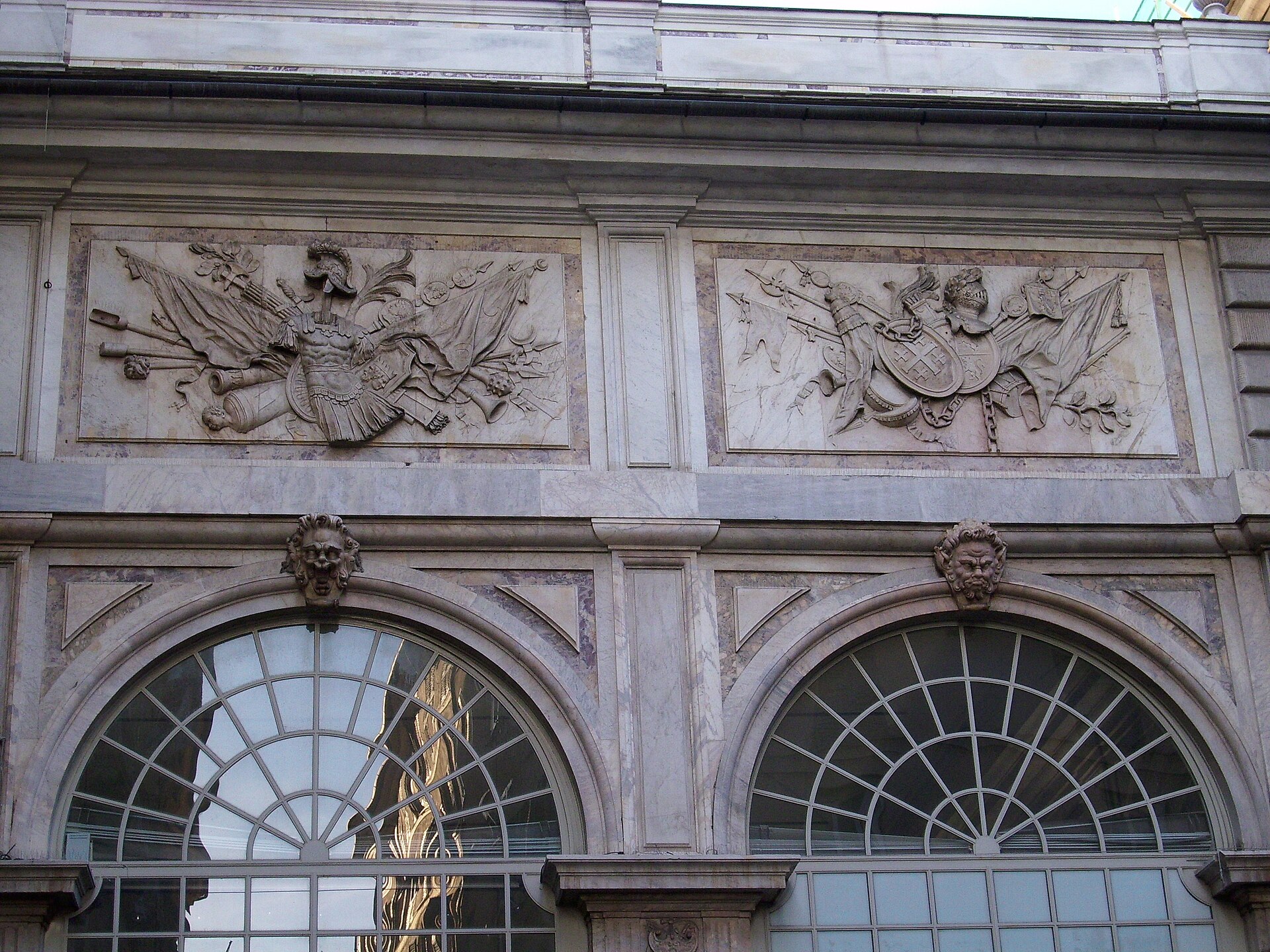
The loggia is richly ornamented in keeping with its civic dignity. Above the arches on the exterior runs a series of bas-reliefs of military trophies — arms, armour and standards — carved by the Ticinese sculptor Taddeo Carlone, a leading figure of late-sixteenth-century Genoese sculpture (Loggia della Mercanzia (Genova), Wikipedia; Cultura Liguria). On the rear wall is a fresco of the late sixteenth century by the Tuscan painter Pietro Sorri, depicting the Madonna Enthroned with the Christ Child and Saints John the Baptist and George, the two patron saints of Genoa — a sacred presence watching over a place dedicated to the most worldly of transactions (visitGenoa; it.wikipedia). A second fresco by Giovanni Battista Brignole, showing the coat of arms of the Genoese Republic, was lost in the bombing of 1942.
The loggia stands in Piazza Banchi, at the corner of Via San Luca in the ancient sestiere of the Maddalena, the mercantile and financial nerve-centre of medieval and early-modern Genoa (Loggia della Mercanzia (Genova), Wikipedia). The square took its name from the 'banchi' — the benches or counters of the money-changers and bankers who had transacted business there since the Middle Ages, drawn by its proximity to the old port. Around it cluster the church of San Pietro in Banchi, raised on shops, and the Palazzo Senarega; a short walk away lie the Palazzo San Giorgio and the Rolli palaces of Via Garibaldi. The loggia thus sits at the symbolic origin point of Genoese high finance, where the activities later formalised in the Casa di San Giorgio first took shape in open-air dealing.
Genoese trading in goods and in the 'luoghi' (shares) of the Banco di San Giorgio had taken place for centuries beneath this loggia before any formal exchange existed (Borsa di Genova, Wikipedia). After restoration, the City handed the building to the Chamber of Commerce in 1840 and devoted it to exchange dealings. A formal Borsa di commercio — Italy's first modern commodity and securities exchange — was instituted by Royal Decree No. 1020 of 18 August 1855, on the initiative of Camillo Benso, Count of Cavour; the exchange briefly took premises in the adjacent Palazzo Senarega, but brokers preferred their accustomed loggia, and after a second restoration the Borsa was re-established at Banchi in 1859 (Borsa Italiana, 'Borsa di Genova'; Camera di Commercio di Genova). The securities exchange remained here until the new Palazzo della Borsa in Piazza De Ferrari was inaugurated on 20 July 1912, while the commodity exchange continued to operate at Banchi for decades afterward. The loggia later hosted exhibitions and is being converted into the Museum of the History of the City of Genoa.
Beneath the loggia, Genoese merchants, bankers and brokers dealt in the full range of instruments that had made the republic a financial power: foreign bills and currencies handled by the money-changers of Piazza Banchi, the 'luoghi' or transferable shares of the Casa di San Giorgio, marine insurance, and cargoes of the maritime trade. From 1855 the formal Borsa added quotations in government bonds, bank and railway shares, and the produce of the commodity exchange — grain, oils, colonial goods and raw materials passing through the port of Genoa (Borsa Italiana, 'Borsa di Genova'; Borsa di Genova, Wikipedia). After the securities market departed for Piazza De Ferrari in 1912, the Banchi loggia continued chiefly as a commodities exchange, its prices cried from the central rostrum as they had been since the sixteenth century.
Images will be added as the project develops. Photographs by Larry Ng and from research sources.