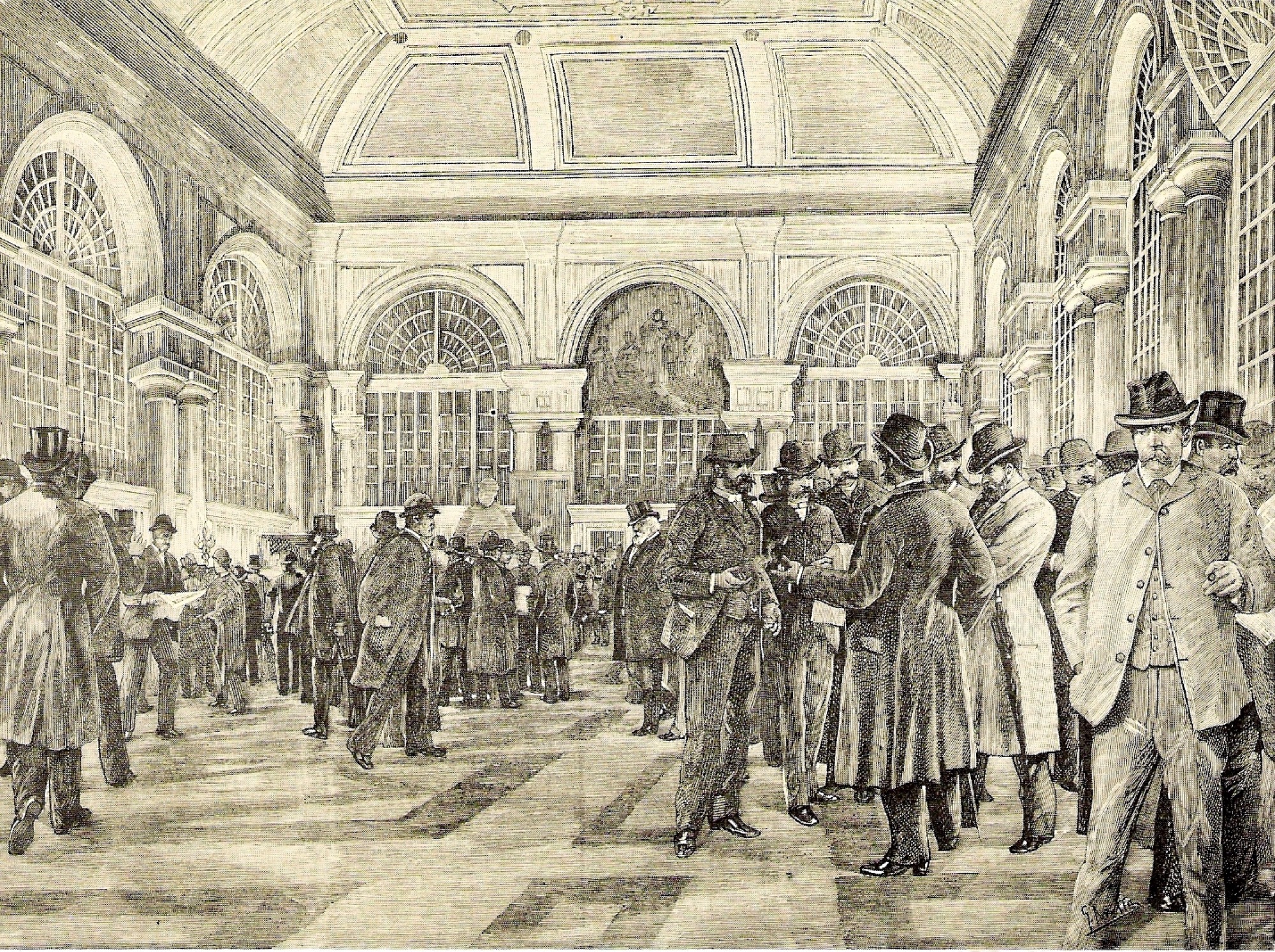
Genoa Grain Exchange
Genoa, Italy · Established 1886
This site requires authorization to access.
To request access, contact
william.goetzmann@yale.edu
The Palazzo di San Giorgio, Genoa’s monumental seat of maritime finance, was commissioned in 1260 by Guglielmo Boccanegra, the city’s first capitano del popolo, and designed by the Cistercian friar Oliverio. As Steven A. Epstein documents in Genoa and the Genoese, 958–1528 (University of North Carolina Press, 2001), the original structure incorporated Byzantine spolia—marble columns and carved capitals—taken from Genoese conquests in Constantinople and the Levant, embedding the Republic’s commercial empire into the very fabric of the building. The medieval core, constructed of local Promontorio stone and brick, features a five-arched ground-floor portico surmounted by Ghibelline swallowtail battlements and a prominent thirteenth-century lion’s head relief. Between 1571 and 1608, the seaward façade was extended in a Renaissance idiom with superimposed loggias, creating the monumental waterfront elevation visible today. The palazzo served simultaneously as the seat of the Banco di San Giorgio (from 1407) and as the administrative nerve center of Genoa’s colonial possessions. Alfredo D’Andrade directed a major restoration campaign from 1890 to 1904, stripping later accretions to reveal the medieval polychrome masonry and restoring the crenellated roofline. As Lucina Napoleone has shown in her study of the Palazzata della Ripa renovations (2022), the building’s position at the head of the Ripa Maris wharf was integral to its function—cargo unloaded at the quay passed directly into the palazzo’s ground-floor customs hall before proceeding to the trading floors above.
The interior decorative program of the Palazzo di San Giorgio constitutes one of the most important cycles of civic-commercial art in the Mediterranean. The original frescoes by Andrea Semino (1592) were replaced between 1606 and 1608 by Lazzaro Tavarone’s ambitious program depicting the Republic’s patron Saint George alongside Janus (the mythical founder), Neptune, and a pantheon of Genoese heroes: the chronicler Caffaro, Admiral Andrea Doria, Captain Boccanegra, the Crusader Guglielmo Embriaco, Columbus, and the naval commander Biagio Assereto. Having faded and partly disappeared over the centuries, Lazzaro Tavarone’s sea-facade fresco cycle was reconstructed by Lodovico Pogliaghi between 1912 and 1914, based on surviving cartoons. The Sala del Capitano del Popolo features marble portrait statues of the Bank’s most generous benefactors—Luciano Spinola, Francesco Vivaldi, Domenico Pastine, and Ambrogio Di Negro—carved by Michele D’Aria, Antonio Della Porta, and Pace Gaggini in the late fifteenth century, each figure rendered in the formal robes of Genoese patrician office. A bas-relief panel by D’Aria in the Manica Lunga corridor depicts allegorical figures of Commerce and Navigation flanking the arms of the Republic. The decorative ensemble served a deliberate institutional purpose: by surrounding the Bank’s directors with images of martial and commercial triumph, the artwork reinforced the legitimacy of the creditors’ governance over public finance and colonial administration.
The Palazzo di San Giorgio stands at the nexus of Genoa’s medieval commercial infrastructure. Directly before it stretches the Sottoripa arcade, constructed between 1125 and 1133, extending nearly a kilometer along the waterfront—one of Europe’s oldest continuously functioning commercial arcades, where merchants, brokers, and notaries conducted business beneath its stone vaults. Behind the palazzo, the caruggi—the dense network of narrow medieval lanes designated a UNESCO World Heritage Site in 2006—channeled foot traffic between the port and the hilltop residential quarters. A few hundred meters west lies Piazza Banchi, the Republic’s open-air financial marketplace, dominated by the Loggia della Mercanzia designed by Andrea Ceresola (il Vannone) and completed in 1595, where commodity brokers and bill dealers gathered daily. As Quentin van Doosselaere argues in Commercial Agreements and Social Dynamics in Medieval Genoa (Cambridge University Press, 2009), this “information-dense” environment—where the palazzo, the arcade, the loggia, and dozens of notarial offices clustered within a few hundred meters—dramatically lowered the transaction costs of maritime commerce. The Ripa Maris waterfront, rebuilt in stone during the twelfth century, provided direct ship-to-warehouse access, while the adjacent Darsena (arsenal) handled naval construction. This compact commercial quarter generated what economic historians recognize as powerful agglomeration effects, concentrating financial, legal, and logistical services within walking distance.
The Casa delle compere e dei banchi di San Giorgio, founded in 1407, ranks among the most innovative financial institutions in European history. As Giuseppe Felloni documents in “A Profile of Genoa’s Casa di San Giorgio, 1407–1805” (Rivista di storia economica, 2010), the Bank originated as a consolidation of the Republic’s various compere—syndicates of government creditors who had advanced loans in exchange for the right to collect specific tax revenues. The Bank’s transferable debt shares, known as luoghi, could be bought, sold, inherited, and used as collateral, creating one of Europe’s earliest secondary securities markets. Governance was vested in eight Protectors elected annually by the luogatari (shareholders), establishing a creditor-controlled institution that Machiavelli praised in his Florentine Histories as a “state within the state.” As Yves Winter analyzes in “A Government of Creditors” (Polity 54, 2022), the Bank eventually administered vast colonial territories—Corsica, Caffa in Crimea, and Famagusta in Cyprus—exercising sovereign powers delegated by a Republic too indebted to govern them directly. Heinrich Sieveking’s foundational Studio sulle finanze genovesi nel medioevo (1905–1906) and Jacques Heers’s Gênes au XVe siècle (1961) established the institutional framework that subsequent scholarship has elaborated. The Bank operated continuously for nearly four centuries before Napoleon dissolved it by decree in 1805, transferring its assets and archives to the French state.
The Palazzo di San Giorgio facilitated an extraordinarily diverse range of financial instruments and commodities. The Bank’s luoghi functioned as transferable, hereditary government securities, with an active secondary market that Michele Fratianni has analyzed in his study of “Government Debt, Reputation and Creditors’ Protections” (Boston University working paper). The Bank also operated deposit accounts, giro transfers, credit facilities, and bearer notes—a full spectrum of banking services. On the commodity side, Genoa’s Ufficio dell’Abbondanza regulated the grain supply, importing Sicilian wheat through the palazzo’s customs hall; salt was a state monopoly administered through the compere system; and Phocaean alum—essential for textile dyeing—was controlled through the Mahona of Chios, one of history’s earliest chartered trading companies. Silk from the Genoese Riviera and Eastern spices transshipped through the port generated substantial customs revenues. As Epstein notes, the commenda contract—documented in Genoa from 1150—was the foundational instrument of Mediterranean venture capital, allowing sedentary investors to finance trading voyages while limiting liability. Bills of exchange (cambium) facilitated long-distance payments across the Mediterranean, while divisible ship shares (loca) spread maritime risk among multiple investors. Leonard Ceccarelli’s study of “Marine Insurance in Early Modern Genoa, 1564–1571” (Asia-Pacific Journal of Risk and Insurance, 2023) traces the evolution of standalone insurance contracts, the earliest known example dating to 1347 in Genoa. The formal Borsa Merci e Valori was established at the Loggia dei Mercanti in 1855.
Images will be added as the project develops. Photographs by Larry Ng and from research sources.