Genoa Palazzo San Giorgio (Casa di San Giorgio)
Genoa, Italy · Established 1407
This site requires authorization to access.
To request access, contact
william.goetzmann@yale.edu
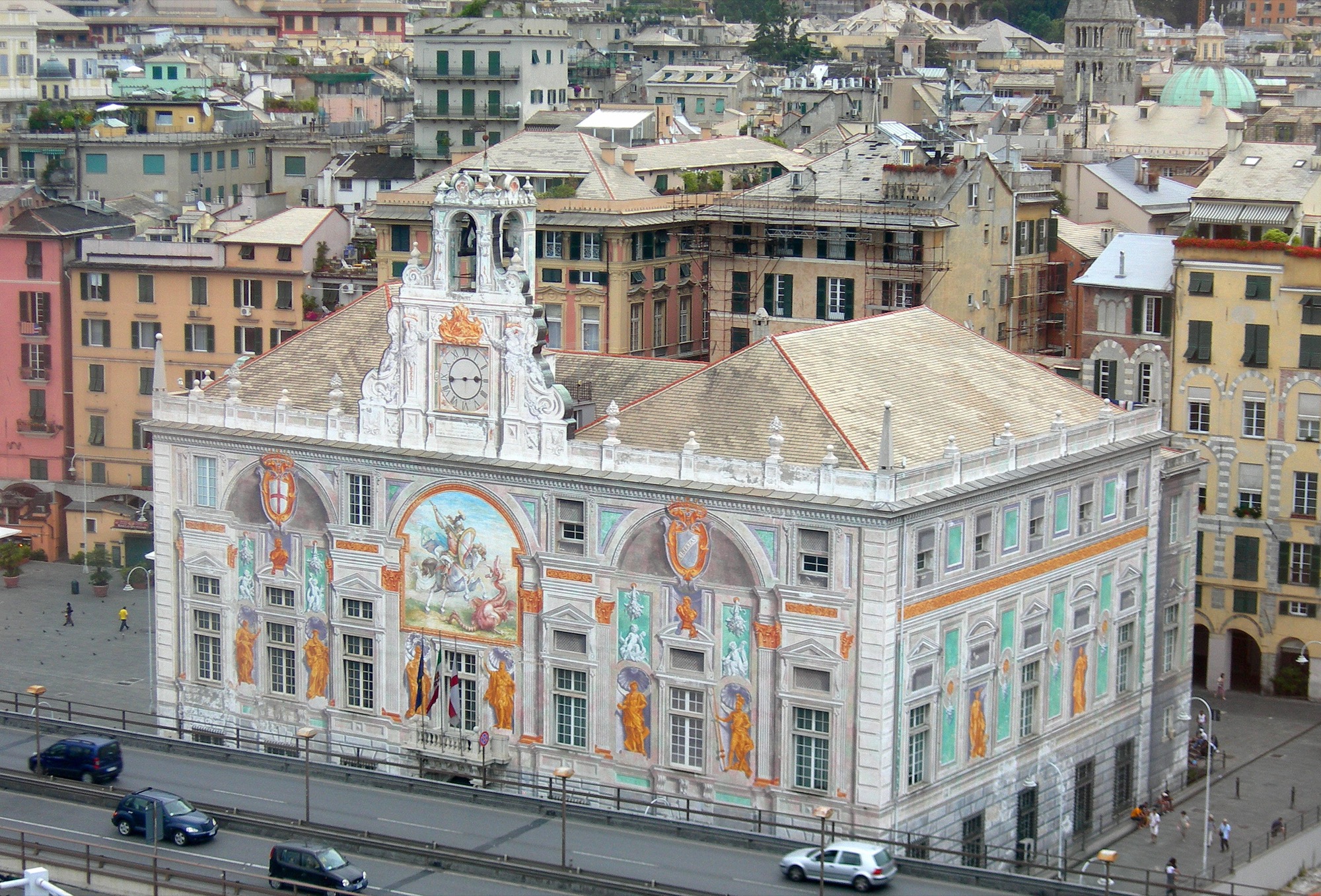
The Palazzo San Giorgio stands on the Ripa Maris at the edge of Genoa’s Porto Antico, where harbor and city meet. In 1260, Guglielmo Boccanegra, Captain of the People, commissioned the Cistercian friar Oliverio—who had previously designed the extension of the Old Pier—to erect a seat of civic government on reclaimed land over the covered mouth of the Suziglia stream. As Steven A. Epstein details in Genoa and the Genoese, 958–1528 (University of North Carolina Press, 2001), the palazzo was known originally as the Palazzo del Mare because its foundations were lapped by the sea, and it incorporated spolia salvaged from the demolished Venetian embassy in Constantinople, granted by Emperor Michael VIII Palaiologos in gratitude for Genoese naval aid at the reconquest of 1261. The medieval core rises in squared gray Promontorio stone on the ground floor and exposed red brick above, crowned by Ghibelline battlements and fronted by a portico of five pointed arches on stone columns facing the Sottoripa arcade; a thirteenth-century lion’s head from Constantinople is set into the portico wall. Between 1571 and 1608 the palazzo was expanded seaward with a monumental Renaissance wing whose frescoed facades were designed to impress arrivals by ship. Following a period of neglect, the architect and Superintendent of Piedmontese Monuments Alfredo D’Andrade directed a comprehensive restoration between 1890 and 1904, reconstructing the medieval interiors in a neo-Gothic spirit that emphasized the dualism between the ancient civic façade facing the city and the Renaissance front facing the port, as Lucina Napoleone has analyzed in “Renovation of the Palazzata della Ripa in Genova (1865–1903)” (Academia.edu, 2022). Since 1904 the palazzo has housed the Autonomous Port Consortium, now the Western Ligurian Sea Port Authority.
The harbor-facing Renaissance façade received its first fresco cycle from the Genoese painter Andrea Semino in 1592, but the eight Protectors of the Bank of Saint George, dissatisfied with the result, commissioned Lazzaro Tavarone—a pupil of Luca Cambiasi and veteran of the Escorial decorations in Spain—to repaint the entire sea front between 1606 and 1608. Tavarone’s monumental program, described in the Port Authority’s official survey (portsofgenoa.com), placed Saint George Slaying the Dragon at the center, flanked by the two-faced Janus (mythical founder of Genoa), Neptune, the twelfth-century chronicler Caffaro, the admiral Andrea Doria, Simone Boccanegra, the Crusader Guglielmo Embriaco, Christopher Columbus, and the naval hero Biagio Assereto—a pantheon of Genoese maritime power that framed the institution’s commercial identity in civic mythology. When the frescoes deteriorated, Lodovico Pogliaghi reconstructed them between 1912 and 1914, working from Tavarone’s surviving sketches and a large canvas by Paggi preserved in the palazzo’s library. Inside, the Sala del Capitano del Popolo—dedicated to Boccanegra and reconstructed under D’Andrade—preserves fifteenth-century marble benefactor statues by the sculptors Michele D’Aria, Antonio Della Porta, and Pace Gaggini, set in painted niches along the east wall: these depict Luciano Spinola (1473), Francesco Vivaldi (1473)—credited with pioneering compound interest—Domenico Pastine, and the Corsican commissioner Ambrogio Di Negro (1490). The room’s ceiling is of carved and painted red wooden joists, and a fifteenth-century bas-relief by D’Aria in the Manica Lunga reprises the Saint George and the Dragon motif that pervades the building’s decorative program.
The palazzo anchors the Ripa Maris, the waterfront strip where Genoa’s commercial life concentrated from the twelfth century onward. Directly behind it runs the Sottoripa arcade, whose porticoes were built between 1125 and 1133 by order of the Republic’s Consuls to shelter shops, warehouses, and artisan workshops serving the port—making it, as the Musei di Genova’s “Ripa Maris” exhibit notes, one of the oldest continuously functioning commercial arcades in Europe, stretching nearly a kilometer from the Old Pier to the Porta dei Vacca. The sea once reached the arcade’s foundations; “Sottoripa” means “under the bank.” From the palazzo’s landward side, a dense web of caruggi—narrow medieval lanes described in the UNESCO designation of Genoa’s historic center (2006) as Europe’s largest surviving medieval urban fabric—threaded toward Piazza Banchi, where moneychangers set up their benches (banchi) and the Loggia della Mercanzia, designed by Andrea Ceresola (il Vannone) and completed in 1595, formalized commodity and currency exchange under a vaulted arcade of twin columns. As Quentin van Doosselaere argues in Commercial Agreements and Social Dynamics in Medieval Genoa (Cambridge University Press, 2009), the physical proximity of port, warehouse, exchange loggia, and notarial offices within a few hundred meters created an “information-dense” environment that lowered transaction costs and accelerated the development of novel financial instruments. To the west, the Lanterna lighthouse—first built around 1128 and rebuilt in 1543 with financial support from the Bank of Saint George—marked the harbor entrance, completing a landscape in which civic architecture, commercial infrastructure, and maritime signaling were inseparably fused.
On 23 April 1407, a consortium of Genoese creditors chartered the Casa delle compere e dei banchi di San Giorgio to consolidate the Republic’s fragmented public debts—a patchwork of individual compere, or tax-farming contracts pledged against specific customs revenues—into a single institution. As Giuseppe Felloni demonstrates in “A Profile of Genoa’s Casa di San Giorgio (1407–1805): A Turning Point in the History of Credit” (Rivista di storia economica, 2010), the Casa managed government debt through transferable shares called luoghi—standardized units of 100 Genoese lire—backed by assigned tax streams, whose yields ranged from two to seven percent depending on fiscal conditions. Shareholders (luogatari) elected a governing board of eight Protectors annually, creating what Michele Fratianni terms a “creditors’ republic” in “Government Debt, Reputation and Creditors’ Protections: The Tale of San Giorgio” (Boston University working paper). The bank took up residence in the palazzo in 1451. Machiavelli observed in his Florentine Histories (1532) that citizens “took away their love from the Commune, as something tyrannical, and placed it in San Giorgio, as a party well and equitably administered”—a passage Yves Winter reexamines in “A Government of Creditors” (Polity 54, 2022). Under financial pressure, the Republic ceded sovereign authority over colonial territories to the bank: Famagusta on Cyprus, Corsica (1453–1562), the Black Sea port of Caffa, and numerous Ligurian towns. Heinrich Sieveking’s foundational Studio sulle finanze genovesi nel medioevo (1905–1906) remains the most detailed account of the pre-Casa compere system, while Jacques Heers’s Gênes au XVe siècle (1961) situates the bank within Genoa’s broader social and economic structures. The Casa operated until Napoleon dissolved it in 1805.
The Casa di San Giorgio dealt primarily in government debt shares (luoghi), which functioned as transferable securities—hereditary from at least 1300, freely alienable to third parties, and registrable in the bank’s ledgers, as Felloni and Fratianni have documented. Beyond debt management, the bank accepted deposits, transferred funds between accounts via a giro system, extended credit, and from around 1625 issued bearer notes transferable by endorsement—an early form of paper money that anticipated the instruments of the Bank of England by nearly three centuries. In the broader Genoese market, merchants traded commodities including grain (supplied through the Ufficio dell’Abbondanza, the civic annona authority), Sicilian wheat, salt, Phocaean alum—controlled after 1346 by the Mahona of Chios, as Epstein describes—silk (an increasingly important Genoese manufacture from the fifteenth century), and Eastern spices routed through the Levantine and Black Sea colonies. Genoese traders pioneered several financial instruments of lasting significance: the commenda contract, a profit-sharing partnership between sedentary investors and travelling merchants documented in notarial records from as early as 1150; bills of exchange (cambium) that facilitated credit across the Mediterranean without physical transfer of coin; divisible ship shares (loca) that created a secondary market in voyage investments; and, most consequentially, the standalone maritime insurance contract, the earliest known example of which dates from Genoa in 1347—separating risk transfer from credit for the first time, as Leonard Ceccarelli examines in “Marine Insurance in Early Modern Genoa (1564–1571)” (Asia-Pacific Journal of Risk and Insurance, 2023). The Genoa Commodity and Value Exchange (Borsa Merci e Valori) was formally established at the Loggia dei Mercanti in Piazza Banchi in 1855, institutionalizing centuries of informal trade.
Images will be added as the project develops. Photographs by Larry Ng and from research sources.