Geneva Stock Exchange
Geneva, Switzerland · Established 1857
This site requires authorization to access.
To request access, contact
william.goetzmann@yale.edu
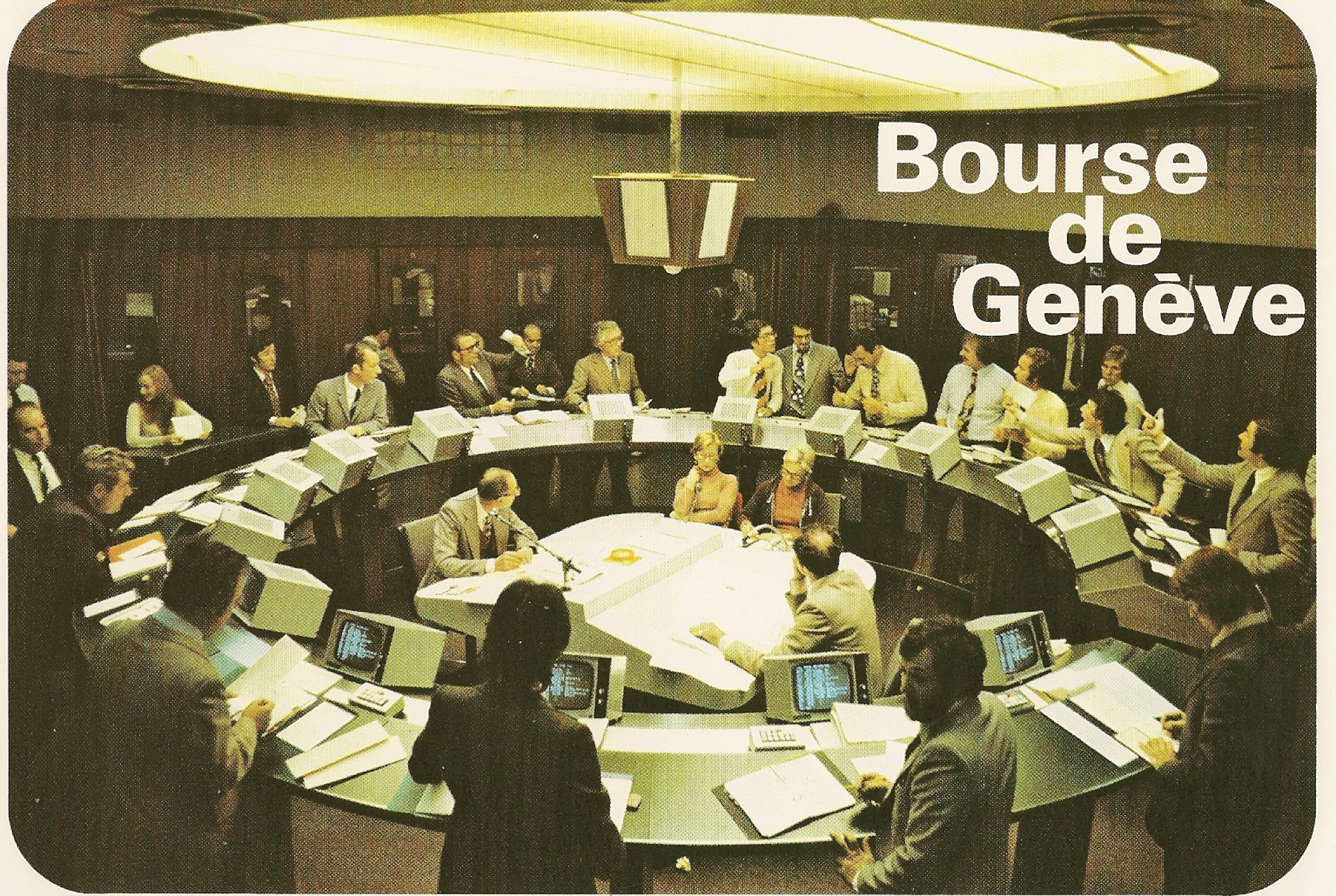
The Bourse de Genève occupied a remarkable succession of premises over its 146-year history, reflecting both the institution’s growth and the evolving cityscape of Geneva’s commercial center. When the Société des agents de change réunis was established in 1850, trading initially convened at 8 Rue de la Corraterie in the office of a financial agent, as documented in the Bibliothèque de Genève’s iconographic archives. By 1852, the brokers had moved to 3 Rue de la Corraterie, then briefly to 2 Rue Centrale before the Grand Council of Geneva formally authorized the exchange in 1856, granting it space in the Bâtiment de la Poste aux Lettres on Place Bel-Air. The official establishment at 5 Place Bel-Air in 1857 gave the exchange a permanent public identity in what was already emerging as Geneva’s commercial crossroads—the site where, as the Ville de Genève’s historical survey records, the Crédit Lyonnais would later stand. In 1868, the Bourse relocated to Rue Petitot in the heart of the banking quarter. A purpose-built exchange building was completed there around 1914–1915, with interior stuccowork attributed to an architect identified in the Bibliothèque de Genève’s photographic records as “H. Goss, arch.,” likely a member of the distinguished Goss architectural dynasty that included Jacques-Élysée Goss, designer of Geneva’s Grand Théâtre (1874–1879). A 1915 silver gelatin print preserved at the Bibliothèque de Genève (inventory vg p 5095) documents the interior of the Rue Petitot exchange, revealing a formal trading hall with ornamental plasterwork. In 1986, the exchange made its final physical move to the first floor of the newly opened Confédération Centre on Rue de la Confédération—a vast commercial complex measuring approximately 110 meters by 50 meters, originally clad in white marble and aluminum, initiated by two major Swiss banks. The trading floor at the Confédération Centre operated until early August 1996, when open-outcry trading was definitively replaced by electronic systems, and the physical Bourse de Genève ceased to exist.
The decorative programs of the Geneva exchange buildings reflected the institution’s aspiration to convey financial probity and civic pride within the restrained aesthetic traditions of Calvinist Geneva. Unlike the grandiose sculptural programs of the Paris Palais Brongniart or the Brussels Bourse, Geneva’s exchange buildings adopted a more understated approach consistent with the city’s Reformed Protestant heritage. The earliest locations at Rue de la Corraterie and Place Bel-Air were shared commercial premises with no dedicated artistic commissions. The purpose-built exchange on Rue Petitot, completed around 1914–1915, represented the first opportunity for a coherent decorative scheme. The 1915 interior photograph preserved at the Bibliothèque de Genève (Atelier Boissonnas, inv. fbb p ge 05 02 20) reveals refined ornamental stucco or “staff” work—decorative plaster relief in the French academic tradition—adorning the trading hall’s ceiling and walls. The Atelier Boissonnas, Geneva’s preeminent photographic studio active from the 1860s through the 1980s, documented both the architectural facades and interior spaces with characteristic precision. The trading ring itself followed the Parisian corbeille model: a circular barrier around which brokers gathered for open-outcry trading, or criée, a system Geneva was the first Swiss exchange to adopt, as the Swiss Finance Museum’s digital exhibition on the history of trading records. This physical arrangement became the visual signature of the exchange. When the Bourse moved to the Confédération Centre in 1986, the aesthetic shifted to a late-twentieth-century commercial modernism—soft, rounded forms in white marble, aluminum, chrome, and mirrors that characterized the original interior design. The final session of the physical Bourse de Genève on 31 July 1996 was documented by photographer Daniel René Winteregg, whose images in the Bibliothèque de Genève’s collection constitute the most comprehensive visual record of the trading floor’s last hours. These photographs capture the end of an era—the extinction of the physical marketplace in favor of the fully automated electronic system that had made the SIX Swiss Exchange, as the institution was later renamed, the first stock exchange in the world to automate trading, clearing, and settlement.
Geneva’s position as an international financial center has deep historical roots in the city’s Calvinist heritage, its tradition of sheltering religious refugees, and its role as a hub of multilateral diplomacy. John Calvin’s theological willingness to permit lending at interest—a stance explored in depth by scholars of Reformed economic thought—provided a doctrinal foundation for banking in the city. The arrival of approximately 60,000 Huguenot refugees between 1682 and 1720, of whom some three to four thousand settled in Geneva, transformed the local economy. As the Tontine Coffee-House’s historical survey notes, these refugees brought watchmaking expertise, banking skills, and international commercial networks that made Geneva a European financial center by 1710. The Great Council of Geneva cemented this financial character in 1713 by requiring bankers to maintain client registers while prohibiting disclosure of customer information—a regulation that Sébastien Guex, in The Origins of the Swiss Banking Secrecy Law and Its Repercussions for Swiss Federal Policy (2000), identifies as the earliest codification of banking secrecy. The Bourse de Genève emerged within this ecosystem. Its various locations traced the geography of Geneva’s financial quarter: from the Corraterie and Place Bel-Air to Rue Petitot and finally Rue de la Confédération, all within the compact rive gauche district where private banks, watchmakers, and luxury retailers cluster along Rue du Rhône. The great private banking dynasties—Lombard Odier (founded 1796), Pictet (1805), Mirabaud (1819), and Bordier (1844)—maintained their headquarters in this quarter. Stefano Ugolini, in The Origins of Swiss Wealth Management? Genevan Private Banking, 1800–1840 (Financial History Review, 2018), demonstrates how these families formed the “Quatuor” syndicate in the 1840s to finance European railways and sovereign loans. Geneva’s role as seat of the International Committee of the Red Cross (founded 1863), the League of Nations, and today more than 200 international organizations and forty UN agencies reinforced the city’s cosmopolitan financial character. The financial sector generates approximately 38,000 jobs and contributes some 12.9 percent of cantonal GDP, as the Geneva Financial Center Foundation reports.
The Bourse de Genève was the first stock exchange established in Switzerland, founded in 1850 when a group of brokers formed the Société des agents de change réunis. Its initial trading list mentioned only six securities, with currency exchanges holding the primary place. A trading floor was opened in 1855, and the Grand Council of Geneva formally authorized the exchange in 1856; on 27 June 1857, the Bourse became an officially recognized institution. Geneva’s exchange opened a quarter-century before those of Basel (1866) and Zurich (1873), and it remained the most important of the Swiss exchanges, central to the city’s private banking and international finance. Under the Swiss federal system, stock exchanges were regulated at the cantonal level—a framework that Kim Oosterlinck and Hugues Pirotte examine in Stock Exchange Competition: The Case of Geneva During the Interwar Period (Financial History Review, vol. 25, 2018, pp. 183–201). Their research, drawing on archival sources, traces the gradual decline of Geneva’s exchange during the 1920s and 1930s, as independent brokers struggled to maintain their oligopoly against the encroachment of German-Swiss banks seeking to penetrate the cantonal marketplace. During World War I, all Swiss exchanges closed except for bond trading at the Geneva exchange—a testament to the city’s unique position within neutral Switzerland. In 1945, the monopoly of the agents de change ended, permitting banks to intervene directly in exchange trading. The Swiss Banking Act of 1934 had already codified banking secrecy at the federal level, reinforcing Geneva’s attractiveness as a center for international capital and wealth management. The decisive transformation came in 1993, when the Geneva, Basel, and Zurich exchanges merged into the Verein Schweizerische Effektenbörse (Swiss Securities Exchanges Association), publicly known as Swiss Exchange and headquartered in Zurich. On 15 August 1996, the closing bells rang for the last time on the trading floors. The newly unified exchange became the first in the world to fully automate trading, clearing, and settlement. In 2008, further consolidation merged the Swiss Exchange with SIS Group and Telekurs into SIX Group, which operates the SIX Swiss Exchange today.
The Bourse de Genève’s trading list evolved from its modest origins—six securities in 1850, dominated by currency exchanges—into a sophisticated marketplace for bonds, equities, and international financial instruments reflecting Geneva’s distinctive role as a center of private banking and wealth management. Swiss Confederation government bonds (Bundesobligationen) and cantonal bonds constituted a core segment; as the Springer volume Swiss Equity Markets (2023) documents, cantonal bonds carry implicit backing by their respective cantons and historically offered slightly higher coupons than federal issues, making them attractive to the conservative wealth-management clientele that defined Geneva’s financial culture. The exchange also traded shares of Swiss banking institutions, including the great private banks that dominated the city’s financial life: firms such as Lombard Odier (founded 1796) and Pictet (1805), whose partners in the 1840s formed the “Quatuor” syndicate to finance European railway ventures and sovereign loans, as Ugolini (Financial History Review, 2018) documents. Insurance company shares featured prominently—the Swiss accident insurance industry emerged in the 1870s alongside railway expansion, as the Winterthur Group’s corporate history records. Geneva’s role as the world capital of haute horlogerie shaped its securities market in distinctive ways: while the great watch houses—Patek Philippe (founded 1839), Vacheron Constantin (1755), and Rolex (incorporated in Geneva 1920)—remained privately held, the publicly traded luxury conglomerates Richemont (listed on SIX Swiss Exchange as CFR) and the Swatch Group brought watchmaking-related equities to the Swiss market. During the interwar period, as Oosterlinck and Pirotte (2018) demonstrate, Geneva attracted particular attention for its trading in foreign bonds and international securities, leveraging the city’s neutrality and banking secrecy traditions. The modern SIX Swiss Exchange, successor to the merged Geneva, Basel, and Zurich bourses, now trades a comprehensive range of instruments: straight bonds, floating-rate notes, convertibles, asset-backed securities, green bonds, and loan participation notes alongside equities and derivatives including stock options—an evolution from Geneva’s original six-security trading list to one of Europe’s most diversified marketplaces.
Images will be added as the project develops. Photographs by Larry Ng and from research sources.