Galveston Cotton Exchange
Galveston, USA · Established 1873
This site requires authorization to access.
To request access, contact
william.goetzmann@yale.edu
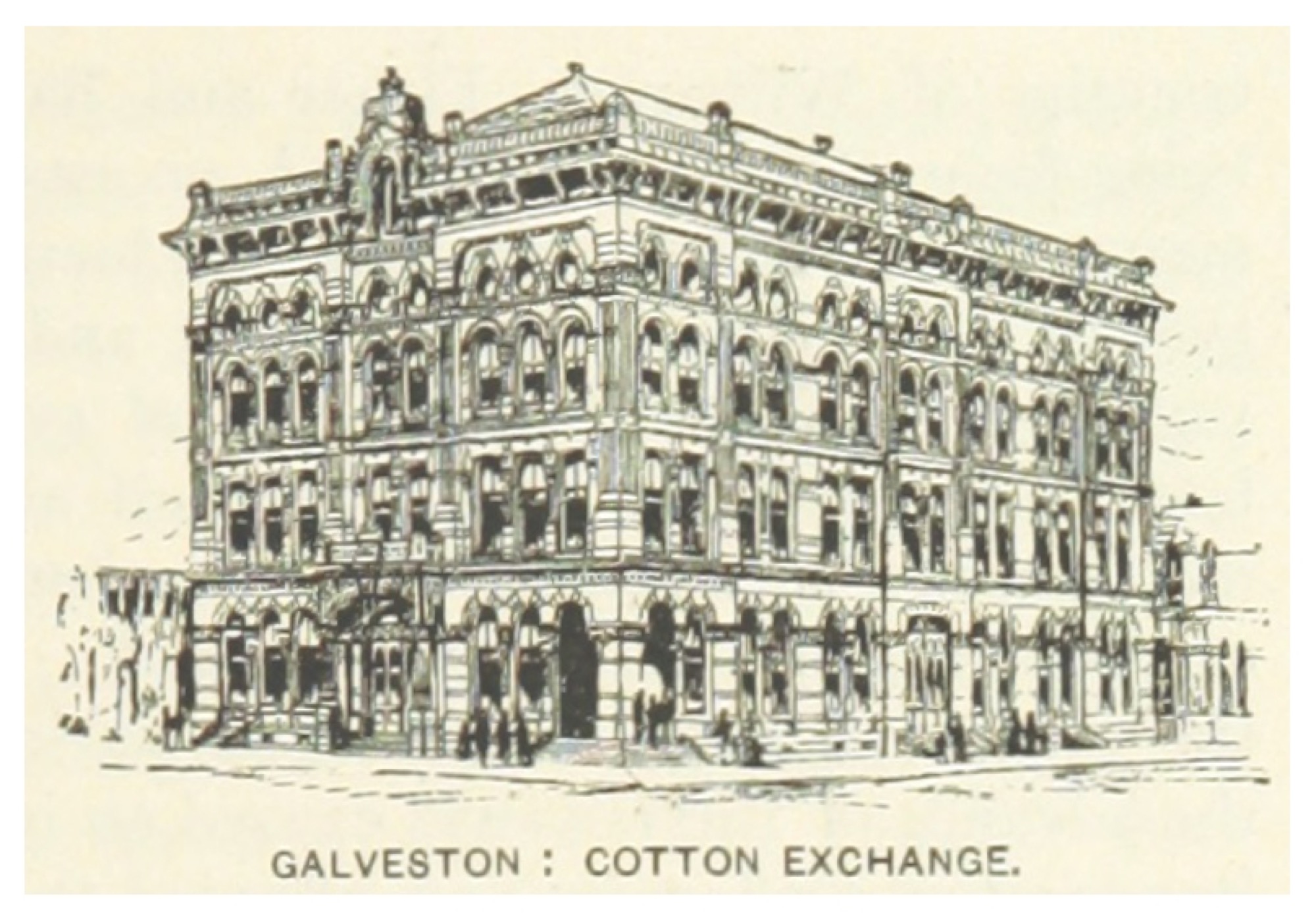
The Galveston Cotton Exchange and Board of Trade occupied two successive buildings at the northwest corner of Twenty-First Street and Mechanic Street. The first, completed in December 1878 and designed by the architectural firm Gibbs and Moser, was an ornate three-story structure built of Austin limestone and Philadelphia pressed brick treated with a faux-stone finish, its cornices fashioned from galvanized iron. As the Rosenberg Library Museum records describe, the exterior combined Georgian Colonial symmetry with elaborate Roman elements—continuous archways and grand columns flanking the entrance—at a total cost of $102,000. The exchange hall within measured eighty-three by sixty-three feet beneath a thirty-eight-foot ceiling, and its opening on December 14, 1878, was celebrated with a grand ball that drew coverage from Frank Leslie’s Illustrated Newspaper (March 22, 1879). When the Category 4 hurricane of September 8, 1900—the deadliest natural disaster in United States history, claiming an estimated 6,000 to 12,000 lives as documented by Erik Larson in Isaac’s Storm (1999)—devastated Galveston, the Cotton Exchange suffered serious structural damage. An extensive renovation followed, adding a fourth story. By the late 1930s the aging structure was deemed inadequate and it was razed in 1940. Galveston architect Ben Milam designed its Art Deco and Streamline Moderne replacement, completed in 1941 at 2102 Mechanic Street. This three-story modernistic structure featured glass-block accents, original granite tiles, and glazed interior finishes. The Cotton Exchange stands within the Strand-Mechanic National Historic Landmark District, designated to the National Register of Historic Places in 1970 and declared a National Historic Landmark in 1976.
The decorative program of the original 1878 Cotton Exchange building reflected the visual culture of the Texas cotton trade with remarkable specificity. Barrie Scardino and Drexel Turner, in Clayton’s Galveston: The Architecture of Nicholas J. Clayton and His Contemporaries (2000), document Galveston’s Victorian-era commercial ornament as an expression of mercantile identity. The interior woodwork and floors were inlaid walnut and oak, while decorative brackets featuring designs of the cotton plant in its various stages of growth adorned the perimeter of the exchange hall, as described in the Rosenberg Library’s institutional records. The entrance facade bore a heraldic device—an image of crowned cotton bolls flanked by the words “Cotton” and “Exchange”—and two shields carved into the Twenty-First Street cornice displayed a bull and a bear, the universal symbols of market speculation, directly linking the building’s ornamentation to its commercial function. A glass display case inside contained eight standardized cotton samples against which all shipments would be graded, transforming the instrument of quality control into an aesthetic object of institutional authority. The 1941 Ben Milam replacement building adopted the Art Deco vocabulary, with streamlined geometric forms, glass-block accents, and granite tile surfaces. Inside, giant chalkboards recorded market numbers and cotton futures prices in real time via Western Union telegraph connections. During a recent renovation, these chalkboards—still bearing chalk marks dating to approximately 1965—were preserved behind glass as decorative artifacts, converting the material residue of daily trading into historical installation art.
Galveston occupies a barrier island roughly twenty-seven miles long and no more than three miles wide, oriented northeast to southwest in the Gulf of Mexico approximately fifty miles southeast of Houston. This geographic position on Galveston Bay’s natural deepwater harbor made the island the commercial gateway to Texas throughout the nineteenth century. As the Texas State Historical Association’s Handbook of Texas records, all major railroads served Galveston, and sixty percent of the state’s cotton crop was exported through its port during the apex of prosperity from the mid-1870s to the mid-1890s. The Strand—the five-block commercial thoroughfare between Twentieth and Twenty-Fifth streets, running parallel to the wharves—earned the sobriquet “Wall Street of the Southwest” for its concentration of banks, wholesale houses, cotton factors, commission merchants, insurance companies, and shipping agencies. The American Planning Association designated the Strand one of America’s “Great Streets” in 2013, noting it contains one of the country’s largest collections of cast-iron commercial buildings. The cotton compress and warehouse district processed millions of bales for export; by 1900, more than two million bales shipped annually from the Galveston Wharf and Cotton Compress Company, founded in 1854. The catastrophic 1900 hurricane ended Galveston’s commercial supremacy. The subsequent construction of a seventeen-foot seawall (1902–1904) and the extraordinary grade-raising of 2,000 buildings across five hundred city blocks, documented by the American Society of Civil Engineers as a Historic Civil Engineering Landmark, could not prevent Houston’s ascendancy after the Houston Ship Channel was opened on November 10, 1914.
The Galveston Cotton Exchange was founded on May 6, 1873, as the first cotton exchange in Texas and the third in the United States. As the Rosenberg Library Museum documents, Colonel William Lewis Moody led the founding effort, chairing the committee that drafted bylaws addressing three objectives: resolving pricing disputes between buyers and sellers, establishing fair trade principles, and collecting and disseminating crop and market intelligence. Moody served as president during three terms (1877–1882, 1884–1888, 1898–1900) and his firm, W. L. Moody and Company, built Texas’s first dockside cotton compress in 1894. The exchange was renamed the Galveston Cotton Exchange and Board of Trade in 1888–1889 when membership expanded to include merchants in grain, coffee, and produce. L. Tuffly Ellis, in “The Revolutionizing of the Texas Cotton Trade, 1865–1885” (Southwestern Historical Quarterly, 1970), documents how postwar railroad expansion transformed the cotton marketing system, with Galveston emerging as the dominant port. By the 1890s, Galveston was among the wealthiest cities per capita in America, its Strand district generating $38 million in merchandise and services in 1881 alone. The hurricane of September 8, 1900, killed an estimated 6,000 to 12,000 people and destroyed approximately 7,000 buildings. The exchange building was severely damaged but was repaired and expanded with a fourth story. Yet the storm irrevocably undermined Galveston’s position. The opening of the Houston Ship Channel in 1914 diverted trade inland; within a decade Houston surpassed Galveston as the nation’s leading cotton port. The Galveston Cotton Exchange’s spot cotton market officially closed in 1967.
Texas cotton, overwhelmingly of the upland variety (Gossypium hirsutum), dominated the Galveston exchange. As the Handbook of Texas documents, Texas production surged from 58,073 bales in 1849 to 431,645 bales in 1859, and to more than 3.5 million bales by 1900, making the state the nation’s leading producer. Cotton moved from interior growing regions to Galveston by rail—the Gulf, Colorado and Santa Fe Railway and other trunk lines converging on the island—where it was compressed, graded, and loaded for export. The Galveston Wharf and Cotton Compress Company, established in 1854, pioneered high-density compression technology; by 1860, more than $500,000 had been invested in Galveston’s compress facilities. At the exchange, eight standardized cotton samples were displayed in a glass case, against which all incoming shipments were classified—a practice predating the federal cotton classification standards later codified by the USDA. Cotton futures prices from the New York Cotton Exchange, established in 1870, were transmitted to Galveston via Western Union telegraph, enabling hedging and speculation. As Kenneth Lipartito and Joseph Pratt document in “The New York Cotton Exchange and the Development of the Cotton Futures Market” (Business History Review, 1991), the telegraph and transatlantic cable linked Liverpool, New York, and New Orleans into a unified pricing chain. Galveston’s primary export destination was Liverpool, with regular steamship service established by the Galveston and Liverpool Steamship Company. By 1899, the Handbook of Texas records, Galveston was “the world’s foremost cotton port.” The Board of Trade’s expanded mandate after 1888 also encompassed grain, coffee, and general produce trading.
Images will be added as the project develops. Photographs by Larry Ng and from research sources.