Frankfurt Stock Exchange (Frankfurter Wertpapierbörse)
Frankfurt, Germany · Established 1879
This site requires authorization to access.
To request access, contact
william.goetzmann@yale.edu
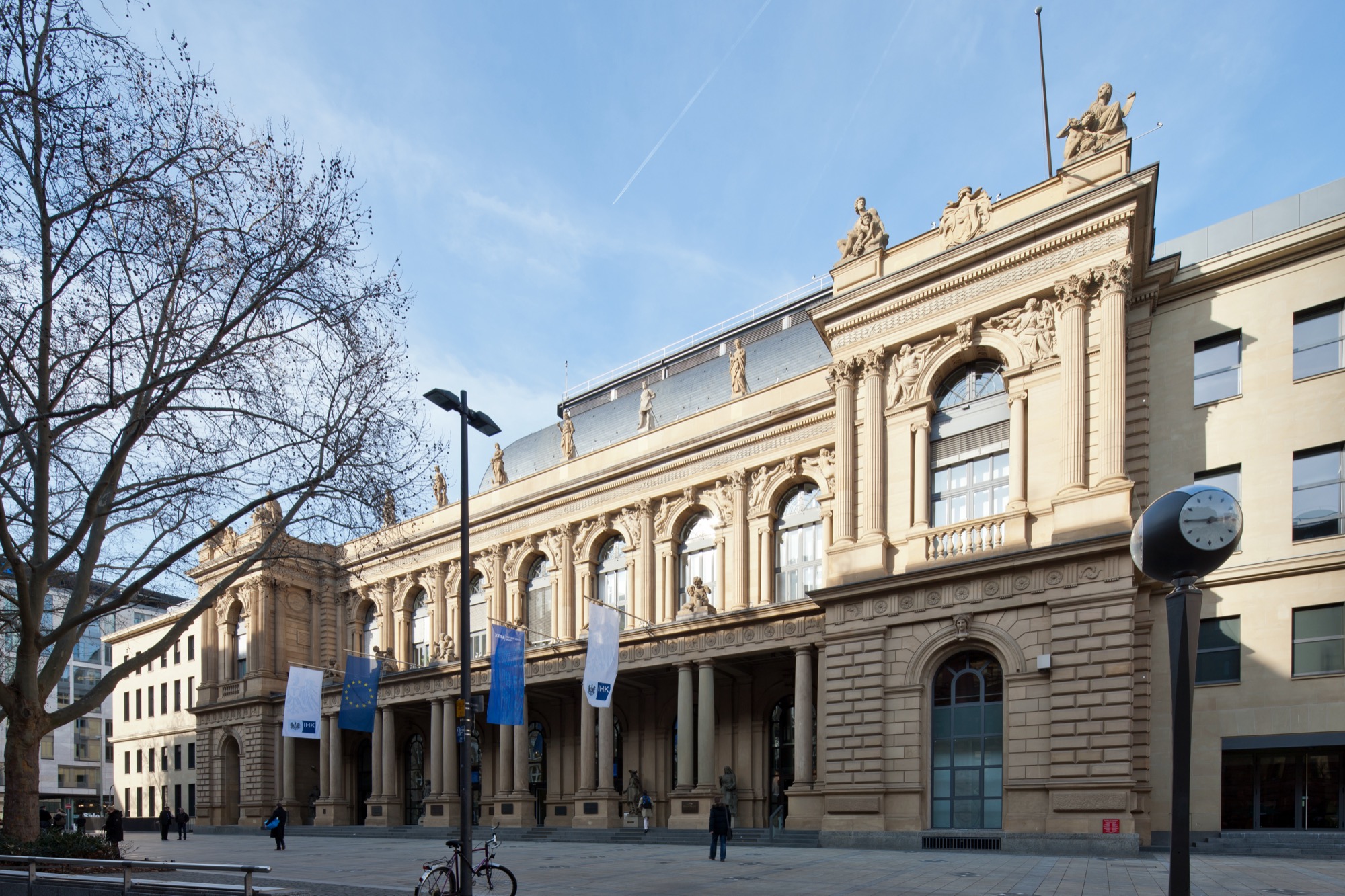
The first purpose-built quarters for Frankfurt's exchange were surprisingly late in coming. For centuries, as Carl-Ludwig Holtfrerich detailed in Frankfurt as a Financial Centre: From Medieval Trade Fair to European Banking Centre (C. H. Beck, 1999), trading took place informally at the Römerberg during the biannual Messe fairs, and from 1694 in the Haus Braunfels on the Liebfrauenberg. Only in 1843 did the exchange acquire its own building: the Alte Börse on the Paulsplatz, designed by the Frankfurt architect Friedrich Peipers in a commanding neoclassical style, its portico adorned with allegorical statues representing the five continents. As trading volumes surged, this building proved inadequate within a generation. The architects Heinrich Burnitz and Oskar Sommer were commissioned to design a successor, and on its completion in 1879 the Neue Börse on Börsenplatz was inaugurated. Burnitz, the son of the prominent Frankfurt architect Rudolf Burnitz, conceived the building in the neo-Renaissance idiom characteristic of the Wilhelminian era, its facades clad in red Main sandstone with an ornate Greco-Roman colonnade. The Deutsche Börse's own institutional history ranks the Neue Börse alongside the Hauptbahnhof and the Alte Oper as one of the three most important Wilhelmine-era structures in Frankfurt. The interior benefited from the contributions of Alexander Linnemann (1839-1902), the Frankfurt-born architect and glass painter who had studied at the Berlin Bauakademie and was already known for his work on the restoration of Mainz Cathedral. Linnemann's decorative program for the Börse, executed from 1878, included stained glass and painted elements reflecting his transition from architectural practice to the applied arts, a shift influenced by the painter Eduard Jakob von Steinle. The Neue Börse's grand trading hall became the stage for decades of open-outcry trading, with brokers negotiating prices at the top of their voices. An Allied air raid in 1944 severely damaged the building; trading was reduced to basement rooms. After the war, the restored trading floor was reopened on February 9, 1957, by Economics Minister Ludwig Erhard, who used the occasion to advocate broader public share ownership.
The most recognizable artistic emblem of the Frankfurt Stock Exchange is the bronze Bull and Bear sculpture group on Börsenplatz, created by the Würzburg sculptor Reinhard Dachlauer. Commissioned by the exchange's board to mark its 400th anniversary in 1985, the sculptures were formally installed on October 6, 1988, and presented to the City of Frankfurt. Dachlauer's muscular figures — the bull straining upward, the bear pressing downward — have since become among the most photographed symbols of global finance and a favored backdrop for companies staging their initial public offerings. Inside the Neue Börse, the decorative program executed by Alexander Linnemann in the late 1870s originally enriched the trading hall and public rooms with stained glass panels and painted decorations. Linnemann, whose dynasty of glass painters continued through his sons Rudolf and Otto into the Jugendstil period, brought to the Börse interior a historicist vocabulary consistent with the building's neo-Renaissance architecture. Beyond the exchange building itself, the commercial life of Frankfurt has been richly documented in visual art. The Städel Museum holds Christian Georg Schütz the Elder's A Market on the Römerberg in Frankfurt (1754, oil on canvas, 104 x 123 cm, Inv. Nr. 14), a veduta that captures the bustling market activity on the historic square where the earliest exchange meetings took place — merchants, wagons, and market stalls arrayed before the Gerechtigkeitsbrunnen and the medieval facades of the Salzhaus and Haus Frauenstein. The Swiss-born engraver Matthäus Merian the Elder, who settled in Frankfurt in 1620 and married the daughter of the publisher Theodor de Bry, produced his celebrated bird's-eye view of the city in 1628, documenting the dense urban fabric of the trade fair city. Merian's views, published in the Topographia Germaniae (1642-1688) and the Theatrum Europaeum (from 1635), constitute an indispensable visual archive of early modern Frankfurt's commercial landscape.
Frankfurt's destiny as a financial center is inseparable from its geography and political status. Situated on the Main River at the point where it could most easily be forded — hence the name 'Frank-furt,' the ford of the Franks — the city commanded the intersection of Europe's most important medieval trade routes. As Holtfrerich emphasized in Frankfurt as a Financial Centre (1999), the route from Paris through Frankfurt and Leipzig to Nizhny Novgorod made the city a natural node of continental commerce. Emperor Ludwig IV of Bavaria reinforced this advantage in 1337 by issuing an imperial diploma forbidding any rival city from establishing a trade fair that might harm Frankfurt's Messe. The city's status as a Freie Reichsstadt (Free Imperial City), formally established in 1372 and maintained until 1806, granted it direct subordination to the Emperor rather than to any regional prince, providing the political autonomy essential for an independent commercial culture. The Römerberg, Frankfurt's principal civic square since the fourteenth century, served as the original site of exchange meetings and trade fair commerce, its half-timbered facades and the Römer town hall forming the backdrop to centuries of mercantile activity. The Börsenplatz, where the Neue Börse was erected in 1879, lies within the Innenstadt between the Hauptwache and the Zeil — Frankfurt's central commercial axis — placing the exchange at the heart of the city's commercial geography. The nearby Judengasse, established in 1462 when Frankfurt's Jewish community was confined to a single narrow lane outside the city ramparts, became one of the most important sites in European financial history. As the Jewish population grew to over 3,000 persons crammed into 195 houses by the sixteenth century, the Judengasse became a crucible of financial expertise, producing the Rothschild dynasty among others. The ghetto restrictions were finally abolished in 1811 under the Napoleonic-era Grand Duke Karl von Dalberg, who required the Jewish community to pay 440,000 florins for its emancipation. The Museum Judengasse, opened in 1992 on the excavated foundations of nineteen Judengasse houses, preserves this history.
The institutional origins of the Frankfurt Stock Exchange lie in the city's medieval trade fairs, first documented in 1150. Emperor Frederick II granted an imperial privilege for the autumn fair in 1240, and Emperor Ludwig IV added a spring fair in 1330, establishing the biannual rhythm that would define Frankfurt's commercial calendar for centuries. As Peter Spufford observed in Money and Its Use in Medieval Europe (Cambridge, 1988), such fairs served as critical nodes for currency exchange across the fragmented monetary landscape of the Holy Roman Empire. On September 9, 1585, Frankfurt's merchants convened to establish uniform exchange rates for the bewildering variety of coins circulating through the fair, an event recognized as the founding of the Frankfurter Börse and one of the earliest formal acts of exchange regulation in European history. The term 'Börse' first appeared in written records in 1605. The Thurn und Taxis family, whose postal monopoly had made Frankfurt a central hub by 1598, accelerated the flow of commercial information essential to securities pricing. In the eighteenth century, Bankhaus Bethmann, founded in 1748 by Johann Philipp and Simon Moritz Bethmann, transformed Frankfurt's capital markets by inventing the fractional bond (Partialobligation) in 1778-1779: breaking the Austrian Emperor's massive borrowing into sub-bonds of 1,000 gulden each, making government debt tradeable by ordinary investors for the first time. As Niall Ferguson documented in The House of Rothschild: Money's Prophets, 1798-1848 (Viking, 1998), Mayer Amschel Rothschild (1744-1812), born in the cramped Judengasse and initially a coin dealer and court factor to the Landgrave of Hesse-Kassel, built upon this Frankfurt tradition to create a banking dynasty that would reshape European sovereign finance. Napoleon's dissolution of the Holy Roman Empire in 1806 and the creation of the Grand Duchy of Frankfurt under Karl von Dalberg disrupted but did not destroy the city's financial institutions. The 1848 revolution brought the Frankfurt Parliament to the Paulskirche, steps from the Alte Börse, in an abortive attempt at German unification. After Bismarck's unification in 1871 elevated Berlin to imperial capital, Frankfurt lost its primacy — but, as Holtfrerich argued, its deep international connections and conservative reputation for government bonds ensured its survival. The Stock Exchange Act (Börsengesetz) of 1896 unified the regulation of Germany's 29 exchanges. The Nazi regime restricted free trading and directed capital to the war economy. Allied bombing in 1944 devastated the Neue Börse, yet the exchange reopened under American military authority in September 1945, one of the first German exchanges to resume operations. With Berlin divided by the Cold War, Frankfurt gradually reclaimed its position as Germany's undisputed financial capital.
The original commercial function of the Frankfurt exchange was the standardization of currency exchange rates — a necessity born of the monetary fragmentation of the Holy Roman Empire, where hundreds of principalities, bishoprics, and free cities each minted their own coins. The 1585 Börsenordnung established fixed exchange rates for foreign notes and coins, and the oldest surviving Frankfurt price list, dating from 1721, recorded rates for sixteen different currencies. Bills of exchange (Wechselbriefe), as Spufford analyzed in Money and Its Use in Medieval Europe (1988), were the primary financial instruments of the medieval fairs, enabling merchants to transfer value across borders without physically moving coin. The transition from a commodity fair to a securities market accelerated in the eighteenth century with the innovation of tradeable government bonds. Bankhaus Bethmann's fractional bonds of 1778-1779, issued to finance the Austrian Emperor's borrowing, opened the market to a wider investing public and established Frankfurt as a center for sovereign debt, a specialization the Rothschilds would perfect. The first equities appeared in 1820 when shares of the Austrian National Bank were listed. In 1837 a consortium led by Gebrüder Bethmann and the Rothschild bank issued shares in the Taunus Railway from Frankfurt to Wiesbaden — a landmark transaction that was forty times oversubscribed and inaugurated the era of railway share financing in Germany. As Holtfrerich noted in Frankfurt as a Financial Centre (1999), Frankfurt maintained a conservative preference for government securities over industrial equities even as Berlin embraced the Gründerzeit boom of 1870-1874, which saw 857 company foundations in Prussia alone. This conservatism gave Frankfurt a reputation for stability but required strategic adjustment by the century's end, when the exchange intensified its trading in industrial shares to remain competitive. The Thaler, the large silver coin that served as a benchmark across the Empire's fragmented monetary landscape, was among the most actively quoted currencies on the early exchange lists. The evolution from currency exchange to bond underwriting to equity trading traces a continuous arc from the medieval Messe to the modern Deutsche Börse.
Images will be added as the project develops. Photographs by Larry Ng and from research sources.