Florence Mercantile Exchange (Loggia del Mercato Nuovo)
Florence, Italy · Established 1547
This site requires authorization to access.
To request access, contact
william.goetzmann@yale.edu
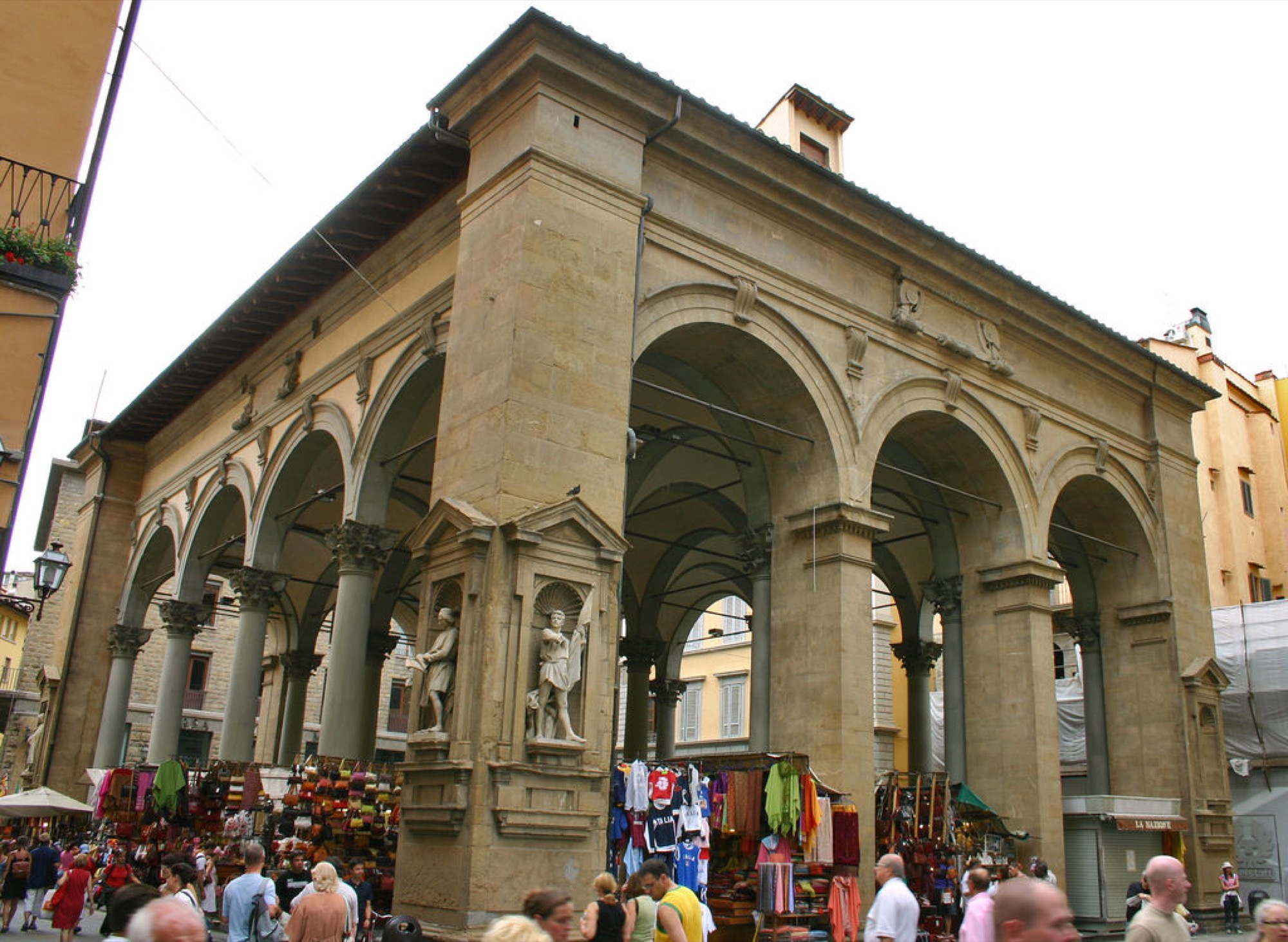
The Loggia del Mercato Nuovo was commissioned by Duke Cosimo I de' Medici and constructed between 1547 and 1551 to designs by the architect and woodworker Giovanni Battista del Tasso (1500-1555). As Lauren Jacobi has documented in The Architecture of Banking in Renaissance Italy: Constructing the Spaces of Money (Cambridge University Press, 2019), the loggia was built as part of a deliberate ducal program to bolster the trade of gold and silk in Florence, giving these luxury trades a monumental architectural setting at the heart of the city. The structure is a rectangular open-air hall, three bays wide and four bays deep, defined by piers encasing an inner colonnade of arches. Del Tasso deployed two types of locally quarried stone characteristic of Florentine Renaissance construction: pietraforte sandstone for the external piers and pietra serena sandstone for the interior columns and architectural detailing, a material combination that linked the building to Florence's geological and aesthetic identity. Giorgio Vasari commemorated del Tasso in a fresco at the Palazzo Vecchio depicting the architect holding a model of the loggia, with an inscription affirming his authorial role in the design. After del Tasso's death in 1555, the architect Bernardo Buontalenti intervened to replace the original corner columns with four reinforcement pillars, creating eight niches intended for marble statues of famous Florentines. Buontalenti also incorporated a spiral staircase within one of these pillars to provide access to a large upper room that served as an archive for notarial deeds. Of the planned statues, only three were eventually executed at the end of the nineteenth century: Michele di Lando by Ippazio Antonio Bortone, Giovanni Villani by Gaetano Trentanove, and Bernardo Cennini by Emilio Mancini, all carved in Apuan marble. The loggia represented a new type of purpose-built commercial architecture distinct from the older Mercato Vecchio, Florence's medieval market on the site of the ancient Roman forum, which occupied the center of the city until its controversial demolition in 1885 to create the Piazza della Repubblica. Where the Mercato Vecchio had grown organically over centuries, the Mercato Nuovo was conceived as a unified architectural statement, its elegant Renaissance proportions lending civic dignity to commercial exchange. Nearby stood the Palazzo dell'Arte della Lana, the headquarters of the powerful wool guild since 1308, connected by a gallery designed by Buontalenti to the church of Orsanmichele, forming a dense cluster of guild and commercial architecture in the center of the city.
The most celebrated artistic feature of the loggia is the bronze fountain known as Il Porcellino, cast by the Baroque sculptor Pietro Tacca (1577-1640) shortly before 1634. Tacca modeled his bronze after an Italian marble copy of a Hellenistic original depicting a wild boar, likely representing the mythical Calydonian Boar. The ancient marble had been brought from Rome to Florence in the mid-sixteenth century by the Medici and is now displayed in the classical section of the Uffizi. Tacca's bronze was originally intended for the Boboli Garden but was subsequently moved to the Mercato Nuovo, where it was placed facing east toward the Via Calimala. The Scottish literary traveler Tobias Smollett noted the tradition of visitors rubbing the boar's snout for good luck as early as 1766 in his Travels through France and Italy. In 2004 Tacca's original was moved to the Museo Stefano Bardini in Palazzo Mozzi for conservation, and the present statue in the loggia is a modern copy cast in 1998 by the Ferdinando Marinelli Artistic Foundry. Equally significant for the history of financial culture is the pietra dello scandalo, a round stone set into the pavement at the center of the loggia. This bicolored marble disc reproduces a wheel of the Carroccio, the war chariot that symbolized the Florentine Republic. On this stone the ritual punishment known as the acculata was administered: bankrupt debtors and dishonest merchants were publicly humiliated by having their bare buttocks struck against the stone amid the jeers of onlookers. The stone thus functioned as a physical marker of financial accountability embedded directly into the architecture of commerce. The related practice of bancarotta, from which the modern English word bankruptcy derives, involved the public destruction of the merchant's bench or counter (banco) in the marketplace, a ritual breaking that signified the irreversible ruin of a trader's credit and reputation. The loggia originally also featured a clock surmounted by a putto attributed to Andrea del Verrocchio, now lost, reflecting the Renaissance ideal of integrating artistic refinement with commercial functionality. The decorative program of the loggia itself, while restrained compared to religious or palatial architecture, expressed through its classical proportions and carefully dressed stonework the dignity that Cosimo I wished to confer upon Florentine trade.
The Loggia del Mercato Nuovo occupies a strategic position in the dense commercial core of Florence, situated a few blocks north of the Ponte Vecchio and roughly equidistant between the Arno River to the south and the cathedral complex to the north. This placement embedded the loggia within what Richard Goldthwaite described in The Economy of Renaissance Florence (Johns Hopkins University Press, 2009) as a remarkably compact urban fabric in which financial, commercial, and artisanal activities were concentrated within walking distance of one another. The nearby Ponte Vecchio, Florence's oldest bridge, underwent its own commercial transformation in 1593 when Grand Duke Ferdinando I de' Medici expelled the butchers and tanners whose shops had lined the bridge for centuries, replacing them with goldsmiths and jewelers, partly because the stench rising to the Vasari Corridor above offended Medici sensibilities. The Via Calimala, running past the loggia, took its name from the Calimala guild of cloth merchants, one of the earliest and most powerful of Florence's trading corporations. The Arte del Cambio, the money changers' guild, maintained its seat from 1324 in a Cavalcanti palace at the northwest corner between Via Porta Rossa and Calimala, and later from 1352 at a loggia in the Piazza della Signoria, placing the institutional heart of Florentine banking within a few hundred meters of the Mercato Nuovo. Members of the Arte del Cambio conducted their business at benches in the market, each seated with a purse called a scarsella hung around his neck, recording daily transactions in registers while exchanging currencies and extending credit. As Gene Brucker demonstrated in The Civic World of Early Renaissance Florence (Princeton University Press, 1977), the physical proximity of guild halls, markets, banks, and civic buildings in Florence fostered a dense network of personal relationships, information exchange, and mutual surveillance that was fundamental to the functioning of the city's commercial economy. The Palazzo dell'Arte della Lana and the church of Orsanmichele, originally a grain market converted to religious use while retaining its commercial ground-floor arcades, stood nearby, reinforcing the concentration of trade and guild governance in this quarter. The old Mercato Vecchio, which had occupied the site of the Roman forum since the early medieval period, functioned as the city's principal food market and popular gathering place until its demolition in the 1880s as part of a modernization campaign, a loss lamented by the Macchiaioli painter Telemaco Signorini. Florence's compact topography, constrained by the Arno to the south and its medieval walls, meant that the financial district was never far from political power at the Palazzo della Signoria or cultural patronage at the Duomo, creating an unusually integrated urban environment for the conduct of trade and finance.
Florence's role as the birthplace of modern banking stretches back to the thirteenth century, when the city's merchant companies developed financial instruments and organizational forms that would shape European commerce for centuries. As Raymond de Roover documented in The Rise and Decline of the Medici Bank, 1397-1494 (Harvard University Press, 1963), the great Florentine banking houses emerged from the cloth trade, using profits from textile manufacturing and finishing to build international networks of credit and exchange. The earliest giants were the Bardi and Peruzzi companies, which Edwin Hunt analyzed in The Medieval Super-Companies: A Study of the Peruzzi Company of Florence (Cambridge University Press, 1994) as firms of exceptional size, diversity, and geographical reach. The Peruzzi went bankrupt in 1343 and the Bardi followed in 1346, their collapse long attributed to massive unrecoverable loans to Edward III of England during the early stages of the Hundred Years' War, though Hunt argued that commodity trading losses and overextension were equally culpable. From the wreckage of these medieval super-companies, smaller firms rose to prominence, and by the end of the fourteenth century the Medici Bank had emerged as the dominant force in European finance. De Roover's meticulous reconstruction of the Medici Bank's operations, drawing on the libri segreti (confidential ledgers) discovered in 1950, revealed a sophisticated organization with branches in London, Bruges, Geneva, Lyon, Avignon, Rome, Venice, and Milan. The bank's structure was notable for its use of the accomandita, a form of limited partnership descended from the medieval commenda contract, in which an investing partner contributed capital and bore financial risk while a managing partner operated the business. This legal innovation, which de Roover traced through Florentine commercial practice, allowed the Medici to limit liability across their far-flung branch network. Florence's guild system, the Arti, provided the institutional framework for commercial life. The Ordinances of Justice of 1293 had placed political power in the hands of the guild federations, with the seven Arti Maggiori (greater guilds) dominating governance. Among these were the Arte del Cambio (money changers), the Arte della Lana (wool manufacturers), the Arte della Seta (silk producers), and the Arte di Calimala (cloth importers and finishers). At its height, as Goldthwaite documented, the wool industry alone directly employed thirty thousand workers and indirectly supported about a third of Florence's population. The intellectual foundations of commercial practice were also Florentine. Leonardo Fibonacci's Liber Abaci of 1202 introduced Hindu-Arabic numerals and practical commercial arithmetic to European merchants, revolutionizing calculation and record-keeping. The earliest surviving examples of double-entry bookkeeping appear in the ledgers of Florentine firms, including the Rinieri Fini company (1296) and the Farolfi merchant house (1299-1300), and the method was first systematically described in print by the Franciscan mathematician Luca Pacioli in his Summa de Arithmetica of 1494. Against this deep background of financial innovation, Cosimo I de' Medici commissioned the Loggia del Mercato Nuovo in 1547 as part of his program to revitalize Florence's luxury trades under ducal patronage, giving the silk and gold merchants a purpose-built monumental marketplace. The loggia thus represented not merely a commercial convenience but a statement of political economy, linking the new Medici ducal state to Florence's centuries-old traditions of trade and finance.
The Loggia del Mercato Nuovo was purpose-built for the trade in silk, gold thread, and luxury textiles, the high-value goods that defined Florence's commercial identity. As Richard Goldthwaite demonstrated in The Economy of Renaissance Florence (Johns Hopkins University Press, 2009), the Florentine silk industry had grown dramatically from the late fourteenth century onward as a response to the economic dislocations caused by plague and demographic crisis, with silk manufacturing replacing some of the volume lost in the declining wool trade. Silk cloth, brocades interwoven with gold and silver thread, and fine textiles were traded under the loggia's arcades, where merchants could display and negotiate over their goods in a covered space that offered protection from weather while remaining open to the flow of the market. The upper rooms of the loggia served as an archive for notarial deeds, integrating the legal documentation of commercial transactions with the physical space of trade. Beyond the luxury goods sold at the loggia itself, the broader Florentine marketplace was defined by the financial instruments that its bankers pioneered. The bill of exchange (lettera di cambio or cambium) was the most important written instrument in the international financial world of the later Middle Ages, as de Roover showed in Business, Banking, and Economic Thought in Late Medieval and Early Modern Europe (University of Chicago Press, 1974). Bills of exchange allowed merchants to settle transactions across distant markets, transfer funds internationally, and extend credit, all while navigating the Church's prohibition on usury by disguising interest within exchange-rate differentials. By the early fifteenth century, the bill of exchange had acquired the status of a document of credit, supported by the spread of acceptance in Florence (1393), Lucca (1396), and Genoa (1403). Letters of credit, deposit banking, and the accomandita partnership were further Florentine contributions to the financial repertoire of European commerce. Members of the Arte del Cambio conducted currency exchange at their benches in the marketplace, but as de Roover documented, their greater profits came from interest-bearing loans and transferring money through the bill-of-exchange system rather than from simple currency conversion. In the centuries following its construction, the loggia's commercial character shifted. By the nineteenth century it had become known as the Mercato della Paglia, or Straw Market, famous for the sale of Florentine straw hats and woven straw goods, a transformation that reflected the broader changes in Florence's economy from a center of international banking and luxury manufacture to a city increasingly oriented toward craft production and tourism. Today the loggia houses stalls selling leather goods and souvenirs, but its Renaissance arcades remain a powerful architectural reminder of the era when Florentine merchants and bankers dominated European finance.
Images will be added as the project develops. Photographs by Larry Ng and from research sources.