Edinburgh Corn Exchange
Edinburgh, Scotland · Established 1909
This site requires authorization to access.
To request access, contact
william.goetzmann@yale.edu
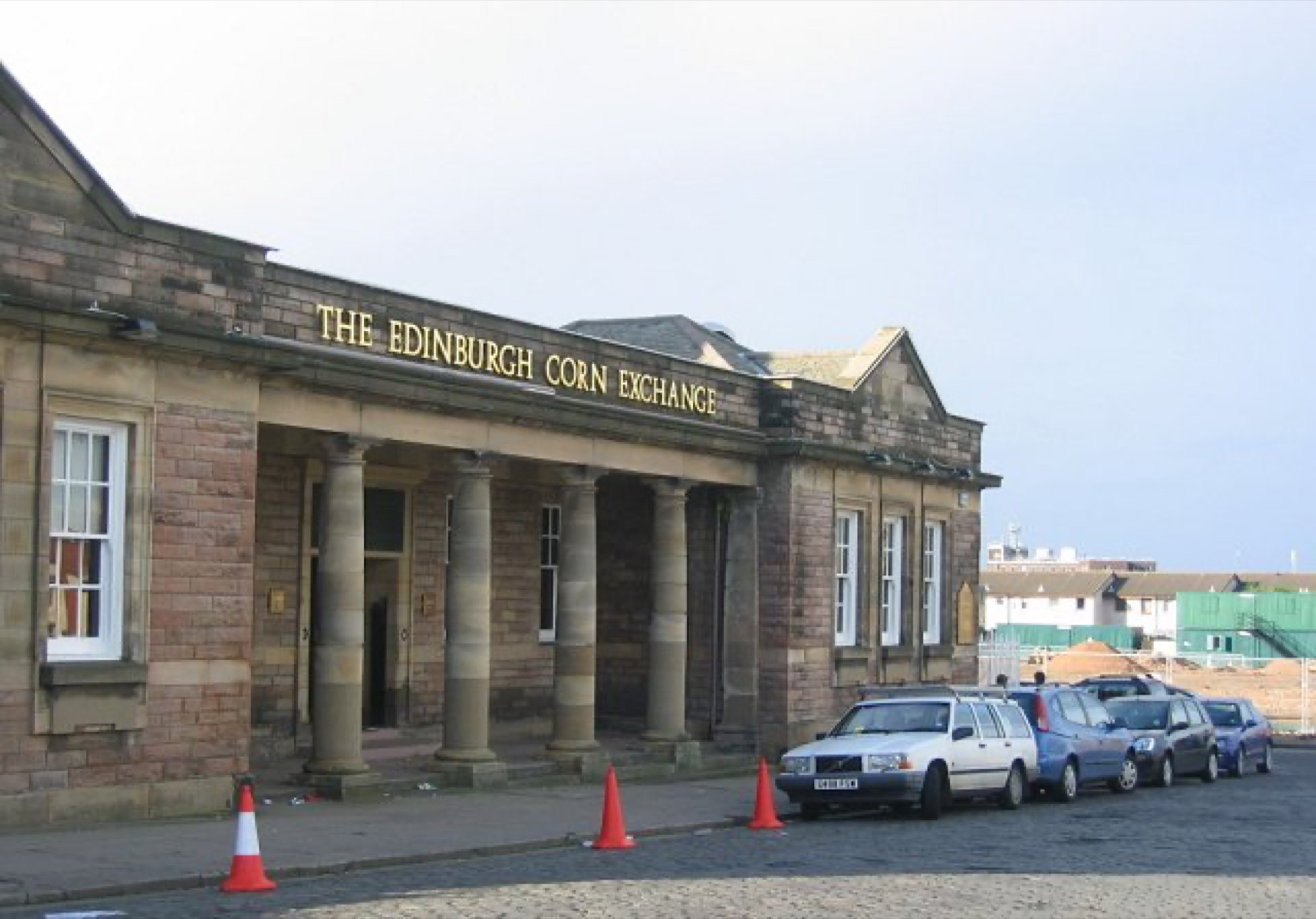
The Edinburgh Corn Exchange traces its architectural lineage through two distinct structures reflecting the evolution of Scotland’s grain trade infrastructure. The original Corn Exchange, erected in 1849 at the western end of the Grassmarket beneath the battlements of Edinburgh Castle, was designed by David Cousin (1809–1878), Edinburgh’s City Superintendent of Works, in the Italian style. As documented in the Dictionary of Scottish Architects, Cousin’s building measured 160 feet by 120 feet, featured a three-storey frontage with a campanile at the north end, and cost £20,000 to construct. This imposing hall hosted both mercantile transactions and public assemblies, including the great Crimean banquet of 1856 and a speech by Prime Minister Gladstone in 1884. The building was tragically demolished in early 1965. The successor Edinburgh Corn Exchange at New Market Road in the Chesser district was designed by City Superintendent of Works James A. Williamson as part of a comprehensive New Markets complex. Officially opened on 23 June 1910 by Archibald Primrose, 5th Earl of Rosebery, the Edwardian neoclassical building was constructed in ashlar stone with a symmetrical main frontage of eleven bays. The central section of five bays features a loggia formed by four Roman Doric columns supporting an entablature, cornice, and parapet, while the projecting end pavilions of three bays each are surmounted by small central pediments. Now a Category B listed building, the structure was refurbished in 1997 as a conference and events venue accommodating up to 3,000 people, as recorded by Historic Environment Scotland.
The decorative program of the Edinburgh Corn Exchange at Chesser reflects the restrained civic grandeur characteristic of Edwardian public architecture in Scotland. James A. Williamson’s neoclassical design employed the Roman Doric order as its principal ornamental vocabulary—the four freestanding columns of the central loggia, supporting a classical entablature with architrave, frieze, and cornice, conveyed the solemnity of commercial purpose through ancient architectural language, as discussed in Miles Glendinning, Ranald MacInnes, and Aonghus MacKechnie’s A History of Scottish Architecture (1996). The ashlar stone facade, with its carefully proportioned sash windows and projecting pavilion pediments, exemplified the functional aesthetic deemed appropriate for agricultural commerce. The earlier Grassmarket Corn Exchange, designed by David Cousin in 1849, had adopted a more eclectic Italian style, its campanile serving as both a visual landmark and a signaling device for market hours. Joseph Mallord William Turner’s graphite sketch The Old Corn Exchange, Edinburgh Grassmarket (1818, Tate collection, D13448) records the even earlier market structures that preceded Cousin’s building, capturing the rough-hewn commercial architecture of the grain trade beneath the castle walls. Within the Chesser building, the great trading hall was designed with practical austerity—ample floor space for grain inspection and sampling, good natural lighting, and robust interior finishes suited to the heavy foot traffic of farmers and merchants. Unlike the ornate Victorian corn exchanges of England described by Nikolaus Pevsner, the Scottish examples favored a more austere neoclassical restraint.
The Edinburgh Corn Exchange’s migration from the medieval Grassmarket to the industrial suburb of Chesser encapsulates the transformation of Edinburgh’s commercial geography across five centuries. The Grassmarket, established by royal charter of King James III in 1477, occupied a dramatic topographic setting in the valley beneath the Castle Rock, as described by Charles McKean in Edinburgh: An Illustrated Architectural Guide (1992). This elongated marketplace served as Edinburgh’s principal grain and livestock trading center from the fifteenth century until the early twentieth century, with horse and cattle markets held weekly from 1477 until 1911. By the mid-nineteenth century, the congestion of the Old Town markets prompted civic authorities to consider relocation. The cattle market had already moved to Lauriston Place in 1843, as recorded in the Canmore database of Historic Environment Scotland. The selection of the Chesser site, some 2.5 miles southwest of the city centre, reflected the logic of Victorian urban planning along railway corridors—the area was served by the Edinburgh Suburban and Southside Junction Railway (opened 1884). As Ian Adams argues in The Making of Urban Scotland (1978), the relocation of markets to purpose-built peripheral sites was a characteristic feature of Scottish municipal improvement. The Gorgie-Chesser district had already attracted the North British Distillery (1885) and numerous breweries, making it Edinburgh’s de facto agro-industrial quarter.
Edinburgh’s grain trade stretches back to the medieval burgh’s earliest commercial foundations. The Grassmarket was first recorded as “the street called Newbygging under the castle” in 1363, and King James III’s charter of 1477 formalized weekly markets there for grain, hay, butter, cheese, and livestock. T.C. Smout, in A History of the Scottish People, 1560–1830 (1969), describes how Scotland’s grain economy centered on oats and bere (a primitive barley), with the fertile Lothian plains serving as the nation’s principal cereal-producing region. Almost half the years in the late sixteenth century saw local or national scarcity, necessitating grain imports from the Baltic—particularly from Poland through Danzig, which Smout terms Scotland’s “emergency granary.” The Scottish Agricultural Revolution, beginning in earnest in the early eighteenth century, transformed the Lothians into highly productive farmland, making East Lothian renowned as the “breadbasket of Scotland.” The formalized grain trade that emerged at the Grassmarket Corn Exchange of 1849 reflected this agricultural prosperity, while the Corn Laws (repealed 1846) had both protected and distorted Scottish grain prices. The subsequent influx of cheap American grain after repeal undermined domestic cereal profitability, as Smout details in A Century of the Scottish People, 1830–1950 (1986), accelerating the consolidation of Scottish farming and the need for efficient, centralized trading facilities such as the New Markets at Chesser.
The Edinburgh Corn Exchange handled the full range of Scotland’s distinctive agricultural produce. Oats—Scotland’s staple grain, famously defined by Samuel Johnson as “a grain which in England is generally given to horses, but in Scotland supports the people”—dominated trading volumes, reflecting centuries of cultivation suited to the country’s cool, wet climate, as discussed in Robert Dodgshon’s Land and Society in Early Scotland (1981). Barley, particularly bere, was the second great cereal commodity, its importance magnified by Scotland’s distilling and brewing industries. Edinburgh itself was, by the late nineteenth century, the most important brewing centre in Britain, with firms such as William Younger & Co. and William McEwan’s Fountain Brewery at Fountainbridge consuming vast quantities of locally grown barley. The North British Distillery, established in Gorgie in 1885 adjacent to the future Corn Exchange site, used malted barley and maize for grain whisky production. Wheat was traded in smaller but growing quantities as Lothian farmers adopted improved varieties during the nineteenth century. Beyond cereals, the exchange handled hay, straw, seeds (particularly rye grass and clover for the improved pastures of the Agricultural Revolution), and turnips—the root crop whose introduction had revolutionized Scottish livestock husbandry by enabling winter feeding. The adjacent cattle market at Gorgie handled livestock—cattle from Ayrshire and the Highlands, and sheep from the Border hills, where farming traditions had sustained wool production since the great Cistercian monasteries of the medieval period exported thousands of sacks annually to Flanders.
Images will be added as the project develops. Photographs by Larry Ng and from research sources.