Dunhuang Monastery Pawnshops
Dunhuang, China · Established c. 5th century CE

This site requires authorization to access.
To request access, contact
william.goetzmann@yale.edu
The Mogao cave complex—known also as the Caves of the Thousand Buddhas—comprises 492 decorated grottoes carved into a mile-long stretch of sandstone cliff face along the Daquan River, approximately twenty-five kilometers southeast of the oasis town of Dunhuang in Gansu Province. As Roderick Whitfield, Susan Whitfield, and Neville Agnew describe in *Cave Temples of Mogao at Dunhuang: Art and History on the Silk Road* (Getty Conservation Institute, 2000), the earliest caves were excavated in 366 CE after the monk Yuezun reportedly beheld a vision of a thousand golden Buddhas radiating from the cliff, and construction continued through successive dynasties—Northern Wei, Sui, Tang, Five Dynasties, Song, Xi Xia, and Yuan—until the fourteenth century. The caves are arranged on five levels and range from intimate meditation cells to vast worship halls spanning multiple stories, their interiors shaped with niches, altars, and antechambers designed to house painted stucco sculptures and to frame elaborate mural programs. The most consequential space for financial history is Cave 17, the so-called Library Cave, a small sealed chamber originally built between 851 and 862 CE as a memorial chapel for the eminent monk Hong Bian. As the International Dunhuang Programme has documented, the Daoist monk Wang Yuanlu, who had taken up residence at the caves to restore them, discovered on 25 June 1900 a walled-up doorway concealed behind a mural in the corridor of Cave 16. Behind it he found a chamber barely three meters square, packed floor to ceiling with more than fifty thousand manuscripts, printed texts, paintings, and textiles dating from the fourth to the eleventh centuries—one of the most important archaeological finds of the twentieth century.
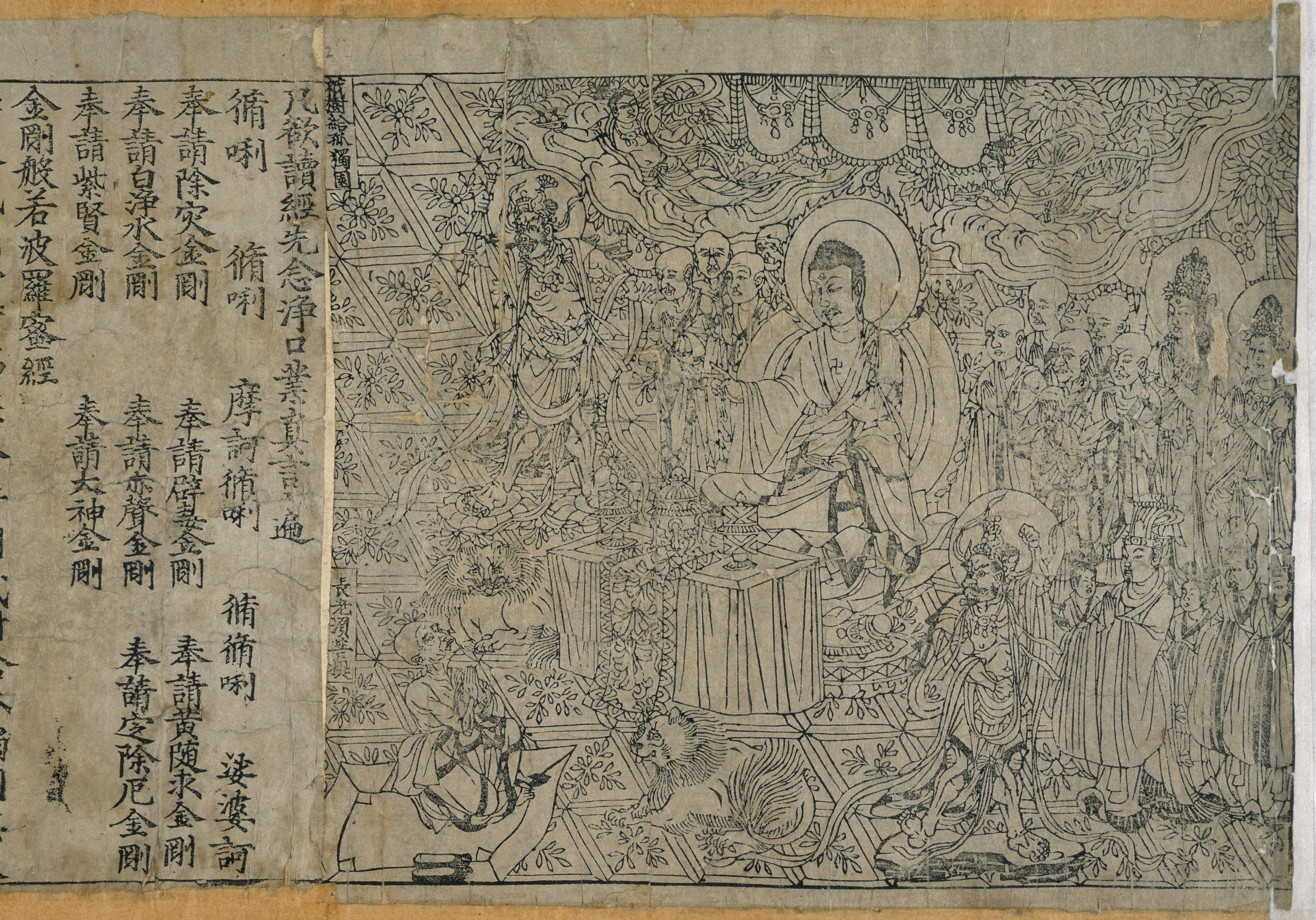
The Mogao grottoes constitute what UNESCO has designated “the largest, most richly endowed, and longest used treasure house of Buddhist art in the world,” containing approximately 45,000 square meters of murals and more than 2,000 painted clay sculptures. As Roderick Whitfield catalogued in his three-volume *The Art of Central Asia: The Stein Collection in the British Museum* (Kodansha, 1982–1985), the wall paintings progress through a millennium of stylistic evolution, from the austere Indo-Gandharan influences of the Northern Wei period to the sumptuous, richly colored paradise scenes of the High Tang. Cave 302 of the Sui dynasty preserves one of the oldest depictions of Silk Road commercial exchange, showing a camel pulling a merchant’s cart. Caves 23 and 156 of the Tang dynasty depict agricultural laborers in the fields and a procession of warriors, while Song-dynasty Cave 61 contains the celebrated cartographic landscape of Mount Wutai, rendered with roads, cities, temples, and caravans. Beyond the murals, the manuscripts retrieved from the Library Cave are themselves extraordinary art objects. The printed Diamond Sutra of 868 CE, now in the British Library (Or.8210/P.2), is the world’s earliest dated complete printed book, featuring an ornate woodblock-printed frontispiece of the Buddha preaching. Illustrated sutras on silk and paper, devotional paintings on hemp, and embroidered Buddhist banners were recovered alongside the financial documents. The dispersal of these treasures began when Aurel Stein acquired approximately seven thousand manuscripts and paintings in 1907 for the British Museum and British Library; Paul Pelliot, whose command of Chinese allowed him to identify the rarest pieces during three weeks of intensive examination in 1908, selected some three thousand Chinese and four thousand Tibetan texts for the Bibliothèque nationale de France. Further acquisitions went to the National Museum in New Delhi, the Hermitage in St. Petersburg, and various Japanese institutions, as Susan Whitfield and Ursula Sims-Williams documented in *The Silk Road: Trade, Travel, War and Faith* (British Library, 2004).
Dunhuang occupies a fertile oasis at the western edge of the Hexi Corridor, the narrow passage between the Qilian Mountains and the Gobi Desert through which all overland traffic between China proper and Central Asia was funneled. As Valerie Hansen demonstrates in *The Silk Road: A New History* (Oxford University Press, 2012), Dunhuang sat precisely at the junction where the northern and southern branches of the Silk Road diverged to skirt the Taklamakan Desert—the northern route passing through Hami and Turfan along the Tian Shan foothills, the southern route departing through the Yangguan gate toward Miran, Khotan, and the Kunlun piedmont. The Han dynasty established a military commandery at Dunhuang in 111 BCE, constructing garrison walls and watchtowers along the frontier to protect trade caravans and diplomatic missions. The town itself lay some twenty-five kilometers northwest of the Mogao cliff face, sustained by snowmelt irrigation from the Danghe and Shule rivers. Five kilometers south of the town rise the Mingsha Dunes—the “Singing Sand Mountains”—whose shifting golden ridges reach heights of over 1,600 meters and have been celebrated in Chinese literature since the Han dynasty. At their base, the crescent-shaped Yueyaquan spring has persisted for millennia, fed by subterranean aquifers. Merchants of diverse origins—Sogdian, Persian, Indian, Turkic, and Chinese—converged at Dunhuang, and the UNESCO Silk Roads Programme notes that the city’s monasteries and markets served as nodes of cultural and commercial exchange from the first through the eleventh centuries. The Mogao caves themselves functioned as a spiritual counterpart to the secular town: donors from the garrison, from merchant families, and from the local gentry sponsored individual caves, inscribing their names and titles on the walls, linking piety to economic patronage in ways that the cave’s financial manuscripts would later confirm.
The financial documents preserved in Cave 17 reveal that Buddhist monasteries at Dunhuang operated as sophisticated lending institutions across several centuries. As Jacques Gernet demonstrated in his foundational study *Buddhism in Chinese Society: An Economic History from the Fifth to the Tenth Centuries* (Columbia University Press, 1995), monasteries accumulated capital through the “inexhaustible treasury” (wujinzang) system, whereby pious donations were treated as permanent endowments whose principal was lent at interest to generate perpetual income for the sangha. The logic was theological as well as financial: because the donated capital continued to earn revenue indefinitely, the merit accruing to the donor was itself inexhaustible. Lien-sheng Yang, in his landmark article “Buddhist Monasteries and Four Money-Raising Institutions in Chinese History” (*Harvard Journal of Asiatic Studies*, 1950), argued that the pawnshop as a credit institution first appeared in Buddhist monasteries around the fifth century, alongside mutual financing associations, auction sales, and lottery-ticket sales—all four innovations traceable to monastic origins. Among the Dunhuang manuscripts, approximately seventy grain-loan contracts survive, documenting advances of wheat, millet, and beans from monasteries including Yongshou Temple, Yongkang Temple, and Lingtu Temple. Interest on these seed loans typically ran at fifty percent per annum, due at the harvest. Borrowers were required to pledge collateral valued at twice the loan amount, and written contracts were executed before witnesses specifying default penalties, including seizure of movable property. Gernet’s analysis drew on population registers, itemized construction accounts, ordination certificates, wills, deeds, and auction receipts from the Dunhuang cache. Paul Pelliot, who selected the manuscripts for Paris in 1908, was particularly drawn to documents relating to monastic administration and finance; his acquisitions thus preserved a disproportionate share of the economic record. Valerie Hansen’s *Negotiating Daily Life in Traditional China: How Ordinary People Used Contracts, 600–1400* (Yale University Press, 1995) further analyzed Dunhuang-era contracts as evidence of how ordinary people navigated legal and economic relationships. More recently, Cuilan Liu’s study “Merit-Making or Financial Fraud? Litigating Buddhist Nuns in Early Tenth-Century Dunhuang” (*Journal of the International Association of Buddhist Studies*, 2018) examined manuscript P. 4810v, a legal dispute between two nuns over lending activities, demonstrating that monastics were legally active participants who did not hesitate to seek adjudication in secular courts when financial conflicts arose.
The monasteries at Dunhuang lent three principal commodities: grain (wheat, millet, and beans), cloth (silk and hemp textiles), and cash (copper coins). Grain loans, the most common form documented in the surviving contracts, were advanced as seed before the planting season and repaid after the autumn harvest at annual interest rates of approximately fifty percent, as Gernet established from the Dunhuang evidence. Cloth loans functioned similarly, with bolts of silk or hemp serving both as the medium of lending and as a unit of account—Valerie Hansen and Xinjiang Rong, in their study of how Turfan residents used textiles as money, showed that fabric served as currency across Silk Road communities from the third through the eighth centuries. Pawn transactions required borrowers to deposit movable property—tools, clothing, livestock, or household goods—as security, with collateral valued at twice the amount borrowed; unredeemed items were forfeit after stipulated deadlines. The changshengku, or “long-life treasuries,” managed these revolving funds as permanent institutional capital. What distinguished monastic lending from secular usury was its doctrinal framework: loans generated income to sustain the sangha, and the interest earned from endowed capital was understood as the continuing fruit of a donor’s religious merit, as Lien-sheng Yang explained. Beyond internal lending, the oasis town of Dunhuang channeled the full spectrum of Silk Road commodities. The UNESCO Silk Roads Programme records that goods produced locally and traded through Dunhuang included silks of many varieties, cotton, wool, fur, tea, ceramics, medicine, fragrances, jade, dried fruits, and embroidery, while imports arriving from the west encompassed Persian brocades, metalware, incense, lapis lazuli from Afghanistan, agate from India, amber from northeastern Europe, coral, and pearls from Sri Lanka. Sogdian merchant networks, which dominated trans-Asian trade for centuries, dealt in gold, silver, gemstones, camphor, and musk, passing through Dunhuang as they moved between Samarkand and Chang’an.