Dunedin Stock Exchange (Exchange Building)
Dunedin, New Zealand · Established Brokers' association 1867; stock exchange 1893; occupied the Exchange Building from May 1900
This site requires authorization to access.
To request access, contact
william.goetzmann@yale.edu
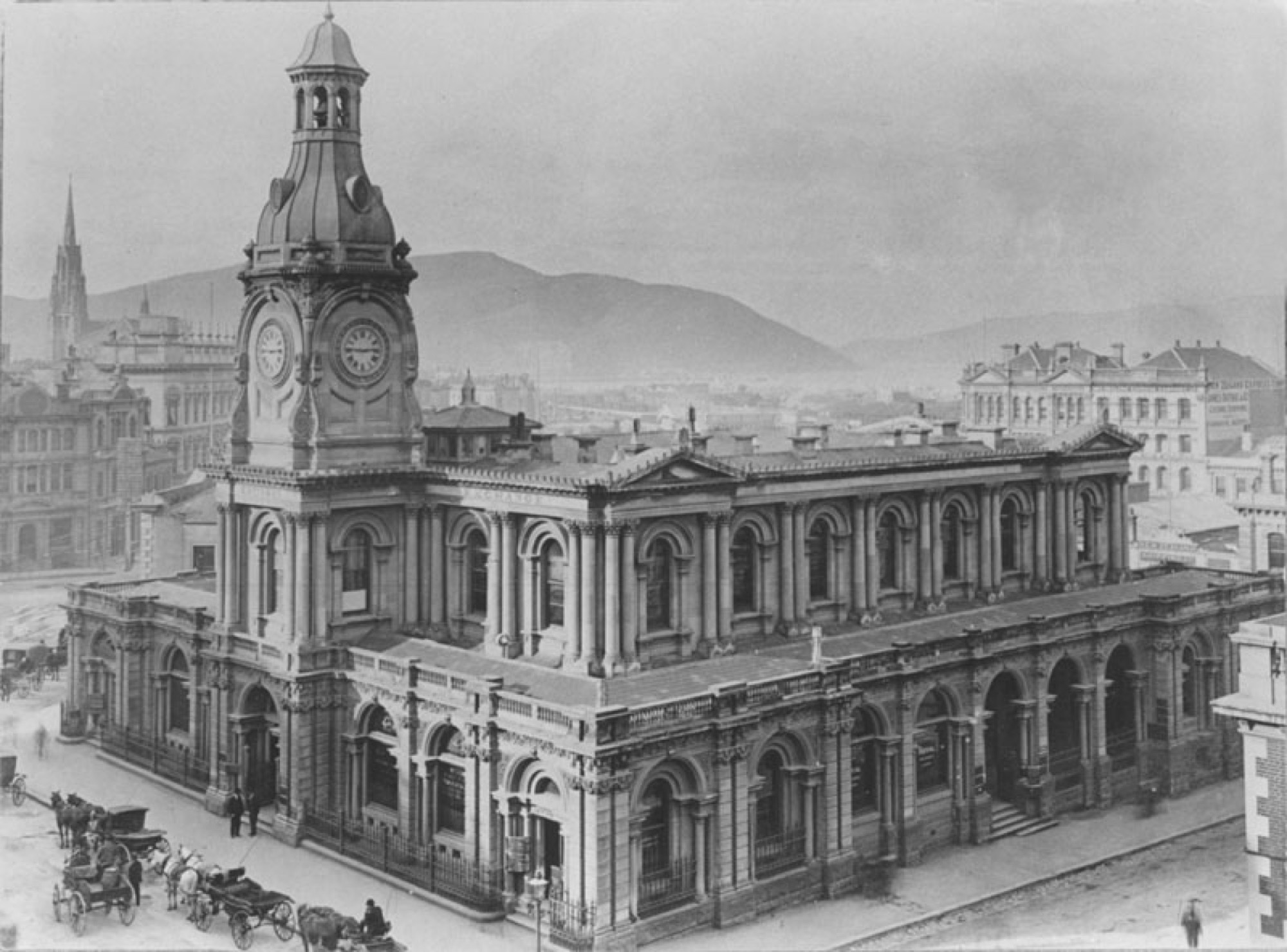
The home of the Dunedin Stock Exchange was one of colonial New Zealand's most admired public buildings, an Oamaru-stone pile that dominated the lower end of Princes Street. It was designed by the architect William Mason, co-founder of the long-lived Dunedin firm Mason & Wales, and built between roughly 1864 and 1868, reportedly the first major Dunedin building to be faced in the creamy Oamaru limestone that would come to define the city's Victorian architecture (Built in Dunedin, 'Exchange Building, Princes Street'). Commissioned as Dunedin's new post office, the structure proved far too elaborate for that purpose, and Mason himself described its manner as 'Palladian with Italian and Grecian features' — a graceful composition of Grecian columns, moulded arches and a tall clocktower (Built in Dunedin, s.v. 'William Mason'). It was this richness that ensured the building a varied afterlife and, ultimately, a place at the symbolic centre of the city.
As a working commercial building rather than a temple of fine art, the Exchange's visual interest lay in its carved Oamaru-stone fabric: a Palladian street front articulated by engaged Grecian columns, rusticated and moulded arcading, and an emphatic clocktower that served as a public timepiece for the surrounding business quarter (Built in Dunedin, 'Exchange Building, Princes Street'). Period photographs held by Te Ara, the Hocken Collections and Te Papa record the ornamented facade and the bustling stock-exchange precinct around it, and the building's clocktowered silhouette became a recurring motif in views of nineteenth- and early twentieth-century Princes Street (Te Ara Encyclopedia of New Zealand, 'Dunedin exchange building').
The building stood at the junction of Princes Street and the open space some 400 metres south of the Octagon that Dunedin still calls 'The Exchange'. So completely did the structure define its surroundings that the precinct took its name directly from the stock exchange that occupied it, and the name has outlived the building by more than half a century (The Exchange, Dunedin, Wikipedia). In the late nineteenth century this was the commercial heart of the wealthiest city in New Zealand: the gold rushes had made Dunedin the colony's largest urban centre and its financial capital, and the Exchange sat amid the banks, brokers' offices and warehouses of Princes Street (Te Ara Encyclopedia of New Zealand, 'Stock market: First stock exchanges').
Organised share trading in Dunedin began in 1867, when about a dozen brokers formed the Dunedin Brokers' Association to deal once a week in mining stocks and in bank, insurance, shipping and government securities; this body became a formal stock exchange in 1893 (Te Ara Encyclopedia of New Zealand, 'Stock market: First stock exchanges'). The Otago gold-dredging mania of the 1890s produced New Zealand's first great share boom — dozens of dredging companies were floated, seat prices were raised and two call-overs a day were held — and the prosperity allowed the exchange to move out of cramped quarters into the grand Princes Street building in May 1900, taking it over after the structure had served successively as the Otago Museum, the first home of the University of Otago, and offices of the Colonial Bank and the Bank of New Zealand (Te Ara Encyclopedia of New Zealand, 'Dunedin exchange building'). The dredging bubble collapsed almost at once: production fell from late 1900, companies failed, and the rival Otago Exchange merged into the Dunedin exchange in 1902. The building was bought by the government in 1954 and, despite its symbolic stature, demolished in 1969 for the John Wickliffe House office block — a loss so keenly felt that it is widely credited with awakening Dunedin's modern heritage-preservation movement (Otago Daily Times, '‘Foundation’ building long lost'; The Exchange, Dunedin, Wikipedia).
Dunedin's brokers dealt from the outset in two broad classes of paper: speculative mining stocks and the more sober securities of banks, insurance and shipping companies and government debentures (Te Ara Encyclopedia of New Zealand, 'Stock market: First stock exchanges'). The exchange's defining business, however, was the gold-dredging share — scrip in the companies that worked floating bucket-dredges through the gravels of the Clutha, Shotover and other Otago rivers. By the turn of the twentieth century such dredging companies were floated by the score in Dunedin, and the frenzy of trading in their shares both filled the new Princes Street rooms and, when prices broke after 1900, emptied them again, leaving the exchange to settle back into the steadier diet of bank, insurance, shipping and pastoral-company securities that sustained Otago's regional capital market (Te Ara Encyclopedia of New Zealand, 'Dunedin exchange building').
Images will be added as the project develops. Photographs by Larry Ng and from research sources.