Dundee Stock Exchange
Dundee, Scotland · Established 1879
This site requires authorization to access.
To request access, contact
william.goetzmann@yale.edu
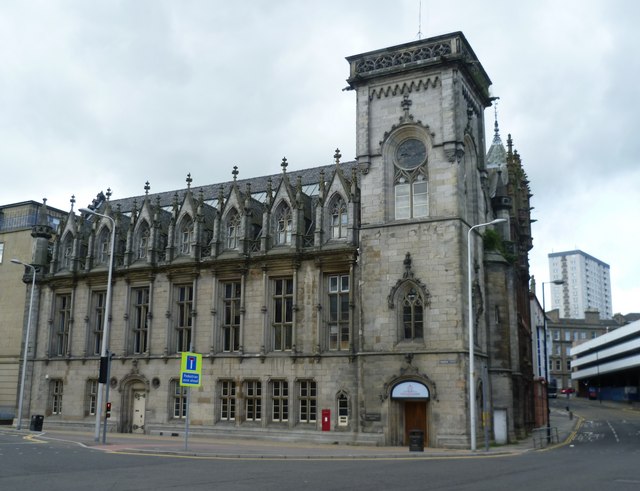
The Dundee Royal Exchange, which housed the city’s stock exchange from 1879, was designed by the Edinburgh architect David Bryce (1803–1876) and erected between 1854 and 1856 on Panmure Street, adjacent to what is now the McManus Galleries. Bryce, who had trained under William Burn and become Scotland’s leading practitioner of the Scottish Baronial style, here adopted a quite different idiom: Flemish Gothic, modelled on the great cloth halls of the Low Countries such as the Lakenhalle at Ypres. The building is constructed in cream stugged ashlar sandstone with rubble and ashlar dressings to the rear elevations, under a grey slate roof. Historic Environment Scotland’s Category A listing (LB25507, designated 1965) describes a two-storey-and-attic structure with a three-stage corner tower, featuring “buttressed and pedimented dormers breaking through open-work parapet with crocketted finials and traceried pointed-arch windows.” The ground floor displays cross windows with roll-moulded architraves and shouldered heads, while the first floor exhibits banded colonette architraves and moulded cornices. Bryce’s original design, preserved in an 1851 watercolour, envisioned a two-tier octagonal extension to the tower capped by an ogival crown spire—a feature symbolic of national freedom in Scottish architectural tradition. However, the building was erected on the Meadows, historically a millpond and bleaching green fed by the Scouring Burn, and the waterlogged foundations proved unable to support the intended weight. As the Dundee Design House records, the foundations “slipped severely” and a Gothic parapet replaced the planned crown spire. Parts of the structure still tilt at a notable angle. In 1881–1882, the architect John Murray Robertson (1844–1901)—described by contemporaries as “the most progressive of the late Victorians” in Dundee—added a new market hall for the Chamber of Commerce, and further additions were made by James Findlay in 1910. The principal first-floor hall originally featured a double hammer-beam roof, though this was lowered and partitioned during internal modifications by T. Lindsay Gray in 1954.
The decorative programme of the Dundee Royal Exchange reflects the Continental Gothic vocabulary that David Bryce adopted from Flemish cloth halls, though the building’s subsidence problems curtailed the most ambitious ornamental schemes. The Panmure Street facade displays an intricate array of carved stonework: gablet-coped crowstepped gables, crocketted finials atop the dormers, and traceried pointed-arch windows that recall the Late Gothic commercial architecture of Bruges and Ghent. The ground-floor arcade features depressed-arch moulded doorcases and cross windows with roll-moulded architraves and shouldered heads—decorative elements that the Historic Environment Scotland listing describes in detail. At the first-floor level, banded colonette architraves with moulded cornices frame the principal windows, lending a rhythmic elegance to the facade. The open-work parapet with its buttressed and pedimented dormers constitutes the building’s most distinctive ornamental feature, serving as a visual crown that compensates for the lost spire. Bryce’s 1851 watercolour design drawing, now reproduced through the Bridgeman Art Library, reveals the full ambition of the original decorative scheme: the proposed crown spire would have rivalled those of St Giles’ Cathedral in Edinburgh and King’s College Chapel in Aberdeen as expressions of Scottish architectural identity. Inside, the principal first-floor exchange hall—where merchants gathered to trade and brokers later conducted stock dealings—was distinguished by its double hammer-beam roof, an unusually elaborate timber construction for a commercial building that referenced the great medieval halls of England and Scotland. John Murray Robertson’s 1881–1882 market hall addition extended the decorative vocabulary into the commercial spaces used by the Chamber of Commerce. The building’s ornamental language as a whole constituted a deliberate statement of Dundee’s mercantile ambition: the city’s textile magnates, enriched by the flax and jute trades, commissioned an exchange that would proclaim their commercial stature in the carved stone idiom of Europe’s greatest trading halls.
The Royal Exchange occupies a strategic site on Panmure Street at the edge of the Meadows—the reclaimed marshland that Dundee’s civic leaders designated as the city’s new institutional quarter in the early nineteenth century. Before the exchange was built, Dundee’s merchants had conducted business in a succession of informal venues: first at the Merchant’s Walk in the Green Market, then from 1778 in a rented room at the Trades Hall on the High Street that they named “The Dundee Exchange Coffee-room and Reading-room,” and from 1828 in a purpose-built Exchange on Shore Street at Exchange Street, designed by the architect George Smith with a principal hall measuring 73 by 36 feet. The decision in 1850 to build a grander exchange on the Meadows reflected the explosive growth of Dundee’s textile economy. The city’s population quadrupled from approximately 45,000 in 1841 to 165,000 by 1901, driven by the jute industry that earned Dundee the sobriquet “Juteopolis.” At the industry’s peak in the 1860s and 1870s, over 50,000 workers laboured in more than sixty mills scattered across the city, their tall chimneys—most famously Cox’s Stack at Camperdown Works, at 282 feet the chimney of the largest jute works in the world—defining the urban skyline. The Royal Exchange stood at the centre of a commercial district that included the McManus Galleries (designed by George Gilbert Scott, 1867), banking houses along Reform Street, and shipping offices serving the harbour. Dundee’s waterfront location on the Firth of Tay was integral to its commercial identity: Baltic merchants who imported flax from St Petersburg and Gdańsk, then exported rough fabric to Charleston, South Carolina, had previously met at a Baltic Coffee House near the harbour before relocating to the exchange. The Scouring Burn, which flowed through the Meadows and had historically powered waulking and scouring processes essential to the textile trade, was gradually enclosed as the institutional quarter developed around the exchange, the galleries, and the Albert Institute.
The Dundee Stock Exchange Association was formally constituted in 1879, establishing organised securities trading in a city whose wealth derived overwhelmingly from the jute and linen industries. As William Arthur Thomas documents in “The Provincial Stock Exchanges” (1973), the exchange was founded to provide “an investment service for shareholders of local shipping and associated companies, certainly not for speculative business.” By 1880, twelve companies were listed on its boards. The exchange’s creation was inseparable from the extraordinary financial innovation that had emerged in Dundee during the preceding decade. In 1873, Robert Fleming (1845–1933)—who had entered the textile trade at age thirteen as a clerk at Messrs Edward Baxter and Son, one of Dundee’s great linen dynasties—co-founded the Scottish American Investment Company, the first Scottish investment trust, to channel jute fortunes into American railroad bonds. As John Newlands records in “Put Not Your Trust in Money” (1997), the initial offering of £150,000 was so oversubscribed that the prospectus was withdrawn and reissued at £300,000; within two years Fleming had £1.1 million under management. By 1882, according to the “Dundee Yearbook,” the city had invested some £3 million in investment and mortgage companies. Ranald Michie’s “Money, Mania and Markets: Investment Company Formation and the Stock Exchange in Nineteenth-Century Scotland” (1981) places Dundee’s exchange within a broader pattern of Scottish provincial markets that emerged to service the capital generated by industrialisation. The Dundee Investment Company, the Dundee Mortgage and Trust, and the Oregon and Washington Trust merged in 1888 to form the Alliance Trust, as Charles Munn chronicles in “Investing for Generations: A History of the Alliance Trust” (2013). Claire Anderson’s research at the University of Dundee, published as “Scottish Cowboys and the Dundee Investors,” traces how jute capital flowed into American ranching, including the Matador Land and Cattle Company’s 800,000 acres in the Texas Panhandle. On 2 January 1964, the Dundee exchange merged with Glasgow, Edinburgh, and Aberdeen to form the Scottish Stock Exchange, continuing to operate as a local branch until 1971 when all four local floors closed. In 1973, the Scottish Stock Exchange was absorbed into the London Stock Exchange. The Dundee Stock Exchange Association’s records are preserved at the University of Dundee Archive Services.
The securities traded on the Dundee Stock Exchange reflected the city’s unique position as the world capital of the jute industry and, remarkably, as one of Britain’s most prolific exporters of investment capital. The initial listings in 1879–1880 centred on shares in local jute manufacturing firms—above all Cox Brothers, whose Camperdown Works at Lochee was the largest jute factory in the world, and Baxter Brothers, whose Dens Works had been the world’s largest linen works since the 1840s. Shipping companies serving the flax and jute routes between Dundee, the Baltic ports, and Calcutta—the source of raw jute—also featured on the exchange’s lists. What distinguished Dundee from other provincial exchanges, however, was the extraordinary prominence of investment trust and mortgage company securities. Robert Fleming’s Scottish American Investment Company (1873), which invested primarily in American railroad bonds and public utilities, was the prototype for a wave of Dundee-based trusts that included the Second Scottish American Trust, the Dundee Investment Company, the Dundee Mortgage and Trust Investment Company, and the Oregon and Washington Trust. These vehicles, as Ranald Michie analyses in “Money, Mania and Markets” (1981), pooled capital from jute magnates, ship owners, and landed gentry—including the Earl of Airlie—and deployed it across American railroads, cattle ranches, prairie mortgages, and even Hawaiian sugar plantations. The 1888 merger that created the Alliance Trust consolidated several of these entities into what Charles Munn describes as one of Scotland’s most enduring financial institutions. By the mid-1890s, Dundee residents had exported approximately £5 million to American investments alone. The exchange also traded shares in local banking institutions, gas and water utilities, and Dundee Corporation stocks. By 1914, Scotland hosted twenty-nine registered investment trusts with around £30 million invested, predominantly abroad—a remarkable figure for a small nation, and one in which Dundee’s exchange played a disproportionate role as the marketplace where trust shares changed hands among the city’s close-knit community of textile industrialists and merchant investors.
Images will be added as the project develops. Photographs by Larry Ng and from research sources.