Dublin Stock Exchange
Dublin, Ireland · Established 1793
This site requires authorization to access.
To request access, contact
william.goetzmann@yale.edu
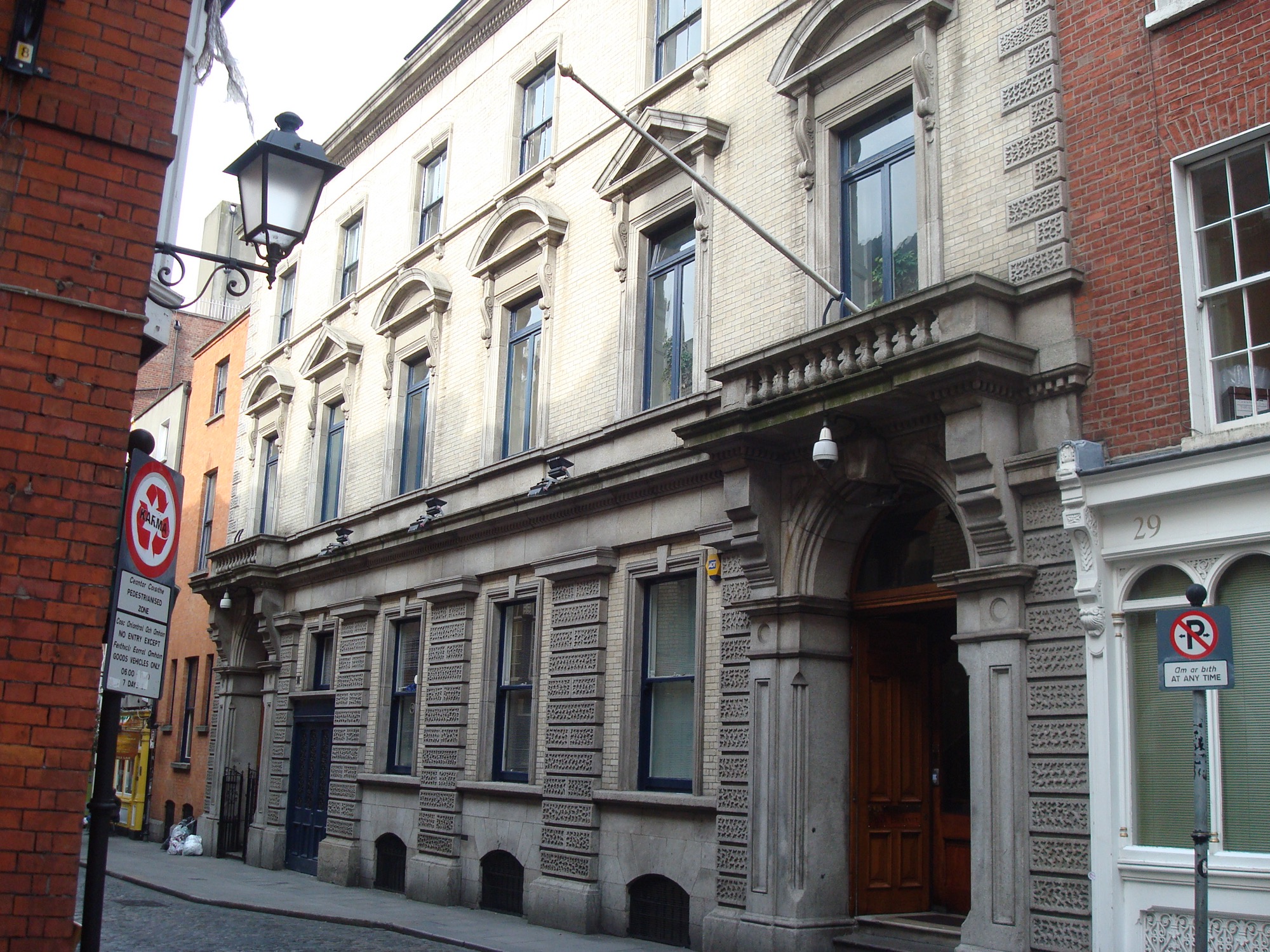
The Dublin Stock Exchange occupied three successive buildings over its history, each reflecting the evolving ambitions of Ireland’s financial community. The earliest trading took place informally at the Old Exchange Coffee House on Dame Street from 1793, part of a network of coffeehouses—including the Little Dublin Coffee House and the Royal Exchange Coffee House—that served as unofficial bourses for Dublin’s merchants before purpose-built facilities existed. In 1799, the exchange moved into the newly completed Commercial Buildings on Dame Street, designed by the architect Edward Parke and erected between 1796 and 1799 by a proprietary company of 400 shareholders holding £50 shares each. As documented in the Dictionary of Irish Architects, Parke served as architect to the Commercial Buildings Company for over forty years. The structure was a fine but austere seven-bay, three-storey granite-fronted building arranged around a small quadrangle, with a principal facade on College Green featuring a central entrance flanked by Ionic columns. The north side of the quadrangle housed the Stock Exchange and merchants’ offices, while the east and west wings contained brokers’ rooms. A news room measuring sixty feet long and twenty-eight feet wide served the Chamber of Commerce, and a handsome coffee room was attached to a hotel. A pedestrian shortcut ran through the building and courtyard connecting Fownes Court to Cope Street. The Commercial Buildings also housed the Ouzel Galley Society from 1805, an influential merchants’ arbitration body founded in 1705, whose carved stone ship plaque dated 1799 adorned the College Green facade. A design by Thomas Sherrard with an additional storey survives in the archives of the Wide Streets Commissioners. The Commercial Buildings were demolished in the 1970s to make way for Sam Stephenson’s controversial Central Bank of Ireland; though the stonework was reportedly dismantled and numbered, only a facsimile was rebuilt. Following a boom in trading associated with the rise of railway and canal securities, the exchange required larger premises and in 1878 moved to a purpose-built building at 24–28 Anglesea Street in the Temple Bar district, designed by the firm of Millar & Symes and constructed by George Moyers between 1877 and 1879. The National Inventory of Architectural Heritage (Buildings of Ireland) records it as a six-bay, three-storey structure over a raised basement in the Italianate style typical of financial institutions erected during Dublin’s period of renewed prosperity in the second half of the nineteenth century. The facade combines carved granite with yellow brick to striking textural and tonal effect. Architectural details include round-headed openings with carved granite surrounds and keystones, vermiculated granite pilasters, a dentillated cornice and entablature, and alternating triangular and segmental pediments on scrolled brackets at the first-floor windows. The high level of craftsmanship in the carved doorcases and consoles is noted in the NIAH survey. Millar & Symes—the partnership of Richard Chaytor Millar and William John Symes, formed in 1874—were also architects to the Bank of Ireland and responsible for numerous bank branches across the country. The exchange remained at Anglesea Street until 2000, and in a recent expansion designed by Henry J. Lyons, the historic Armoury building on Foster Place—a Palladian structure originally serving as a guarded entrance to the Parliament House—was unified with the Anglesea Street premises to form a single integrated campus.
The decorative program of the Dublin Stock Exchange buildings reflects the restrained classicism characteristic of Irish commercial architecture. At the Commercial Buildings on Dame Street (1796–1799), designed by Edward Parke, ornament was deliberately austere: the principal facade on College Green was of hewn stone with a central entrance supported by Ionic columns, but the remaining elevations were described as “wholly un-ornamented.” The most notable decorative element was the carved stone plaque of a sailing ship, dated 1799, affixed to the brickwork panel on the College Green facade—a reference to the Ouzel Galley Society, the merchants’ arbitration body that met in the building from 1805. As Lisa-Marie Griffith has documented in her study of the Ouzel Galley Society in the eighteenth century (published by Routledge), the society’s naval imagery—its members bore titles such as captain, coxswain, and boatswain—was emblematic of Dublin’s mercantile identity and its deep connections to maritime trade. The Anglesea Street building (1877–1879) by Millar & Symes offered a richer decorative vocabulary within the Italianate idiom. The National Inventory of Architectural Heritage describes extensive carved granite ornament: the doorcases feature elaborately carved surrounds with prominent keystones, flanked by carved granite pilasters and brackets supporting a balustrade. Vermiculated rustication on the pilasters—a technique of carving stone to resemble worm-eaten textures—adds a distinctively tactile quality. The granite entablature carries a dentillated cornice, and the first-floor windows are framed by alternating triangular and segmental pediments resting on scrolled brackets, a hallmark of the Italianate palazzo style adapted for Victorian commercial architecture. The interplay between the rough-hewn granite and the smooth yellow brick of the facade creates the tonal variations noted in the NIAH survey. A painting of the Dublin Stock Exchange dated 1924, held in the Google Arts & Culture collection, records the interior character of the trading floor during the early twentieth century. The decorative programs of both buildings served to communicate institutional solidity and mercantile respectability rather than artistic exuberance—a visual language of commerce that distinguished Dublin’s financial quarter.
The Dublin Stock Exchange’s successive locations trace the axis of the city’s commercial power, running from College Green and Dame Street southward into the Temple Bar district, all within a few hundred meters of one another and intimately connected to Dublin’s political and financial heart. College Green, where the Irish Parliament House (begun 1729 by Edward Lovett Pearce, with later additions by James Gandon) dominated the streetscape, became the epicenter of Irish political and financial life in the eighteenth century. After the Act of Union dissolved the Irish Parliament in 1800, the Bank of Ireland purchased the Parliament House in 1803, and banking quickly emerged as the defining use of the College Green area. Dame Street, widened by the Wide Streets Commission beginning in 1777 as part of a campaign to rival the great boulevards of Paris, connected College Green to Dublin Castle and the Royal Exchange (now City Hall), the latter built between 1769 and 1779 to designs by Thomas Cooley as the first public building in Ireland in the neoclassical style. The Guild of Merchants had commissioned the Royal Exchange as a hub for commercial transactions, including currency exchanges between Irish and British sterling. The Wide Streets Commission—established by Act of Parliament in 1758 and staffed by Dublin merchants influenced by Continental town planning—reshaped Dame Street with new facades, better sight lines, and improved carriage access, concentrating financial institutions along the thoroughfare. The Commercial Buildings (1796–1799), where the stock exchange first took permanent quarters, stood at the junction of Dame Street and College Green, with rear access onto Cope Street. When the exchange moved to Anglesea Street in 1878, it entered the Temple Bar district—a neighborhood whose character had been shaped by the arrival of the Custom House in 1707, which drew warehouses, merchants, and commercial activity to the area between Dame Street and the River Liffey. Anglesea Street itself appears on John Rocque’s 1756 survey of Dublin, and by the late nineteenth century it had become part of a compact financial district that included the Bank of Ireland on College Green, the Royal Exchange on Dame Street, and numerous brokerage offices. The proximity to the River Liffey—Dublin’s historic commercial artery connecting the port to the city center—reinforced the district’s mercantile character, even as the Custom House relocated downstream to Gandon’s new building on the North Quays in 1791.
The Dublin Stock Exchange emerged in 1793 as an informal marketplace at the Old Exchange Coffee House on Dame Street, where merchants and brokers gathered to trade securities, bills of exchange, and commodities. As W. A. Thomas documented in The Stock Exchanges of Ireland (Francis Cairns Publications, 1986)—the definitive study, based on the surviving records of the Dublin, Cork, and Belfast exchanges as well as archives of the Bank of Ireland and the Bank of England—the formation of the exchange was preceded by the growth of the Irish National Debt from the mid-eighteenth century and the problems of government borrowing in peace and war. The Irish government had employed tontines in 1773, 1775, and 1777 and state lotteries beginning in 1780 as mechanisms for raising revenue, creating a class of tradeable financial instruments that demanded an organized marketplace. Formal legal recognition came with the Stock Exchange (Dublin) Act of 1799 (39 Geo. 3, c. 60), enacted by the Irish Parliament to regulate stockbrokers, curb fraudulent practices, and establish rules for membership and trading conduct. Thomas records that the recently established Dublin banker John Claudius Beresford and the Chancellor of the Exchequer Isaac Corry introduced a bill “for the better Regulation of Stock Brokers,” which was substantially amended and reintroduced by Beresford and another Dublin banker, Sir William Gleadowe-Newcomen, becoming law on 1 June 1799. The Act transformed the exchange from ad hoc coffeehouse dealings into an incorporated entity under Irish law. The Act of Union of 1800, which dissolved the Irish Parliament and merged it with Westminster, had profound consequences for Dublin’s financial markets. While the loss of legislative independence diminished Dublin’s political significance, it also created an important trade in government securities between London and Dublin as the Irish National Debt was gradually consolidated with the British. Thomas’s account details how this intermarket trade became a defining feature of Dublin broking firms throughout the nineteenth century. In the 1830s and 1840s, the exchange experienced a boom in canal and railway securities, mirroring the speculative mania gripping British markets. The Great Famine of 1845–1852 might have been expected to devastate the Irish stock market, but as Charles R. Hickson and John D. Turner demonstrated in their pioneering study “Pre- and post-famine indices of Irish equity prices” (European Review of Economic History, 2008), the market appears to have been relatively unaffected by the Famine and increased significantly in value in the post-Famine period, consistent with growing demand for financial assets and the rapid commercialization of the Irish economy. Their companion study, “The rise and decline of the Irish stock market, 1865–1913” (European Review of Economic History, 2005), showed that equity prices grew steadily until 1897 before declining markedly, a pattern the authors attributed to political developments including the Home Rule movement. Richard S. Grossman, Ronan C. Lyons, Kevin O’Rourke, and Madalina Ursu constructed “A monthly stock exchange index for Ireland, 1864–1930” (European Review of Economic History, 2014), encompassing 118 equity securities issued by 94 companies. Their index reveals that nominal equity prices doubled between 1864 and 1898, fell 25 percent by 1914 (in contrast to rising London prices), and experienced boom-bust cycles during the war and independence period. Research on co-movements between the Irish and London markets (Financial History Review) using GARCH models confirmed significant volatility spillovers from London to Ireland, with political events—particularly the independence movement—contributing to divergent performance in the final decades of the union. After Irish independence in 1922, the Dublin Stock Exchange continued as a distinct institution, maintaining close but increasingly differentiated ties with London. The exchange merged with the International Stock Exchange of the United Kingdom and Ireland in 1973 but re-established itself as an independent entity, the Irish Stock Exchange, in 1995. It was acquired by Euronext in 2018.
The earliest trading on the Dublin Stock Exchange centered on Irish government debt and canal company shares. As W. A. Thomas detailed in The Stock Exchanges of Ireland (1986), the growth of the Irish National Debt from the mid-eighteenth century created a substantial market in government securities. The Irish Parliament had raised funds through innovative instruments including three state-operated tontines in 1773, 1775, and 1777—whereby subscribers received annuities tied to nominated lives, with payments increasing as nominees died—and state lotteries from 1780 onward, as documented by Rowena Dudley in The Irish Lottery, 1780–1801 (Four Courts Press, 2005). These instruments, along with conventional government bonds and debentures, formed the core of early trading at the Old Exchange Coffee House. Canal shares were among the first corporate securities actively traded. The Grand Canal Company, established in 1772, and the Royal Canal Company offered shares to finance Ireland’s inland waterway network, and these securities attracted significant speculative interest. In the 1830s and 1840s, railway shares became the dominant speculative instrument, as Irish railways expanded rapidly—the Midland Great Western Railway, authorized by Parliament in 1845, eventually purchased the Royal Canal itself. Thomas’s account records the details of this railway boom and its impact on exchange practices. Bank stocks constituted another major category. The Bank of Ireland, chartered in 1783 and headquartered in the former Parliament House on College Green from 1803, was a cornerstone of the market. A growing number of joint-stock banks—the Provincial Bank of Ireland, the National Bank of Ireland (founded by Daniel O’Connell), the Hibernian Bank, and the Royal Bank of Ireland—were floated on the exchange during the first half of the nineteenth century. Gas companies, mining concerns, and insurance companies followed as limited liability became more widely adopted. The Grossman, Lyons, O’Rourke, and Ursu index (European Review of Economic History, 2014) provides the most comprehensive quantitative picture: their dataset of over 35,000 price-year observations from the Investor’s Monthly Manual covers 118 equity securities issued by 94 companies, with sector-specific indices for railways, financial services, and miscellaneous industrial and retail companies. Railway equities, which had trebled between the mid-1860s and the turn of the century, fell sharply during the 1910s and 1920s. Throughout the nineteenth century, the exchange also facilitated an important arbitrage trade in government securities between Dublin and London, a cross-market activity that defined many Dublin broking firms’ business models. By the late nineteenth century, the Dublin list included brewing companies, shipping firms, and utilities alongside the traditional categories of government debt, bank stocks, and railway shares.
Images will be added as the project develops. Photographs by Larry Ng and from research sources.