Doncaster Corn Exchange
Doncaster, UK · Established 1873
This site requires authorization to access.
To request access, contact
william.goetzmann@yale.edu
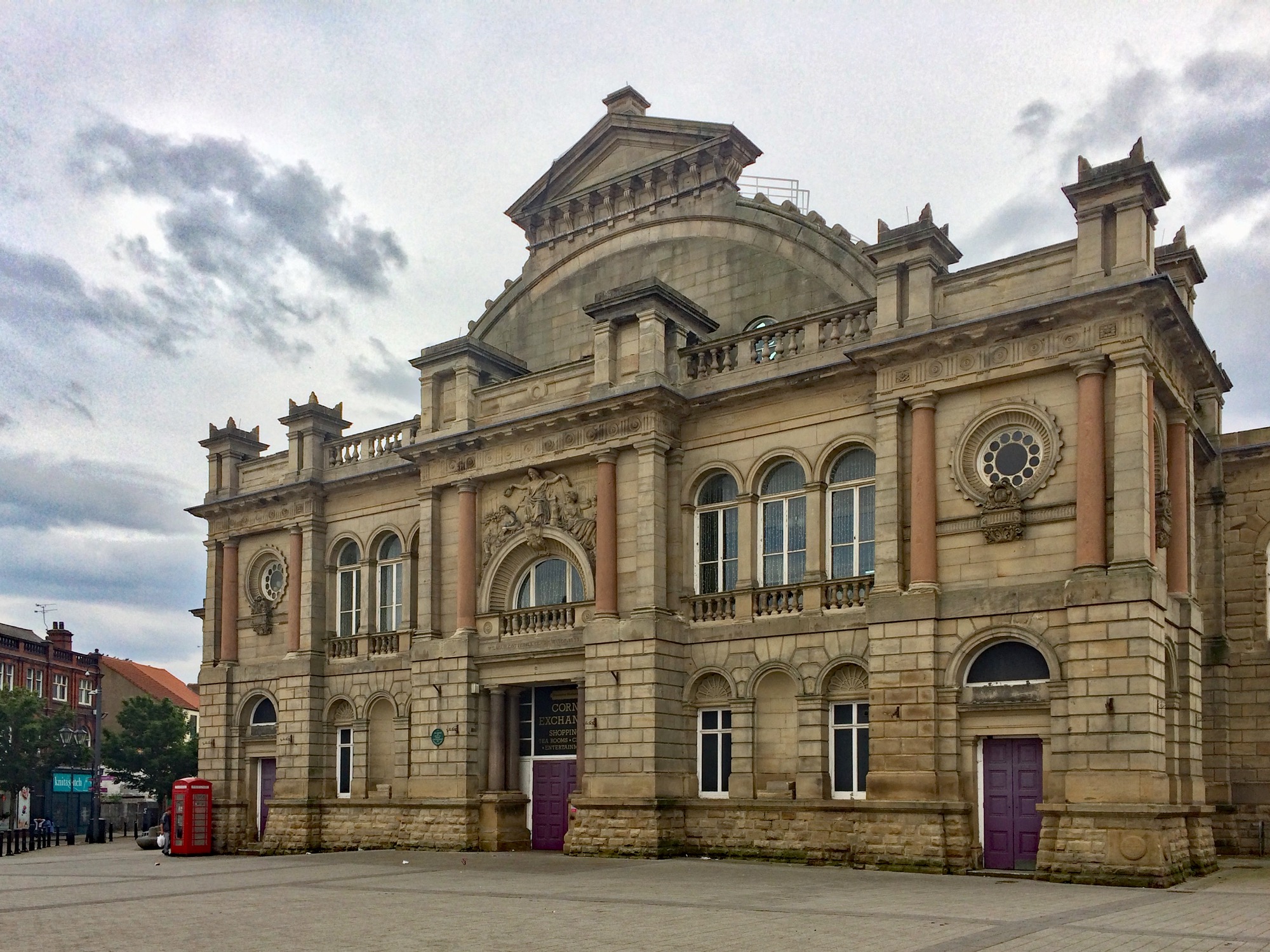
The Doncaster Corn Exchange, opened on 17 April 1873, was designed by the Lincoln architect William Watkins, who won an architectural competition in 1870 to create a purpose-built grain trading hall and concert venue in the heart of Doncaster’s Market Place. As the exhibition catalogue for “Lincoln — The Victorian Facade: The Heritage of William Watkins and Son, Architects” (Lincolnshire College of Art and Design) documents, Watkins was a prolific designer of civic and commercial buildings across the East Midlands and Yorkshire, known for his confident handling of the classical vocabulary. The building replaced Doncaster’s first corn exchange, a modest two-bay iron-and-pitched-roof structure erected by Onions, Wheelhouse & Co. in 1844 at a cost of just £900. Watkins’s far grander replacement was set within the “U” of J. Butterfield’s existing 1847–1849 market hall, projecting forward to create a commanding five-bay ashlar frontage with red sandstone dressings. The Historic England Grade II* listing (entry 1192688, listed June 1950) describes the central bay as featuring a recessed doorway framed by pairs of red sandstone Doric columns supporting an entablature, surmounted by a large Diocletian window flanked by further Doric columns and pilasters. The interior is described as “very elaborate”: a three-sided gallery is supported on a round-arched arcade with alternating plain and panelled pilasters, while paired iron columns with foliage capitals carry round arches of pierced ironwork with “sumptuous decoration to the spandrels.” Semi-circular iron roof trusses with decorative bracing support a large central ridge light on foliage trusses, evoking, as commentators have noted, the glazed iron-and-glass aesthetic of Joseph Paxton’s Crystal Palace of 1851. The south end features a full-height basket-arched niche with a ribbed and panelled dome. Built at a cost exceeding £25,000 and capable of holding up to 3,000 people, the Corn Exchange served simultaneously as a trading hall and a premier concert venue. A devastating fire in 1994 gutted the interior, and restoration work—during which a medieval cemetery and Roman pottery were discovered beneath the floor—led to a 1997 reopening with a raised floor level. A further £5 million restoration by Group Ginger Architects and Civic Engineers, completed in 2024–2025, removed a later mezzanine to reveal the original roof structure, restored heritage stonework and windows, and reconfigured the building as a 400-capacity events venue with retail units, returning the Corn Exchange to something closer to its original dual-purpose design.
The decorative programme of the Doncaster Corn Exchange is unusually rich for a provincial grain market. The most prominent sculptural feature, documented by Bob Speel’s survey of Doncaster public sculpture, is the allegorical composition above the main entrance: two seated female figures flank a central lunette containing an angel. The left figure, emblematic of Agriculture, holds a sickle and sheaf of corn; the right figure rests her arm on the head of a cow and holds what appears to be a rolled carpet, symbolising pastoral wealth. These were executed by the Westminster firm of C.H. & J. Mabey, identified by the University of Glasgow’s “Mapping the Practice and Profession of Sculpture in Britain and Ireland 1851–1951” database as Charles Henry Mabey (c. 1836–1912) and James Mabey (c. 1812–1883), prolific contractors of architectural sculpture for Victorian civic buildings. The interior is equally ambitious in its decorative ironwork, which the Historic England listing describes in detail: paired iron columns with foliage capitals support round arches of pierced ironwork featuring “sumptuous decoration to the spandrels,” crowned by a covered iron cornice with pierced coping. The roof trusses are semi-circular iron members with decorative bracing, supporting a large central ridge light on foliage-ornamented trusses that flood the trading floor with natural light. The south end of the hall features a raised platform set within a full-height basket-arched niche with a ribbed and panelled dome and pilastered sides—an architectural set-piece that doubled as a stage for concerts and public assemblies. The north end displays a six-bay arcade of round arches surmounted by three stepped semicircular windows with pilastered surrounds. The Art UK catalogue records a painting by an unknown artist titled “Corn Exchange and Market” (held in the Doncaster Museum collection), which depicts the building’s exterior as a civic landmark. Throughout, the decorative vocabulary—sheaves of corn, agricultural allegorical figures, foliage ironwork—consistently reinforces the building’s identity as a temple of agricultural commerce.
Doncaster’s position as a grain-trading centre was shaped by deep geographic and historical advantages. The town sits at a strategic crossing of the River Don—the Romans established the fort of Danum here, recognising the site as the best fording point for miles along what would become the Great North Road (now the A1). As the Britannica entry on Doncaster notes, the town grew in the Middle Ages as “the market town of a rich agricultural district.” King Richard I granted a town charter in 1194, and a royal market charter followed in 1248; by 1334, Doncaster was the wealthiest town in southern Yorkshire. Derek Holland and Enid Holland’s “A Yorkshire Town: The Making of Doncaster” traces how the town’s prosperity was sustained by its position at the junction of major north–south and east–west routes, which made it a natural gathering point for agricultural produce from the fertile lowlands of the Don valley and the broader South Yorkshire plain. In the eighteenth century, Doncaster flourished as a coaching town on the Great North Road, with numerous inns serving travellers and merchants. The arrival of the Great Northern Railway in 1848—and the relocation of its locomotive works from Boston to Doncaster in 1853—transformed the town into an industrial and transport hub, greatly expanding the reach of its agricultural markets. The Corn Exchange sits in the Market Place, at the historic heart of the town’s commercial district, alongside the adjacent Wool Market (completed 1863) and the older Butter Cross and Shambles (rebuilt 1756). The medieval Magdalene’s Yard wool market, one of the largest in northern England, had long established the Market Place as a centre of agricultural trade. When William Watkins designed the Corn Exchange in 1870, he placed it within the “U” of J. Butterfield’s existing market hall, creating an integrated market complex that consolidated grain, fish, meat, and general produce trading in a single architectural ensemble—a physical expression of Doncaster’s role as the commercial capital of the surrounding agricultural hinterland.
The institutional history of the Doncaster Corn Exchange reflects the broader arc of English grain trading from the medieval period through Victorian high capitalism to twentieth-century decline and twenty-first-century reinvention. Doncaster’s grain trade long predated the purpose-built exchange: the town’s medieval market charter of 1248 authorised open-air trading in corn alongside other agricultural produce. The first dedicated corn exchange—a simple iron-columned shelter erected by Onions, Wheelhouse & Co. in 1844—was, as the Wikipedia entry on corn exchanges in England documents, part of a nationwide wave of corn exchange construction that accelerated dramatically after the repeal of the Corn Laws in 1846, which opened British markets to foreign grain and intensified the need for efficient domestic price discovery. By the late 1860s, Doncaster’s civic leaders judged the original structure inadequate. The foundation stone for William Watkins’s replacement was laid by Mayor Arthur J. Smith on 22 September 1870, and the building was opened by Mayor William Cotterill Clark on 17 April 1873. The new exchange was designed not only for grain sales but also as a concert hall and public assembly room, reflecting the civic ambitions of Victorian market towns. Concerts by Dame Nellie Melba, Dame Clara Butt, Dame Myra Hess, and Richard Tauber drew national attention, and in October 1909, Sir Edward Elgar conducted the London Symphony Orchestra in the hall. In the early twentieth century, the young Winston Churchill spoke there about his experiences during the Second Boer War. Political figures including Oswald Mosley and Aneurin Bevan addressed audiences in the interwar years. After the Second World War, the Corn Exchange became a municipal restaurant and dance hall, open on Tuesday, Thursday, Friday, and Saturday evenings during the winter season. In 1967, the building was integrated into the larger Doncaster Market complex. The exchange suffered a devastating fire in 1994; archaeological investigation during restoration uncovered a medieval cemetery and Roman artefacts beneath the floor. The building reopened in 1997 with a raised floor and was converted to an indoor market. A £5 million restoration completed in 2024–2025 by Group Ginger Architects has returned the Corn Exchange to its original dual function as a performance venue and marketplace, now with capacity for over 400 people.
The Doncaster Corn Exchange was, in the terminology of its era, a “corn exchange”—where “corn” denoted all cereal grains, not maize specifically. As Gregory Clark documents in “The Price History of English Agriculture, 1209–1914” (Research in Economic History, 2004), the principal grains traded in English markets were wheat, barley, oats, rye, peas, and beans, with wheat overwhelmingly dominant in value terms. At Doncaster, the fertile lowlands of the Don valley and the broader South Yorkshire plain supplied substantial quantities of wheat and barley, supplemented by oats grown on higher ground. Trading at English corn exchanges operated through what economic historians call “sample-based” or “hand-to-eye” dealing: farmers or their agents brought small samples of grain to the exchange, displayed them on tables or counters, and merchants assessed quality by visual inspection and touch before negotiating prices through direct verbal bargaining. This system, as the Cambridge University “Corn Returns Online” project has documented, fed into a national price-reporting infrastructure: from 1770, the British government required corn inspectors at designated market towns to collect weekly data on the quantities and average prices of all grains sold, which were published as the “Corn Returns” in the London Gazette. As the CEPR discussion paper by Brunt and Cannon (“The Truth, the Whole Truth, and Nothing but the Truth: The English Corn Returns as a Data Source in Economic History, 1770–1914,” 2013) demonstrates, these returns constituted a remarkably comprehensive system of agricultural price discovery—“as ubiquitous for contemporaries as stock market prices are for us today.” The repeal of the Corn Laws in 1846 intensified competition from imported grain, particularly after the opening of the American prairies and the advent of steamship transport triggered the Great Depression of British Agriculture (1873–1896). Doncaster’s exchange, opened at the very onset of this depression, thus represented both the apex of the corn exchange building movement and the beginning of its decline. By the early twentieth century, telegraph-facilitated futures trading and centralised markets like the London Produce Clearing House had rendered the physical sample-based system increasingly obsolete, and most provincial corn exchanges gradually ceased to function as grain markets.
Images will be added as the project develops. Photographs by Larry Ng and from research sources.