Dhaka Stock Exchange (DSE)
Dhaka, Bangladesh · Established 1954
This site requires authorization to access.
To request access, contact
william.goetzmann@yale.edu
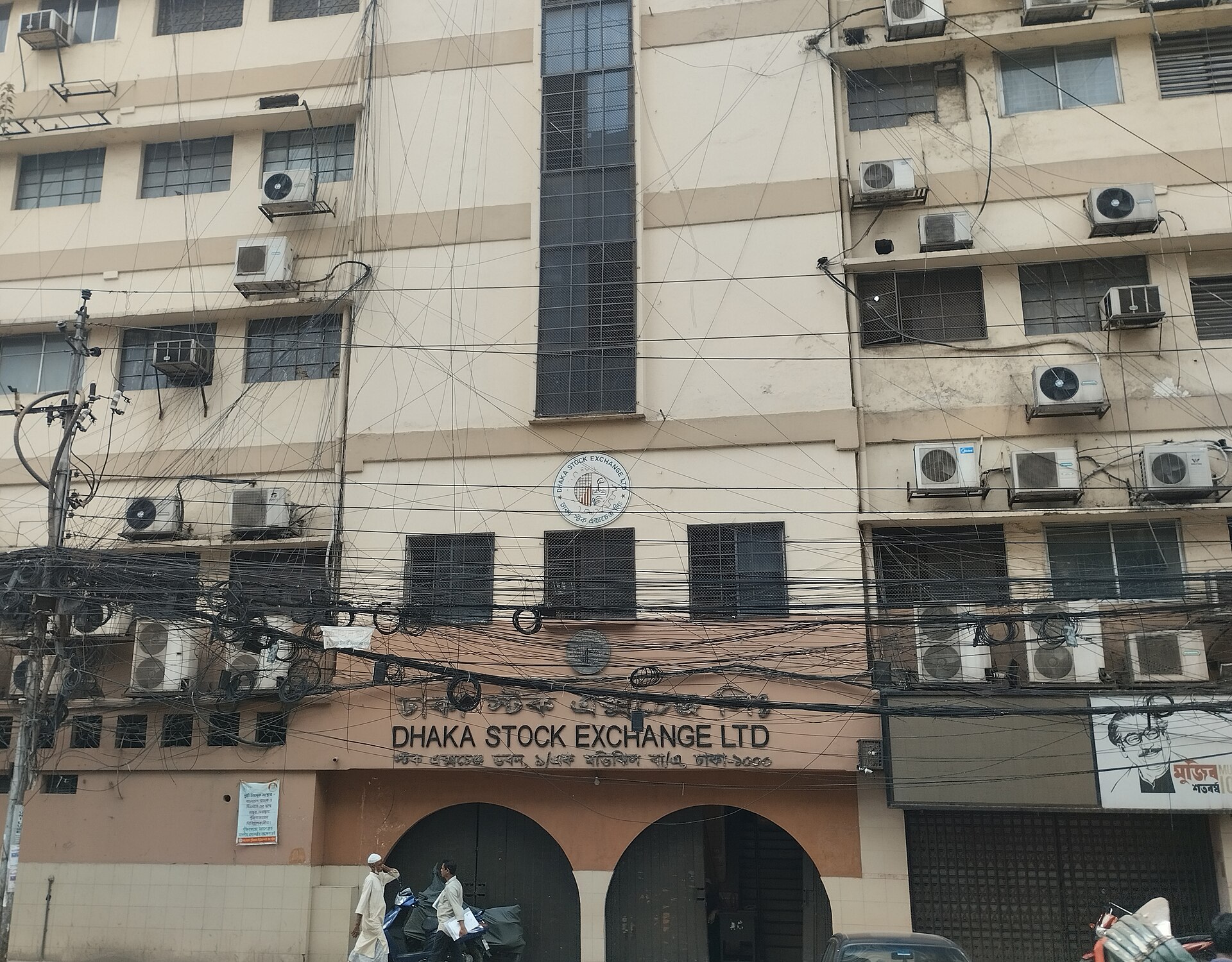
The Dhaka Stock Exchange occupied premises in the Motijheel Commercial Area for six decades before relocating to a purpose-built tower in the Nikunja district of northern Dhaka in November 2019. The original headquarters at 9/F Motijheel C/A, purchased from the government in 1957, was a modest mid-rise structure typical of the reinforced-concrete commercial buildings erected in East Pakistan’s emerging central business district during the late 1950s. As Kazi Khaleed Ashraf documented in “Designing Dhaka: A Manifesto for a Better City” (Loka Press, 2012), Motijheel’s postwar commercial architecture followed utilitarian modernist conventions—flat roofs, concrete frames, minimal ornamentation—shaped by the urgency of nation-building in a newly partitioned state rather than by any coherent aesthetic vision. The exchange’s cramped Motijheel quarters eventually proved inadequate for a market serving over six hundred listed companies. Construction of the DSE Tower at Nikunja began on March 28, 2007, on 1.33 acres allocated by the government in 1996. Design and Development Consultants Limited (DDCL), one of Bangladesh’s leading architectural and engineering firms, provided comprehensive design services for the fourteen-story complex with three basement levels, encompassing approximately 650,000 square feet of floor space. The tower houses a 656-person auditorium, seminar rooms, a media center, a cafeteria, prayer halls, dedicated broker trading floors from the fourth through eleventh stories, and parking for four hundred vehicles. In 2020, the landscape architecture firm MSH Atelier redesigned the tower’s perimeter with rustic Corten steel planters, heavy-canopy shade trees, a central water fountain for microclimate control, and integrated greywater and rainwater reuse systems—a sustainable intervention that transformed the corporate facade into what the firm described as a “portable landscape.” The tower’s data center subsequently earned TIA-942 Rated-3 certification, placing the DSE among South Asia’s most technologically advanced exchange facilities.
The decorative program of the Dhaka Stock Exchange’s commercial spaces reflects the broader aesthetic tensions of Bangladeshi institutional architecture—between utilitarian modernism, postcolonial identity-building, and the pragmatic demands of electronic trading infrastructure. The original Motijheel premises, erected in the functionalist idiom that dominated East Pakistan’s commercial construction, carried virtually no ornamental program; as Nurur Rahman Khan noted in “Architecture and National Identity: The Case of Bangladesh” (Journal of the Asiatic Society of Bangladesh, 2005), early postwar institutional buildings in Dhaka deliberately eschewed Mughal and Indo-Saracenic decorative traditions in favor of an internationalist modernism that signaled modernity and secular statehood. The open outcry trading floor that operated until the automated system’s launch on August 10, 1998, was a characteristically sparse space: rows of wooden benches, chalkboards displaying share prices, and hand-written transaction ledgers constituted the material culture of daily commerce. The transition to screen-based trading eliminated the physical theater of the trading pit—the gestural language of brokers, the cacophony of shouted bids—replacing it with banks of computer terminals. At the DSE Tower in Nikunja, MSH Atelier’s 2020 landscape intervention introduced the most significant aesthetic statement in the exchange’s built environment: contemporary sculptures placed throughout the entry forecourt, Corten steel planters whose deliberately rusted patina evokes an industrial aesthetic, and strategically planted heavy-canopy vegetation that frames the tower’s entrance. The interior spaces prioritize technological functionality—the TIA-942 Rated-3 data center, broker workstations, and surveillance systems—over decorative display, a pattern common to exchanges worldwide that completed their transition from physical trading floors to fully electronic platforms during the late twentieth century.
The Dhaka Stock Exchange’s history is inseparable from the development of Motijheel, Dhaka’s central business district, whose very name—“Pearl Lake” in Bengali, from moti (pearl) and jheel (lake)—preserves the memory of a Mughal-era water body associated with the estate of the Mughal official Mirza Mohammad Mukim. As Md. Tarek Morad explored in “The British Colonial City and a Tale of a Mughal Garden” (Catholic University of Leuven, 2013), the area historically encompassed the Dilkusha Gardens of the Nawab of Dhaka, which British colonial administrators appropriated and transformed during the nineteenth century. After the 1947 partition of British India, Motijheel was rapidly developed as East Pakistan’s commercial center during the 1950s, and the stock exchange’s establishment there in 1954 was integral to this transformation. As Roxana Hafiz and A.K.M. Shahabuddin documented in “Colonial Legacies and Contemporary Urban Planning Practices in Dhaka, Bangladesh” (Planning Perspectives, 2022), the Motijheel area evolved through successive waves of state-directed commercial development, accumulating the headquarters of Bangladesh Bank, Janata Bank, Agrani Bank, and other major financial institutions. By the 1980s, Motijheel had become the undisputed financial nerve center of the nation, its skyline defined by the reinforced-concrete towers of state-owned banks. The DSE’s 2019 relocation to Nikunja, situated beside the Dhaka-Mymensingh highway near Hazrat Shahjalal International Airport, reflects a broader pattern of institutional decentralization as Dhaka’s explosive population growth—from approximately two million in 1970 to over twenty-two million in the metropolitan area today—has rendered the congested Motijheel core increasingly impractical for modern exchange operations requiring robust data infrastructure and vehicular access.
The Dhaka Stock Exchange originated in the financial dislocation caused by the 1947 partition of British India. As the Banglapedia encyclopedia documents, when the Calcutta Stock Exchange prohibited transactions in Pakistani shares and securities in early 1952, the government of East Pakistan recognized the urgent necessity of establishing an independent securities market. An organizing committee formed in 1953 led to the incorporation of the East Pakistan Stock Exchange Association Ltd. on April 28, 1954. Formal trading commenced in 1956 at Narayanganj, the historic jute-trading center where Adamjee Jute Mills—then the world’s largest jute processing plant—had begun production in 1951, symbolizing East Pakistan’s industrial aspirations. The exchange relocated to Dhaka’s Motijheel district in 1958, was renamed East Pakistan Stock Exchange Ltd. in 1962, and became Dacca Stock Exchange Ltd. in 1964. Bangladesh’s independence in 1971 disrupted operations, and the exchange remained dormant until 1976 when trading resumed with only nine listed companies and a paid-up capital of approximately 940 million taka. As Syed Ali-Mumtaz Shah analyzed in “Capital Market Development in Bangladesh: A Sector Reform Perspective” (Asian Development Bank South Asia Working Paper No. 48, 2017), the market’s subsequent growth was shaped by successive waves of reform and crisis. The Bangladesh Securities and Exchange Commission was established in 1993 to provide regulatory oversight. The mid-1996 speculative bubble saw share prices surge six- to sevenfold before a devastating crash that, as Md. Tahidur Rahman, Syed Zabid Hossain, and Md. Habibullah documented in “Stock Market Crash in Bangladesh: The Moneymaking Psychology of Domestic Investors” (American Journal of Theoretical and Applied Business, 2017), took approximately twelve years to recover from. Automated trading was introduced on August 10, 1998, replacing open outcry. A second major bubble inflated through 2010, with the DGEN index reaching a record 8,918.5 on December 5, 2010—approximately 5.6 times its 2006 level—before crashing on December 19, affecting an estimated 3.3 million investors. The DSE demutualized on November 21, 2013, and in May 2018 a consortium of the Shanghai Stock Exchange and Shenzhen Stock Exchange acquired a 25 percent strategic stake, signaling the exchange’s integration into broader Asian capital market networks.
The Dhaka Stock Exchange has evolved from a small postwar market dominated by jute-industry shares into Bangladesh’s principal securities exchange, listing over 625 companies across twenty-two industrial sectors. The exchange’s composition reflects the structural transformation of the Bangladeshi economy—from the jute and tea companies that dominated early listings through the textile and readymade garment firms that mirror Bangladesh’s emergence as the world’s second-largest apparel exporter. As a McKinsey Global Institute report documented in “Bangladesh’s Ready-Made Garments Landscape” (2011), the RMG sector grew from negligible exports in the early 1980s to account for over 80 percent of national export earnings, and listed garment companies now constitute a significant portion of DSE market capitalization. The exchange operates multiple indices: the DSEX (Dhaka Stock Exchange Broad Index), launched in 2013 as the primary benchmark comprising over 250 companies; the DS30, tracking the thirty largest and most liquid stocks; and the DSES (DSE Shariah Index) for Islamic-finance-compliant securities. Trading instruments include common equities, debentures, treasury bonds, mutual funds, and corporate bonds. The market trades Sunday through Thursday from 10:00 AM to 2:30 PM BST, with reduced hours during Ramadan. As K.M. Anwarul Islam and Sk. Alamgir Hossain documented in “Demutualization of Dhaka Stock Exchange: Opportunities and Challenges” (International Journal of Finance and Banking Research, 2015), the transition from mutual to demutualized corporate structure in 2013 was designed to improve governance, attract strategic investment, and diversify product offerings. The exchange’s market microstructure has been extensively studied: research by multiple scholars including Mobarek and Keasey in “Weak-Form Market Efficiency of an Emerging Market: Evidence from Dhaka Stock Market of Bangladesh” (ENBS Conference Paper, 2000) has consistently found that the DSE does not meet weak-form efficiency criteria, with return series exhibiting significant serial correlation, positive skewness, and excess kurtosis—characteristics that behavioral finance scholars attribute to the dominance of retail investors and the influence of speculative sentiment cycles that produced the catastrophic bubbles of 1996 and 2010.
Images will be added as the project develops. Photographs by Larry Ng and from research sources.