Denver Stock Exchange
Denver, USA · Established 1881
This site requires authorization to access.
To request access, contact
william.goetzmann@yale.edu
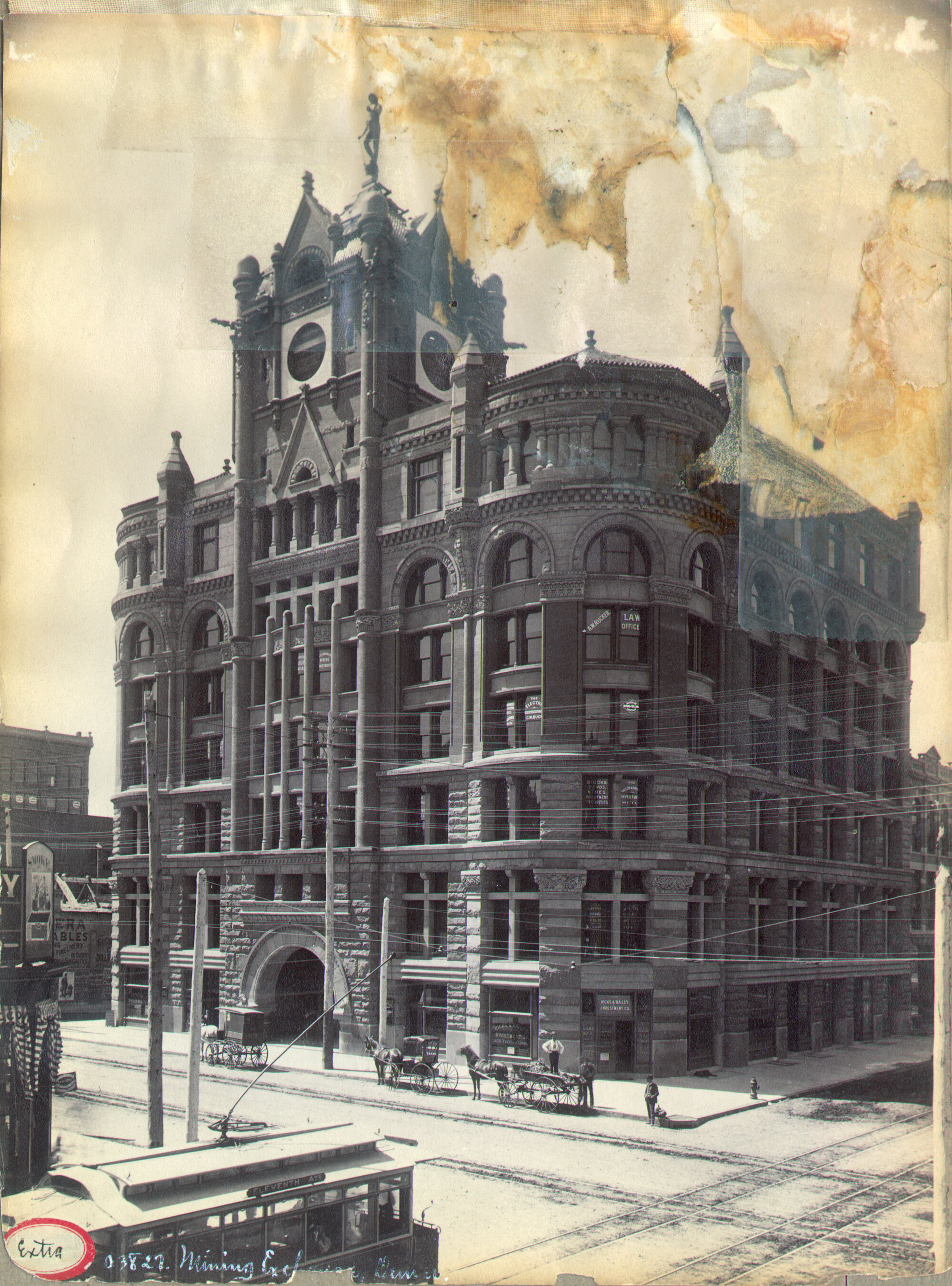
The Mining Exchange Building, erected at Fifteenth and Arapahoe Streets in downtown Denver and opened on November 18, 1891, stood for seven decades as the architectural embodiment of Colorado’s extractive wealth. The seven-story Victorian Romanesque structure featured a prominent corner tower, rusticated stone trim, and deeply recessed arched doorways conveying permanence and monumentality essential to channeling speculative capital into mining ventures. The building was financed by a consortium including John Evans, Colorado’s first territorial governor, banker C.B. Kountze, and Henry C. Brown, developer of the Brown Palace Hotel, who purchased the land for $160,000. As Stephen J. Leonard and Thomas J. Noel recount in Denver: Mining Camp to Metropolis (1990), Denver’s 1890s commercial architecture reflected the city’s ambition to establish itself as the financial capital of the Rocky Mountain West. The Central Savings Bank occupied the ground-floor corner, while the Colorado Mining Stock Exchange claimed the entire second floor as its trading hall. The Mining Record also maintained offices in the building. When the Mining Exchange was razed in 1962–63 to make way for Brooks Tower—a forty-two-story residential high-rise completed in 1968—Denver lost one of its most significant Victorian commercial landmarks. As Thomas J. Noel observed in Mile High City (1997), the demolition was part of the broader urban renewal wave that erased much of the mining-era city.
The decorative program of the Mining Exchange Building celebrated the extractive industries sustaining Denver’s economy. The building’s most iconic element was the twelve-foot copper statue of a prospector, sculpted by Alphonse Pelzer and installed atop the corner tower in 1891. As Mark Ivan Hartensveld documents in “The Old Prospector Statue in Denver” (Rocks & Minerals, vol. 89, no. 3, 2014), the approximately 490-pound figure depicted its subject holding a mining pick in his right hand and gold ore in his left, symbolizing “industry, patience and enterprise.” Pelzer’s model was “Colonel” John W. Straughn (1842–1902), a Civil War veteran and working prospector whose weathered features lent frontier authenticity. Inside, the second-floor trading hall accommodated hundreds of traders and featured a mezzanine-level catwalk permitting observation of the floor below, while a large chalkboard served as the primary medium for recording price fluctuations—a visual technology connecting the interior directly to commercial activity. The Romanesque exterior presented rusticated stone facades with carved ornamental details projecting the solidity late-nineteenth-century financial institutions demanded. The building’s vocabulary unified exterior monumentality with interior functionality, creating an environment reinforcing investor confidence. When the building was demolished in the early 1960s, the Old Prospector statue was preserved and relocated to the Brooks Tower plaza, where it remains today as the sole surviving artifact of the Mining Exchange’s decorative program—a copper sentinel still standing watch over the site where Colorado’s mineral wealth was once traded.
Denver’s emergence as the financial capital of the Rocky Mountain mining frontier was inseparable from its geographic position as the gateway between the Great Plains and the mineral-rich cordillera. As Carl Abbott, Stephen J. Leonard, and Thomas J. Noel explain in Colorado: A History of the Centennial State (5th ed., 2013), the city’s railroads, smelters, and financial institutions formed an integrated infrastructure of extraction drawing mineral wealth from the mountains and concentrating capital on the Front Range. The Argo, Globe, and Grant smelters became Denver’s largest employers by the 1890s, while banks and brokerage houses clustered along Seventeenth Street, earning the sobriquet “Wall Street of the Rockies.” The Mining Exchange Building at Fifteenth and Arapahoe stood two blocks south, anchoring a complementary node of mineral-finance activity. Denver’s financial geography was reinforced by the United States Mint, which had operated as a federal assay office since 1863 and began coinage in February 1906. As U.S. Treasury records note, the Mint’s origins lay in the private minting enterprise of Clark, Gruber and Company, established in 1860 during the Pikes Peak Gold Rush. The spatial proximity of the Mint, smelters, stock exchange, and Seventeenth Street banks created a dense financial ecosystem in which raw mineral deposits, refined metals, negotiable securities, and coined money were all produced and exchanged within a compact urban core—a geography of capital making Denver unique among American cities.
The Denver Stock Exchange traces its origins to August 9, 1881, when directors were elected to organize trading in mining securities. As James B. Copeland documents in “Mining Stock Exchanges and Financing the Colorado Mining Industry” (Mining History Journal, vol. 20, 2013), the exchange emerged during rapid expansion in Colorado’s silver-mining districts, particularly Leadville, where a massive 1877 strike generated enormous speculative interest. In 1890, a consortium formed the Colorado Mining Stock Exchange, which opened the Mining Exchange Building on November 18, 1891. The catastrophe of 1893 tested survival: as John F. Steinle recounts in Colorado and the Silver Crash (2021), the repeal of the Sherman Silver Purchase Act collapsed silver prices from 83 to 62 cents per ounce, devastating Colorado—377 businesses failed, 435 mines closed, and 45,000 workers lost jobs. Denver’s population fell from 106,000 to 90,000 by 1895. Yet the exchange survived, buoyed by the Cripple Creek gold discoveries of 1891, which redirected speculative energy from silver to gold. Through the early twentieth century, the exchange diversified into oil, gas, and base-metal securities. Duane A. Smith, in Rocky Mountain Mining Camps: The Urban Frontier (1967; repr. Indiana University Press, 2009), traces how frontier mining camps evolved into permanent communities linked to metropolitan centers like Denver. The Denver Stock Exchange ultimately closed in 1936, a casualty of the Depression and consolidation following the SEC’s creation in 1934. The Colorado Springs Mining Stock Exchange, a rival focused on Cripple Creek gold stocks, persisted somewhat longer before closing in January 1967.
The securities traded on Denver’s mining exchanges tracked the shifting geology and commodity cycles of the Rocky Mountain West. In the 1880s, silver stocks dominated: shares in Leadville companies—where the 1877 Fryer Hill discovery launched one of the largest silver booms in American history—were joined by issues from Aspen, which in 1891–92 surpassed Leadville as the nation’s most productive silver district, and from the Creede camp. The 1893 Sherman Act repeal cratered silver stocks, but the Cripple Creek gold strike of 1891 quickly redirected business toward gold equities. As Duane A. Smith discusses in Colorado Mining: A Photographic History (1977), shares in Cripple Creek operations—including the Portland, Independence, and Vindicator mines—became the most actively traded through the turn of the century. As Copeland (2013) documents, Denver’s exchanges served as critical intermediaries between Eastern capital and Western mineral deposits. Coal stocks from Colorado’s extensive coalfields also featured, alongside smelting company shares. In the early twentieth century, oil and gas securities entered listings as exploration expanded across the Denver Basin and Western Slope. The mid-twentieth century brought two final speculative waves: uranium stocks surged during the 1950s Cold War boom, when the Colorado Plateau hosted some 800 mines making the state the nation’s largest uranium producer; and shares in the Climax Molybdenum Company, operating the world’s largest underground molybdenum mine near Leadville, became a Cold War bellwether.
Images will be added as the project develops. Photographs by Larry Ng and from research sources.