Delhi Stock Exchange (DSE)
Delhi, India · Established 1947
This site requires authorization to access.
To request access, contact
william.goetzmann@yale.edu
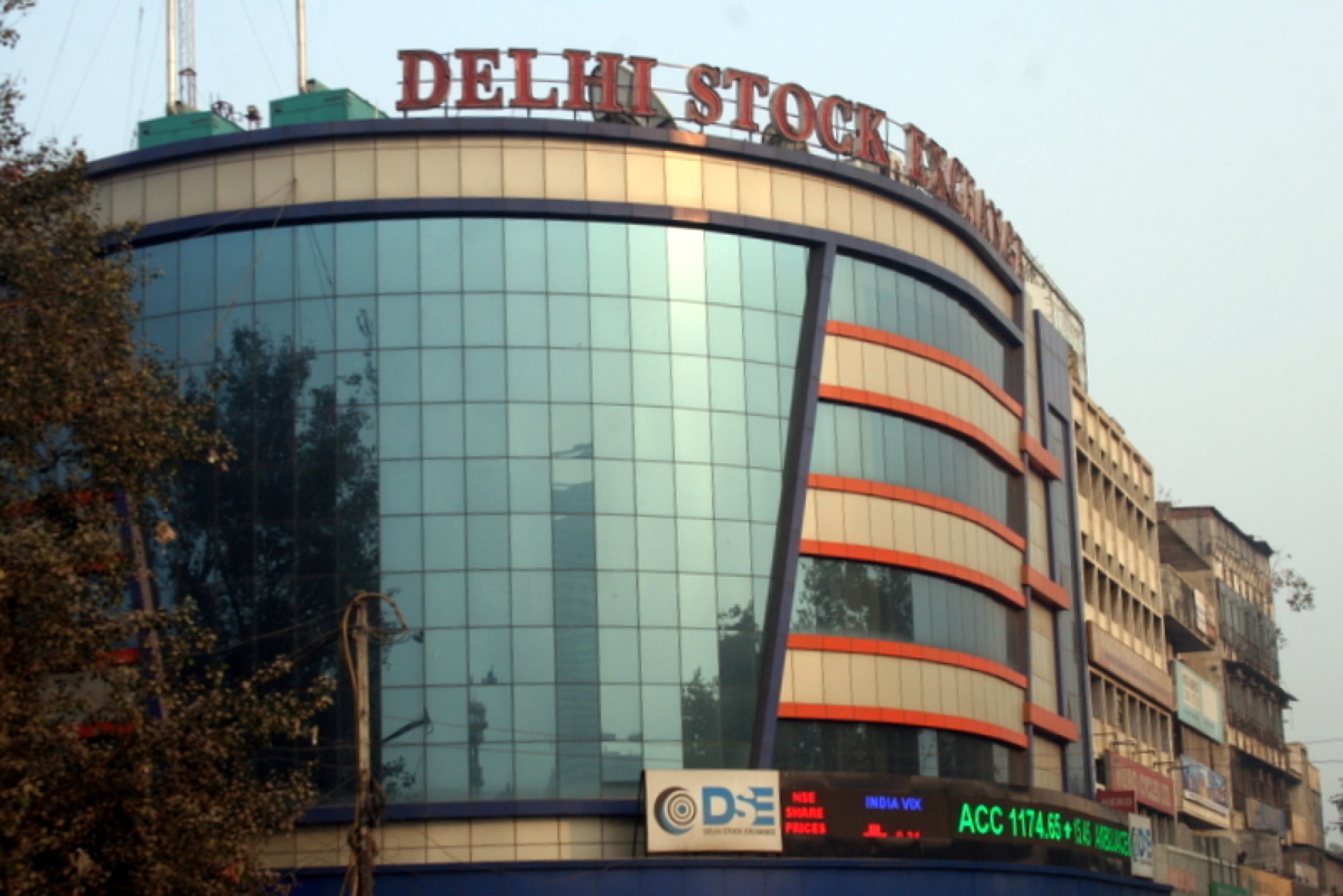
DSE House, the purpose-built headquarters of the Delhi Stock Exchange, stands at 3/1 Asaf Ali Road, New Delhi, inaugurated in December 1997 to replace earlier premises the exchange had occupied since its incorporation in 1947. The building belongs to the tradition of institutional modernism that characterizes Asaf Ali Road’s commercial corridor—a lineage that, as the architectural blog Sarson ke Khet documented in “Governmental Modernisms Along Asaf Ali Road” (2015), comprises “a relatively humble but representative collection of the type of modernisms that were employed by so many governmental commercial and office buildings around India through the decades.” DSE House is a multi-story reinforced-concrete structure with a flat-roofed profile, rectilinear massing, and ribbon fenestration typical of late-twentieth-century Indian commercial architecture. The ground and lower floors housed the exchange’s trading hall—centered on a circular open-outcry ring where brokers congregated to execute orders through the vocal auction system that prevailed until computerized trading was introduced in February 1987 and online screen-based trading launched in August 1997. The broader architectural context of Asaf Ali Road reflects what Riya Singh at thinkMATTER described as “Nehru and the Delhi Modern Movement: Architecture and Design in Delhi 1947–1980” (2022)—a period when architects such as Habib Rahman, the MIT-trained modernist who received India’s Padma Shree in 1955, shaped Delhi’s new institutional landscape with Bauhaus-influenced concrete structures. Though DSE House lacks the monumental ambition of Rahman’s government commissions, it participates in the same vocabulary of reinforced concrete, sun louvers, and functional austerity that defined post-independence Delhi’s commercial architecture. After SEBI permitted the exchange’s exit in January 2017, DSE House was retained by the successor entity, DSE Estates Limited, as a commercial real-estate asset.
The decorative program of DSE House reflected the restrained functionalism characteristic of India’s post-independence institutional buildings rather than the ornamental exuberance found in older colonial-era exchanges such as the Phiroze Jeejeebhoy Towers of the Bombay Stock Exchange. The building’s primary visual element was its trading ring—the circular open-outcry pit that served as the spatial and symbolic heart of the exchange. As descriptions of Indian trading floors from this era indicate, pits were typically sunken circular or octagonal arenas with stepped perimeters descending to a flat central area where market makers and jobbers (known in Indian markets as sauda wallahs) operated, mediating between buying and selling brokers through vocal calls and hand signals. The DSE’s trading hall incorporated the standard furnishings of Indian regional exchanges: electronic ticker boards displaying price quotations, a central annunciator panel, and the distinctive brass or chrome railings demarcating the ring. Metallic lettering on the building’s exterior facade proclaimed the name “Delhi Stock Exchange”—a signage element noted by the Delhi Walla urban heritage blog in its walking survey of Asaf Ali Road (2023). The broader aesthetic vocabulary of Asaf Ali Road’s commercial buildings, as documented by the architectural heritage project Sarson ke Khet, included facades whose “severe asceticism” could “trigger the awe usually inspired by Brutalist architecture,” with the imposing Hamdard Building nearby exemplifying this austere monumentality. Financial instruments themselves constituted a form of material culture: the printed share certificates, broker’s chits, and settlement ledgers that circulated through DSE’s clearing operations represented the documentary art of Indian capital markets—artifacts of the kind that William Goetzmann and K. Geert Rouwenhorst examined in The Origins of Value: The Financial Innovations that Created Modern Capital Markets (Oxford University Press, 2005).
DSE House occupies a strategic position on Asaf Ali Road, the arterial boulevard that traces the vanished southern fortification wall of Shahjahanabad—the walled city founded by the Mughal emperor Shah Jahan in 1648. The road stretches from Delhi Gate to Ajmeri Gate, with the historic Turkman Gate (believed to date from the twelfth century and named for the Sufi saint Shah Turkman Bayabani) punctuating the midpoint. As the urban heritage writer Mayank Austen Soofi documented in “City Walk—Asaf Ali Road, Old Delhi” (The Delhi Walla, 2023), Turkman Gate marks “a symbolic landmark dividing two vastly dissimilar spaces, of two vastly dissimilar times,” with modern Delhi’s broad avenues and office buildings on one side and the dense alleyways and historical fabric of Shahjahanabad on the other. The exchange thus stood at the precise boundary between Old Delhi’s medieval commercial geography and the modern institutional district that emerged after independence. Delhi’s population exploded from roughly 917,000 in 1941 to 1.74 million by 1951, as Partition refugees—many of them business families from Punjab—reshaped the city’s commercial landscape, a demographic transformation analyzed in Vazira Fazila-Yacoobali Zamindar’s “India–Pakistan Partition 1947 and Forced Migration” (Wiley, 2013). The placement of a stock exchange on Asaf Ali Road reflected the Nehruvian vision of building modern economic infrastructure along the transitional zone between the old Mughal capital and Lutyens’ New Delhi to the south, where Parliament House and the administrative quarter represented sovereign political authority. Nearby institutions included the State Trading Corporation building designed by the architect Raj Rewal—a Brutalist landmark—and the commercial offices that housed the expanding bureaucracy of India’s planned economy.
The Delhi Stock Exchange was incorporated on 25 June 1947—exactly seven weeks before Indian independence on 15 August—as an amalgamation of two earlier bodies, the Delhi Stock and Share Brokers’ Association Limited and the Delhi Stocks and Shares Exchange Limited. It was India’s fifth recognized stock exchange, joining the Bombay, Ahmedabad, Calcutta, and Madras bourses. In June 1956, DSE adopted the chopri system for recording transactions, and in December 1957 it received formal recognition under the Securities Contracts (Regulation) Act of 1956—the landmark legislation drafted on the recommendations of the A.D. Gorwala Committee of 1951, which, as the 1991 Project’s scholarly analysis documents, sought to “curb manipulations like badla (carry-over trading) that fueled gambling-like speculation.” The exchange achieved permanent recognition in March 1982. During the 1980s and early 1990s—its most prosperous period—DSE effectively competed with larger bourses, establishing the DSE Index in February 1988, creating an Investor Protection Fund in March 1989, and reaching peak listings of 3,895 companies in March 1997. Computerized trading began in February 1987, and online screen-based trading launched in August 1997, the same year DSE House was inaugurated. However, as Susan Thomas and Ajay Shah documented in “The Evolution of the Securities Markets in India in the 1990s” (ICRIER Working Paper No. 91, 2002), the establishment of the National Stock Exchange in 1994 with anonymous electronic trading and nationwide reach devastated regional exchanges. DSE’s turnover declined precipitously. SEBI withdrew recognition in November 2014, citing “serious irregularities” including a false certificate of demutualisation completion. The exit order of 23 January 2017 formally ended DSE’s seven decades as a stock exchange, directing the entity—renamed DSE Estates Limited—to refrain from using the term “stock exchange” in its name.
The Delhi Stock Exchange served as the principal securities marketplace for North India, listing equities that reflected the region’s industrial base in textiles, sugar refining, and light manufacturing. At its peak in March 1997, DSE listed 3,895 companies—many of them small and medium enterprises headquartered in Delhi, Uttar Pradesh, Haryana, and Punjab. Prominent listings included firms in the textile sector such as Malook Chand Textiles, Balwant Textile Mills, and H.P. Cotton Textile Mills, alongside sugar manufacturers like Naraingarh Sugar Mills and Basti Sugar Mills—industries that, as the historian of Delhi Cloth and General Mills has documented, formed the backbone of North Indian commerce since the early twentieth century. Trading was conducted through the open-outcry auction system until computerization began in 1987, with settlement following the traditional chopri ledger method before electronic clearing was introduced. The exchange facilitated both spot transactions and the badla (carry-forward) system—an indigenous leverage mechanism that, as Narayan Jayesh explained in a Reserve Bank of India–commissioned study (reprinted as IIM Ahmedabad Working Paper 2001-04-05), allowed traders to roll over positions across settlement periods through the intermediation of financiers known as badla wallahs. SEBI banned badla in 1993, briefly restored it in 1996, and permanently prohibited it in July 2001 following the introduction of derivatives trading. DSE paired with the National Securities Depository Limited (established 1996) and commenced trading in dematerialized shares in the late 1990s, while its subsidiary DSE Financial Services Limited (later Delstox Stocks and Shares Limited), incorporated in June 1996, provided brokerage and depository participant services. As M.R. Mayya observed in “Regional Stock Exchanges for Spread of Equity Cult” (BSE publication), the regional exchanges were intended to spread equity participation beyond the metropolitan centers of Mumbai and Ahmedabad, yet by the early 2000s DSE’s daily turnover had declined to virtually zero as liquidity migrated to the NSE and BSE.
Images will be added as the project develops. Photographs by Larry Ng and from research sources.