Chandni Chowk and Dariba Kalan (Shahjahanabad Financial Quarter)
Delhi, India · Established 1650
This site requires authorization to access.
To request access, contact
william.goetzmann@yale.edu
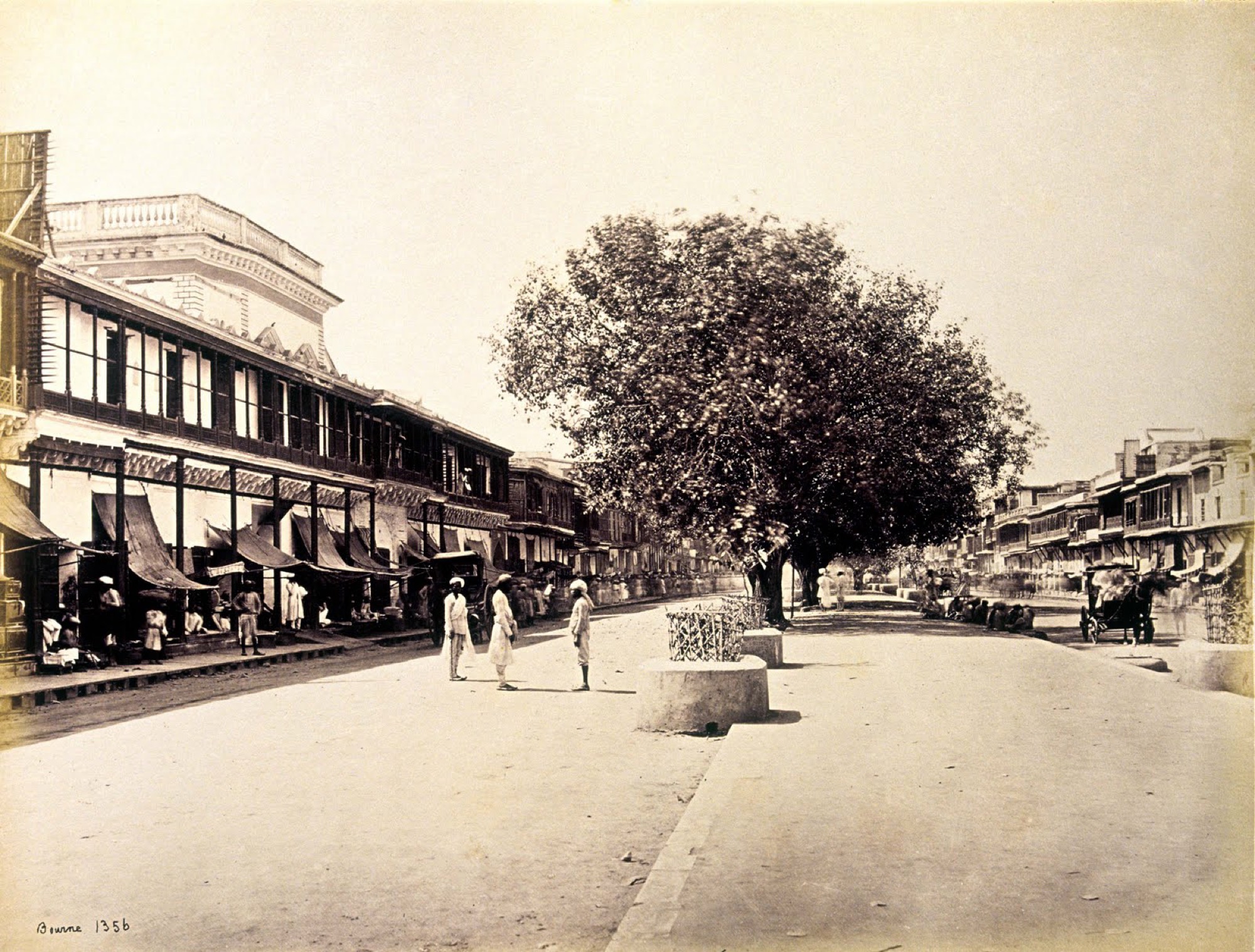
The financial and commercial heart of Mughal Shahjahanabad was organized along Chandni Chowk, a monumental boulevard stretching approximately 1,520 yards from the Lahori Gate of the Red Fort westward to the Fatehpuri Masjid. Designed and patronized by Princess Jahanara Begum, Shah Jahan's eldest and most powerful daughter, the bazaar was established in 1650 as a grand commercial promenade 120 feet wide, containing 1,560 shops arranged on either side of a central canal fed by the Nahar-i-Bihisht, the 'Stream of Paradise,' which drew its waters from the Yamuna River. As Stephen P. Blake documented in Shahjahanabad: The Sovereign City in Mughal India, 1639-1739 (Cambridge University Press, 1991), the canal broadened at the center of the boulevard to form an octagonal reflecting pool whose surface shimmered under moonlight, giving the square its Persian name, Chandni Chowk, or 'Moonlight Square.' North of the pool Jahanara constructed a caravanserai of such magnificence that the French physician Francois Bernier, visiting between 1656 and 1668, judged it 'the most imposing structure in the city after the Jama Masjid.' South of the pool stood a hammam. Branching southward from Chandni Chowk toward the Jama Masjid ran Dariba Kalan, the 'Street of the Incomparable Pearl,' its name derived from the Persian dur-e be-baha. This narrow lane, established during Shah Jahan's reign, served as the specialized quarter for dealers in precious gems, gold, and silver. The commercial infrastructure also included the katra system, gated courtyard market-cum-residential complexes featuring one-room quarters arranged around a court with a single narrow entrance. Within the Red Fort itself, the Chhatta Chowk provided an arcaded marketplace stretching 230 feet behind the Lahori Gate, with 32 arched bays arranged in two stories along a passage 13 feet wide, constructed between 1639 and 1648.
The decorative program of Shahjahanabad's commercial quarter drew upon the full repertoire of Mughal architectural ornament. The Red Fort, within whose walls the Chhatta Chowk marketplace was embedded, represented the pinnacle of Shah Jahan's mature architectural style, combining red sandstone curtain walls with interiors of white Makrana marble enriched by pietra dura inlay work employing lapis lazuli, jasper, carnelian, and onyx. The visual record of Chandni Chowk is preserved in a remarkable sequence of artistic representations. The most celebrated is the great Delhi Panorama of 1846 by Mazhar Ali Khan, a topographical artist working in the Company School tradition, commissioned by Sir Thomas Metcalfe, the East India Company's Agent at the Mughal court. This panoramic work, part of Metcalfe's Delhi Book or Reminiscences of Imperial Delhi, an album of 120 Company School paintings commissioned in 1844, constitutes the finest artistic rendering of the city ever produced. Thomas and William Daniell, the English uncle-and-nephew painters who traveled in India between 1786 and 1793, produced aquatint engravings for their monumental Oriental Scenery, issued in six volumes between 1795 and 1808, including views that situate the commercial quarter within its broader architectural setting. The merchant havelis lining the lanes displayed the characteristic decorative vocabulary of Mughal residential architecture: carved sandstone brackets and jharokha balconies projecting over the street, arched doorways with foliate spandrels, and interior courtyards cooled by fountains and screened by carved jali lattice-work.
Shahjahanabad was founded in 1639 when Emperor Shah Jahan commissioned a new imperial city on the western bank of the Yamuna River in Delhi. The city plan, attributed to the architects Ustad Ahmad Lahori and Ustad Hamid, centered on the Red Fort, a vast palace-fortress covering over 120 acres whose eastern walls rose directly from the Yamuna's bank. The Red Fort's Lahori Gate opened westward directly onto Chandni Chowk, establishing the fundamental spatial relationship between imperial palace and commercial boulevard. As Blake demonstrated in his 1991 study, this axial connection was deliberate: the emperor's household consumed vast quantities of luxury goods while simultaneously regulating commercial life through the office of the kotwal. South of Chandni Chowk rose the Jama Masjid, begun by Shah Jahan in 1650 and completed in 1656 at a cost of one million rupees, the largest mosque in India, its courtyard accommodating 25,000 worshippers. Dariba Kalan ran between these two monumental anchors. The city was enclosed by fortification walls averaging 26 feet in height and 12 feet in width, pierced by fourteen gates named for the destinations to which their roads led: Kashmiri Gate northward, Ajmeri Gate southwestward. Within these walls, the city was organized into mohallas and katras. As Swapna Liddle documented in Chandni Chowk: The Mughal City of Old Delhi (2017), the city's spatial organization reflected a Mughal imperial ideology in which the sovereign's household stood at the apex of a hierarchical urban order.
The founding of Shahjahanabad in 1639 marked the culmination of Delhi's long history as a seat of sovereign power. Shah Jahan laid the foundations of the Red Fort on 12 May 1639, and the palace-fortress was completed in 1648. Jahanara Begum, who held the title Padshah Begum and commanded an annual income rivaling the empire's highest-ranking nobles, designed Chandni Chowk in 1650 as both a commercial enterprise and an expression of Mughal princely patronage. The financial infrastructure was managed by the sarraf community, professional moneychangers and bankers who, as Najaf Haider demonstrated in 'The Moneychangers (Sarrafs) in Mughal India' (Studies in People's History, 2019), served simultaneously as assayers, coin-exchangers, deposit-takers, lenders, and remitters of funds through the hundi system. The sarrafs occupied the Ashrafi Bazaar, named after the gold ashrafi coin. Chandni Chowk's prosperity attracted European observers: Francois Bernier described the bazaar's magnificence in his Travels in the Mogul Empire, A.D. 1656-1668 (translated by Archibald Constable, 1891), while Jean-Baptiste Tavernier documented the gem trade in Les Six Voyages (1676), providing the most comprehensive European account of India's precious-stone markets. The catastrophic turning point came on 22 March 1739, when the Persian conqueror Nadir Shah entered Delhi and unleashed a massacre and plunder lasting for days, carrying off treasures estimated at seventy crore rupees, including the Peacock Throne and the Koh-i-Noor diamond, effectively bankrupting the Mughal state. The final blow came with the Indian Rebellion of 1857, when Chandni Chowk was heavily bombarded and the British, after suppressing the uprising and deposing the last Mughal emperor Bahadur Shah Zafar, systematically razed much of Shahjahanabad's Mughal architecture. The British covered the canal, demolished Jahanara's caravanserai and replaced it with the Delhi Town Hall in 1863.
The financial and commodity exchanges of Shahjahanabad encompassed the full spectrum of Mughal India's monetary and mercantile life. Dariba Kalan served as the empire's premier retail market for precious stones, gold, and silver, where dealers displayed diamonds sourced from the mines of Golconda, rubies from Burma, emeralds from Colombia (carried to India via Portuguese Goa), and pearls from the Persian Gulf. The French jeweler Jean-Baptiste Tavernier documented the gem trade with the precision of a professional dealer in Les Six Voyages (1676). The Mughal monetary system, as analyzed by Irfan Habib in The Agrarian System of Mughal India, 1556-1707 (Oxford University Press, 1963; 3rd ed. 2012), operated on a trimetallic standard of gold mohurs, silver rupees, and copper dams, requiring constant exchange among denominations that the sarrafs facilitated. The sarrafs' most sophisticated financial instrument was the hundi, a bill of exchange that enabled the transfer of funds across the empire's vast distances. Habib demonstrated that the negotiability of hundis had developed to such a degree that large numbers were drawn and honored against other hundis without the intermediation of actual cash payments, constituting a proto-clearing system. Hundis drawn on Delhi's sarrafs circulated from Surat to Dhaka, connecting the commercial networks of Gujarat's ports with the textile-producing centers of Bengal. The broader commodity trade of Chandni Chowk included luxury textiles, muslin, silk brocades, the celebrated zari gold-thread embroideries of Delhi, perfumes and attars, spices, and international goods including Chinese porcelain. The Chhatta Chowk inside the Red Fort traded at an exclusive level, specializing in silk brocades, velvet, gold and silverware for the imperial household.
Images will be added as the project develops. Photographs by Larry Ng and from research sources.