Dalian Commodity Exchange (DCE)
Dalian, China · Established 1993
This site requires authorization to access.
To request access, contact
william.goetzmann@yale.edu
The Dalian Commodity Exchange occupies a modern headquarters complex in the Xinghai Central Business District of Dalian’s Shahekou District, situated at No. 129 Huizhan Road overlooking the waterfront. The exchange’s facilities are part of the broader Dalian Commodity Exchange Plaza, a master-planned development designed by PJAR Architects that features two distinctive towers at the southern edge of the financial district, spiraling upward in what the architects describe as “a gesture of economic growth and prowess.” The towers command panoramic views of Xinghai Square—at 110 hectares the largest oceanfront civic plaza in the world, built entirely on reclaimed land—and the mountainous terrain flanking the district to the east and west. The complex is integrated into a CBD plan that links the major seaport to the north with expanding residential and recreational areas to the south and west, with ascending office towers along the western site edge encircling a pedestrian-exclusive commercial zone. The exchange also maintains a Tier III–certified data center (Building No. 68), recognized by the Uptime Institute for its operational resilience, which supports the fully electronic trading platform that handles billions of contracts annually. Hunter Douglas Architectural contributed specialized ceiling, wall, and façade systems to the exchange building, including perforated panels and sun louvres suited to the coastal climate. The architectural program reflects the broader transformation of the Xinghai district from reclaimed tidal flats into a gleaming financial precinct—a trajectory documented in Christian Hess’s study “From Colonial Port to Socialist Metropolis” (Urban History, 2011), which traces how Dalian’s urban fabric has been repeatedly reinvented to serve successive political and economic regimes.
The decorative program of the Dalian Commodity Exchange follows the restrained aesthetic typical of late-twentieth-century Chinese financial institutions, where monumental scale and technological sophistication substitute for the ornamental sculptural programs found on earlier Western exchanges. The trading floors and public spaces emphasize clean lines, polished stone, and expansive glass curtain walls rather than allegorical murals or figurative sculpture. That said, the broader Xinghai Square precinct in which the exchange sits contains significant public art: the square’s central pavement draws on the design of the circular mound altar at the Temple of Heaven in Beijing, and is inlaid with 999 pieces of red Sichuan marble carved with patterns representing the Heavenly Stems, Earthly Branches, Solar Terms, and Chinese Zodiac. At the seaward end of the square stands a monumental footprint sculpture, symbolizing Dalian’s forward trajectory. While the exchange’s own interior spaces lack the painted ceilings and bronze statuary of, say, the Chicago Board of Trade, its visual identity is closely tied to the commodities it trades: promotional and educational displays within the complex feature imagery of soybeans, iron ore, and petrochemical products—the raw materials that drive northeast China’s industrial economy. The emphasis on digital display screens and real-time data visualization throughout the trading halls represents a contemporary form of market-space decoration, where the flow of price information itself becomes the visual spectacle, consistent with what architectural historian Koolhaas described in studies of Asian financial districts as the aestheticization of data.
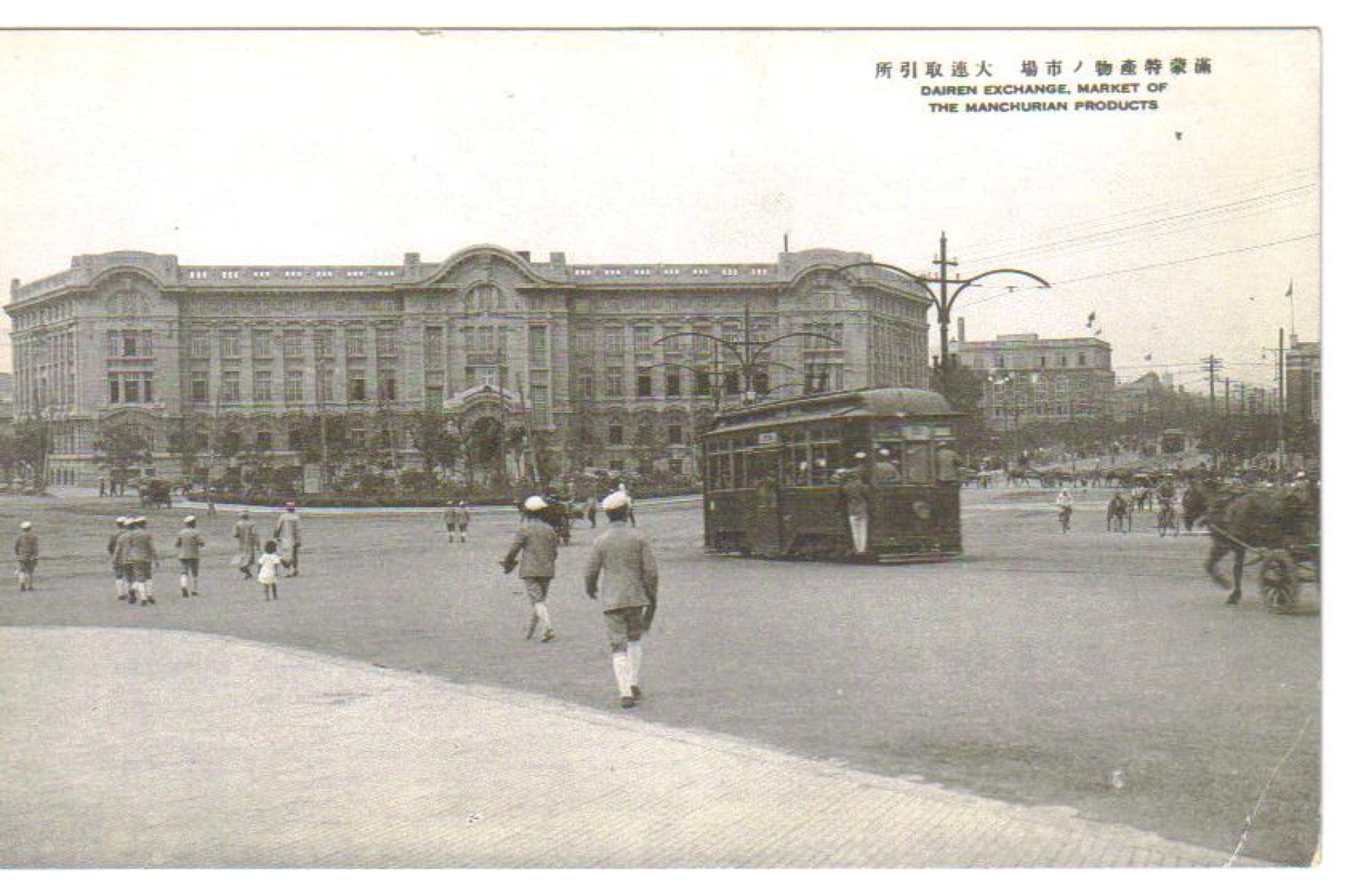
Dalian sits at the southern tip of the Liaodong Peninsula, commanding the entrance to the Bohai Gulf and maritime access to Tianjin and the broader North China Plain. This strategic position made it a coveted prize for successive imperial powers. Russia acquired a lease on the peninsula in 1898, establishing the commercial port of Dal’niy and linking it by 1902 to the Trans-Siberian Railway via the Chinese Eastern Railway through Harbin, as documented in the Encyclopaedia Britannica’s entry on Dalian. After Japan’s victory in the Russo-Japanese War and the 1905 Treaty of Portsmouth, the city—renamed Dairen—became Japan’s principal gateway to Manchuria. By 1931, Dairen ranked second only to Shanghai among China’s ports in trade volume. As Mizuno and Prodöhl documented in “Mitsui Bussan and the Manchurian Soybean Trade” (Business History, 2019), the port quickly surpassed its regional rival at Yingkou to become the major export and processing center for Manchuria’s lucrative soybean trade, with the population growing from 19,000 in 1906 to over 200,000 by 1926. Designated an “open city” for foreign investment in 1984 under Deng Xiaoping’s reforms, Dalian reinvented itself as a technology and finance hub. The Commodity Exchange’s location in the Xinghai CBD—adjacent to the convention center, the World Expo Center, and luxury developments ringing the vast reclaimed-land plaza—places it at the symbolic and geographic heart of this modern financial district, a few kilometers southwest of the older colonial-era commercial center around Zhongshan Square with its ring of Russian and Japanese neoclassical buildings.
The Dalian Commodity Exchange was founded on February 28, 1993, and commenced trading on November 18 of that year with its inaugural soybean futures contract, as recorded in the Futures Industry Association’s historical surveys. Its establishment came during a turbulent period for Chinese futures markets: following the Communist revolution in 1949, futures trading had been dormant for over forty years until liberalization in the late 1980s encouraged a proliferation of speculative forward contracts. By the early 1990s, over forty unauthorized exchanges had emerged nationwide, prompting the State Council to intervene. In October 1994, the first major rectification reduced the number of exchanges from over fifty to fifteen and delisted twenty futures contracts, as Williams, Peck, Park, and Rozelle noted in their early analysis of Chinese commodity markets (1998). A second rectification in 1998 further consolidated the industry to just three national-level exchanges: the Dalian Commodity Exchange, the Zhengzhou Commodity Exchange, and the Shanghai Futures Exchange. The DCE operates as a non-profit, self-regulating membership organization under the supervision of the China Securities Regulatory Commission (CSRC). Key milestones include the launch of No. 1 (non-GMO) soybean futures in March 2002, which within six months became the world’s largest non-GMO soybean futures contract; the introduction of corn futures in September 2004; the listing of China’s first petrochemical futures (LLDPE) in July 2007; the launch of iron ore futures on October 18, 2013, creating the world’s first physically delivered iron ore derivatives contract; and the debut of China’s first commodity option—soybean meal options—on March 31, 2017. The opening of iron ore futures to overseas traders on May 4, 2018, marked a watershed in the internationalization of Chinese commodity markets, as documented in the World Federation of Exchanges’ interview with DCE Chairman Li Zhengqiang (2018).
The Dalian Commodity Exchange trades futures and options contracts across six major sectors: grains, oilseeds, animal products, forest products, plastics and chemicals, and energy and minerals. Its foundational product was the soybean futures contract launched in 1993, reflecting Dalian’s historical centrality to China’s soybean-producing northeast. By 2002, the exchange had split its soybean offerings into No. 1 (non-GMO, for domestic crushing) and No. 2 (including imported GMO beans) contracts, and added soybean meal (2000), soybean oil (2006), and RBD palm olein (2007) to create a comprehensive oilseed complex. Corn futures, launched in 2004, became one of the world’s most actively traded agricultural contracts. The exchange expanded into industrial commodities with linear low-density polyethylene (LLDPE) in 2007—China’s first petrochemical futures product—followed by polyvinyl chloride (PVC) in 2009 and polypropylene (PP) in 2014. In the energy and minerals sector, coke and coking coal futures were introduced alongside the landmark iron ore futures contract in 2013, which as Yang, Li, and Qi documented in the Journal of Futures Markets (2021) became the world’s largest iron ore derivatives market with average daily volumes exceeding two million contracts. Egg futures made the DCE one of the few exchanges globally to list a fresh agricultural product, and live hog futures followed in January 2021. Trading is conducted almost entirely through an electronic matching system, with only a vestigial element of open outcry—a departure from the pit-trading heritage of Western commodity exchanges. The Futures Industry Association ranked the DCE as the world’s ninth-largest derivatives exchange in 2023, with 2.5 billion contracts traded. DCE futures prices now serve as domestic pricing benchmarks for approximately 70 percent of China’s soybean meal and palm oil spot trade, according to Chairman Li Zhengqiang’s statements to the World Federation of Exchanges (2018).
Images will be added as the project develops. Photographs by Larry Ng and from research sources.