Copenhagen Børsen (Børsbygningen)
Copenhagen, Denmark · Established 1640
This site requires authorization to access.
To request access, contact
william.goetzmann@yale.edu
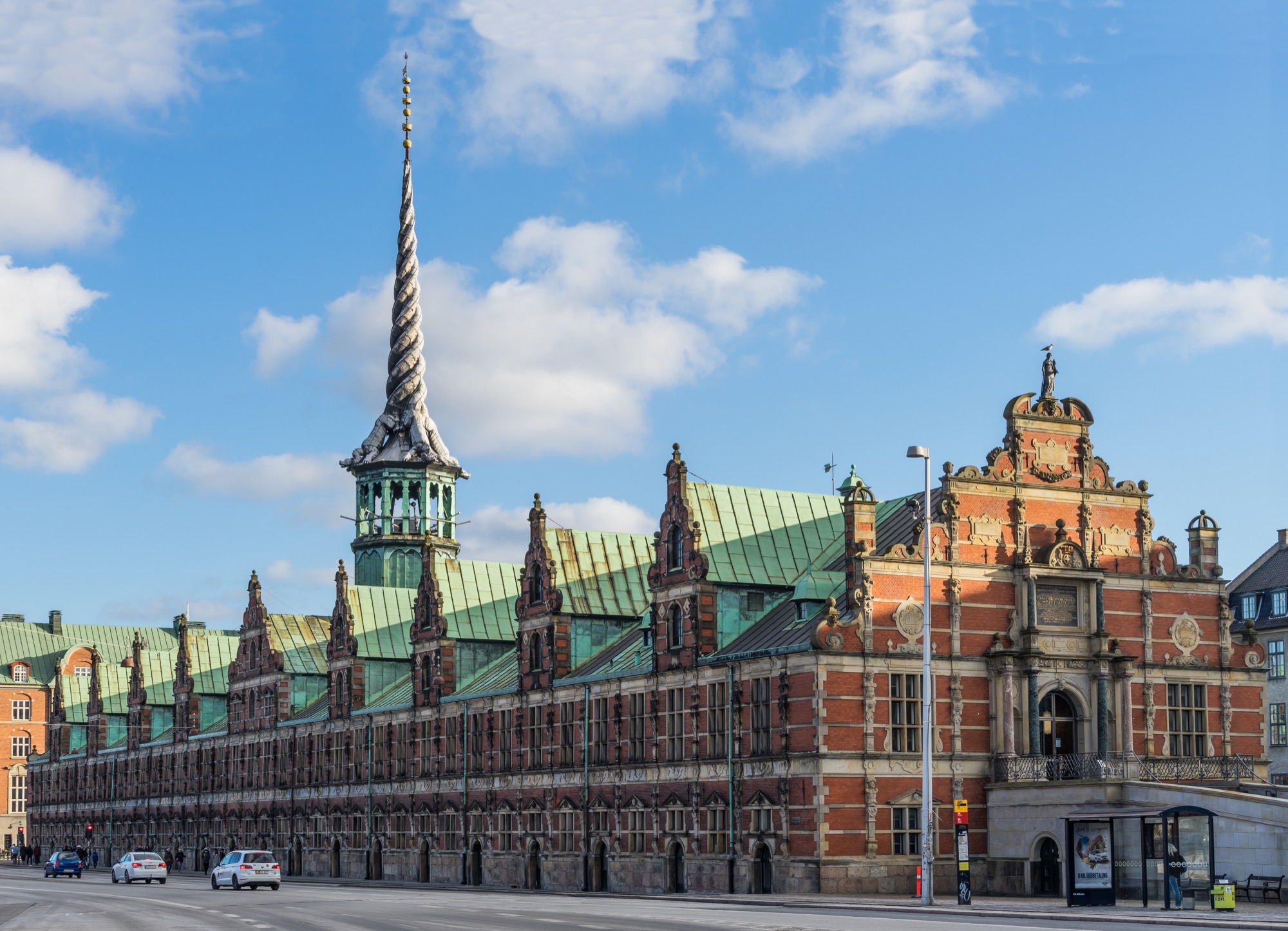
Designed by the brothers Lorenz and Hans van Steenwinckel the Younger, Børsen was constructed between 1619 and 1640 in the Dutch Renaissance style, stretching approximately 128 meters long and 21 meters wide with red brick walls and richly embellished stepped gables. The ground floor originally housed 40 trading offices, while the upper floor contained a single great hall of roughly 500 square meters used as a marketplace. Its most celebrated feature is the Dragespir (Dragon Spire), designed in 1624-25 by Ludvig Heidtrider, Christian IV's fireworks master, in which four dragon tails intertwine upward to a height of 56 meters, crowned by three golden crowns symbolizing the Scandinavian kingdoms of Denmark, Norway, and Sweden. The copper roofing, applied in 1883 and being replaced with recycled copper at the time, was consumed by a devastating fire on 16 April 2024 that destroyed roughly half the structure and toppled the iconic spire; reconstruction began in September 2024, with 800,000 new bricks ordered from a historic brickworks in Luneburg, Germany, to match the original 1624 materials.
Børsen's interior accumulated a remarkable collection of art across four centuries, including a large number of individual and group portraits commemorating Denmark's commercial leaders. Among the most significant works was Peder Severin Kroyer's monumental 1895 oil painting 'From the Copenhagen Stock Exchange,' a group portrait depicting fifty representatives of the Danish commercial and financial industries gathered in the Great Hall. The building also housed Lorenz Frolich's four large charcoal cartoon drawings allegorizing the virtues of Work, Justice, Courage, and Love, along with a two-tonne bust of King Christian IV. When fire struck in April 2024, staff, emergency workers, and passersby rushed to carry hundreds of paintings and historic furnishings to safety; the nearby National Museum dispatched 25 employees to assist in the rescue, and Kroyer's great painting was among the works successfully saved.
Børsen stands on Slotsholmen, the small island in Copenhagen's inner harbor that has served as the seat of Danish governmental power since the medieval period, placing the exchange in immediate proximity to Christiansborg Palace, which houses the Danish Parliament, Supreme Court, and Prime Minister's Office. Construction began in 1620 on a causeway linking Slotsholmen to the newly built Knippelsbro bridge, which connected to Christian IV's ambitious new district of Christianshavn, founded in 1618, making the exchange a literal gateway between old Copenhagen and the king's expanding mercantile quarter. Surrounded by canals and harbor waters, with nine bridges connecting the island to the rest of the city, Børsen occupied a position of both symbolic and practical significance -- a monument to trade situated at the crossroads of government, commerce, and maritime access.
King Christian IV commissioned Børsen as part of his sweeping vision to transform Copenhagen from a peripheral northern capital into a major Baltic trading hub capable of rivaling Amsterdam and Hamburg, with construction beginning in 1619 and the Dragon Spire completed by 1625. The building initially served as a commodities bourse where merchants rented stalls to trade goods from across the known world; the Danish East India Company, chartered in 1616, was among the early joint-stock ventures whose informal securities trading took place within its walls. The Danish Chamber of Commerce acquired the building in the 1850s, and architect Harald Conrad Stilling redesigned the interior in 1855-57 to function as a modern exchange; Børsen continued to house the Danish stock market until trading operations relocated in 1974. On 16 April 2024, during renovation of the copper roof, a catastrophic fire -- whose cause was officially ruled non-criminal but remains undetermined -- destroyed approximately half the building and brought down the spire, prompting King Frederik X to lay a foundation stone for reconstruction on 26 September 2024.
Børsen was purpose-built as a commodities exchange, and its ground-floor stalls teemed with merchants dealing in grain, fish, salt, fur, cheese, and exotic spices, as well as books, maps, fine textiles, and furniture -- a reflection of Denmark's aspirations to command Baltic and global trade routes. Informal securities trading also took place within its walls from an early date, connected to ventures such as the Danish East India Company (chartered 1616), and by the early nineteenth century the exchange had evolved to accommodate organized trading in stocks, bonds, and foreign currencies. The Copenhagen Stock Exchange was formally established in 1808, and Børsen served as the physical home of Danish securities trading until 1974, when market operations moved to a modern facility, leaving the historic building to the Danish Chamber of Commerce.
Images will be added as the project develops. Photographs by Larry Ng and from research sources.