Colombo Stock Exchange (CSE)
Colombo, Sri Lanka · Established 1985
This site requires authorization to access.
To request access, contact
william.goetzmann@yale.edu
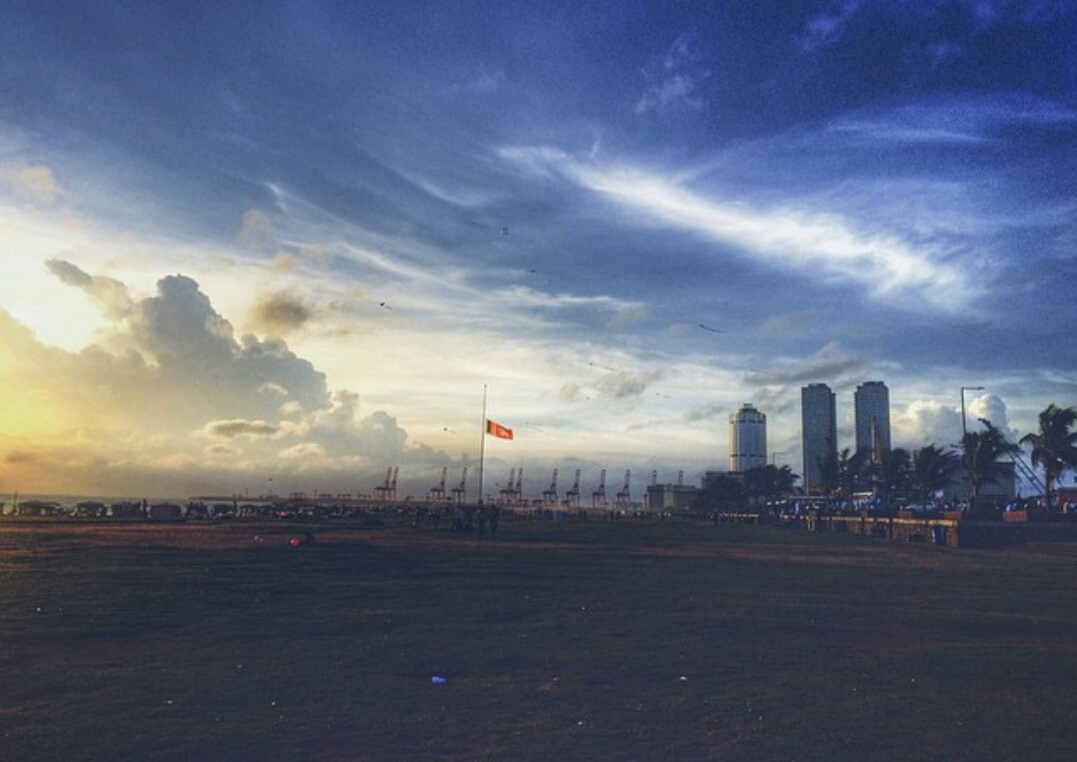
The Colombo Stock Exchange occupies premises within the World Trade Center Colombo (WTCC), a twin-tower commercial complex that has dominated the city’s skyline since its inauguration on 12 October 1997 by President Chandrika Bandaranaike Kumaratunga. The WTCC was the vision of Shing Pee Tao, founder of the Singapore-based Shing Kwan Group, who in 1991 acquired Overseas Realty (Ceylon) PLC—a company that held the undeveloped plot at Echelon Square in the Fort district of Colombo. Tao committed approximately USD 130 million, then the largest single foreign direct investment in Sri Lankan history, and engaged Turner Steiner International of the United States as the principal construction contractor. Ground was broken in 1992 and the five-year build produced two identical thirty-nine-storey towers rising 152 metres above a four-storey retail podium, yielding over 750,000 square feet of leasable commercial space. The structural system employs pre-fabricated pre-cast concrete panels for exterior cladding, bolted to reinforced-concrete columns and beam frameworks, while the façade is finished in a curtain wall of tinted glass and aluminium mullions that lend the towers their characteristic reflective sheen against the Indian Ocean horizon. Interior specifications include 110-millimetre raised flooring to accommodate flexible cable management, a floor-to-ceiling height of 2.5 metres within a structural slab-to-soffit clearance of 3.7 metres, and column-free floor plates exceeding 8,000 square feet—features that allowed the CSE to configure its trading operations, surveillance rooms, and administrative offices to modern institutional standards. Each tower is served by ten high-speed passenger elevators and a service elevator, alongside variable-air-volume central air-conditioning with floor-level air-handling units. The site at Echelon Square carries deep historical resonance: it was formerly the Echelon Barracks, a late-nineteenth-century British military cantonment whose two-storey barrack blocks surrounded a parade ground adjacent to what is now the Presidential Secretariat. The barracks were demolished in the early 1970s, and the land passed through several development proposals before Tao’s WTCC project transformed it into the commercial anchor of post-independence Colombo.
The decorative program of the World Trade Center Colombo expresses the confident internationalism of late-twentieth-century commercial architecture rather than drawing on indigenous Sinhalese or Tamil artistic traditions. The towers’ tinted-glass curtain walls function as a vast reflective surface, mirroring the harbour, the Indian Ocean, and the colonial-era buildings of the Fort quarter—a deliberate visual dialogue between Sri Lanka’s mercantile past and its aspirations for global integration. The lobby interiors feature polished stone flooring, brass detailing, and display cases that have periodically hosted exhibitions of Sri Lankan financial instruments, including reproductions of early share certificates issued by the Colombo Share Brokers’ Association, which commenced operations in 1896 to facilitate trading in plantation-company equities. Within the CSE’s own premises, the evolution from open-outcry to electronic trading has left its physical traces: the original trading floor, installed when the exchange moved into the WTCC in 1997, was designed as a tiered amphitheatre with electronic display boards showing real-time price feeds—a layout modelled on the automated exchanges then emerging across Asia. The Automated Trading System (ATS), installed in 1997, replaced the floor with ranks of dealer terminals, and the physical space was reconfigured to house the Central Depository Systems (Pvt) Limited (CDS), the exchange’s wholly owned subsidiary responsible for electronic clearing and settlement since 1991. The broader Fort commercial quarter surrounding the WTCC preserves a rich material culture of mercantile display: the Cargills Building on York Street (1906), with its Neo-Renaissance red-brick arches and ornamental parapets, was reputedly Asia’s first department store, provisioning colonial planters with luxury goods. Nearby, the Grand Oriental Hotel (opened 1875) retains its white-painted colonial façade and served as the first point of entry for merchants arriving by sea, linking the decorative aspirations of colonial commerce to the modernist glass towers that now house the nation’s principal securities market.
The Colombo Stock Exchange is situated within the Fort district, the historic nucleus of Colombo’s commercial life and the area that successive colonial powers—Portuguese, Dutch, and British—fortified and reshaped over five centuries. The Portuguese erected a fort here in 1518 to protect their cinnamon trade; the Dutch, after capturing the city in 1656, demolished and rebuilt the western fortifications into a more formidable enceinte known as the Casteel, restructuring the street grid that persists in today’s Fort and Pettah layouts. When the British took possession in 1796, they initially maintained the ramparts, but between 1869 and 1871 they demolished the walls to the north, east, and south to accommodate new military barracks—the Echelon Barracks—and to clear space for the planned expansion of the harbour and commercial quarter. As the geographer K. Kulasingam documented in research on the origin and expansion of the Colombo urban area, the demolition of the fortifications in the 1870s transformed the Fort into an open commercial precinct. York Street and Chatham Street became the principal mercantile axes, lined with agency houses, banks, auction rooms, and the offices of the Ceylon Chamber of Commerce (founded 1839). The harbour, expanded under British administration, attracted steamship lines that linked Colombo to London, Calcutta, Singapore, and Sydney, making the Fort area the gateway through which plantation exports—tea, rubber, coconut, and cinnamon—reached world markets. The World Trade Center’s twin towers now anchor the western end of the Fort precinct, standing on the former Echelon Barracks site adjacent to the Presidential Secretariat (formerly the Old Parliament) and within sight of the Colombo Lighthouse and the clock tower. The Pettah bazaar, the traditional retail and wholesale market quarter, abuts the Fort to the east, maintaining a commercial continuity that stretches from medieval Arab and Chinese trading contacts through the colonial plantation economy to the contemporary financial district.
The origins of organized securities trading in Sri Lanka lie in the plantation economy of British Ceylon. As tea cultivation expanded dramatically in the 1880s—surpassing coffee acreage by 1888 and reaching nearly 400,000 acres under cultivation by 1899—British planters required capital to establish and expand estates, and the mechanism of the limited-liability company, already well developed in London, was adapted to the colony. The Colombo Share Brokers’ Association was founded in 1896 to facilitate trading in the shares of these plantation enterprises, operating from premises in the Fort commercial quarter. In 1904, a rival organization, the Colombo Brokers’ Association, began auctioning land shares, and the two bodies coexisted as over-the-counter dealers for decades. The Ceylon Chamber of Commerce, established in 1839 by Governor James Alexander Stewart-Mackenzie with thirteen representatives of the mercantile community, provided the institutional framework within which these brokerage operations developed, alongside the formation of the Colombo Tea Traders’ Association in 1894. The plantation economy was dominated by “sterling companies” and “rupee companies”—British-incorporated and locally-incorporated firms respectively—with agency houses providing management services. By 1930, sterling companies owned roughly eighty percent of tea and fifty percent of rubber estates. Sri Lanka’s nationalization of some 502 privately held estates during 1971–1975 disrupted this structure, but President J. R. Jayewardene’s sweeping economic liberalization of 1977 opened the economy to foreign investment, relaxed exchange controls, and set the stage for capital-market development. In 1985, seven stockbroker firms organized the Colombo Securities Exchange Guarantee Limited, which opened a dedicated trading floor in December of that year. The exchange was renamed the Colombo Stock Exchange in 1990. The Securities and Exchange Commission of Sri Lanka, established by Act No. 36 of 1987, provided the regulatory architecture. Automation proceeded rapidly: the Central Depository System for electronic clearing and settlement was implemented in 1991, and the Automated Trading System replaced open-outcry trading in 1997. The exchange survived the disruptions of Sri Lanka’s civil war, including the devastating Central Bank bombing of 31 January 1996—which killed ninety-one people and destroyed the Central Bank’s computer systems—and the LTTE truck-bomb attack on the World Trade Center and adjacent Galadari Hotel on 15 October 1997, which killed eighteen and shattered the towers’ glass façade but did not compromise their structural integrity. Since the end of the civil war in 2009, the CSE has expanded substantially, and demutualization legislation has been advanced to transform the exchange from a company limited by guarantee into a for-profit entity.
The Colombo Stock Exchange lists approximately 284 companies across twenty Global Industry Classification Standard (GICS) sectors, with a total market capitalization that surpassed LKR 8 trillion in 2025. The exchange’s sectoral composition mirrors Sri Lanka’s economic structure, in which services contribute over sixty percent of GDP, industry around thirty percent, and agriculture under nine percent. Financial services dominate market capitalization, anchored by major commercial banks such as the Commercial Bank of Ceylon, Hatton National Bank, and Sampath Bank, alongside insurance companies and diversified financial conglomerates. The diversified-holdings sector is disproportionately influential, with conglomerates like John Keells Holdings, Hayleys, and the Carson Cumberbatch Group—direct descendants of the colonial-era agency houses that managed plantation estates and brokered commodity trades—ranking among the largest listed entities. The plantation sector, though now a smaller share of market capitalization, remains a symbolically important listing category: companies like Kelani Valley Plantations, Watawala Plantations, and Bogawantalawa Tea Estates carry forward the legacy of the tea, rubber, and coconut enterprises whose need for equity capital gave birth to share trading in Colombo in 1896. Sri Lanka’s Colombo Tea Auction, established in 1883 and historically the world’s largest, operates separately from the stock exchange but is institutionally intertwined through the Colombo Tea Traders’ Association (founded 1894); approximately ninety-five percent of Sri Lanka’s annual production of some 300,000 metric tons of tea passes through the auction. Beyond equities, the CSE has progressively broadened its product range to include corporate and government debt securities. The Central Depository Systems (Pvt) Limited, the CSE’s wholly owned subsidiary, provides electronic settlement on a T+2 cycle, and the exchange’s 2025 launch of CSE Clear as a central counterparty represents the latest step in building a modern market infrastructure. The exchange also tracks twenty sector price indices, allowing investors to calibrate exposure to industries ranging from apparel manufacturing and telecommunications to hotels, power and energy, and the gem and jewellery trade—the last reflecting Sri Lanka’s storied position as the “Island of Gems,” whose sapphire, ruby, and topaz exports have attracted traders since antiquity.
Images will be added as the project develops. Photographs by Larry Ng and from research sources.