Cleveland Stock Exchange
Cleveland, USA · Established 1899
This site requires authorization to access.
To request access, contact
william.goetzmann@yale.edu
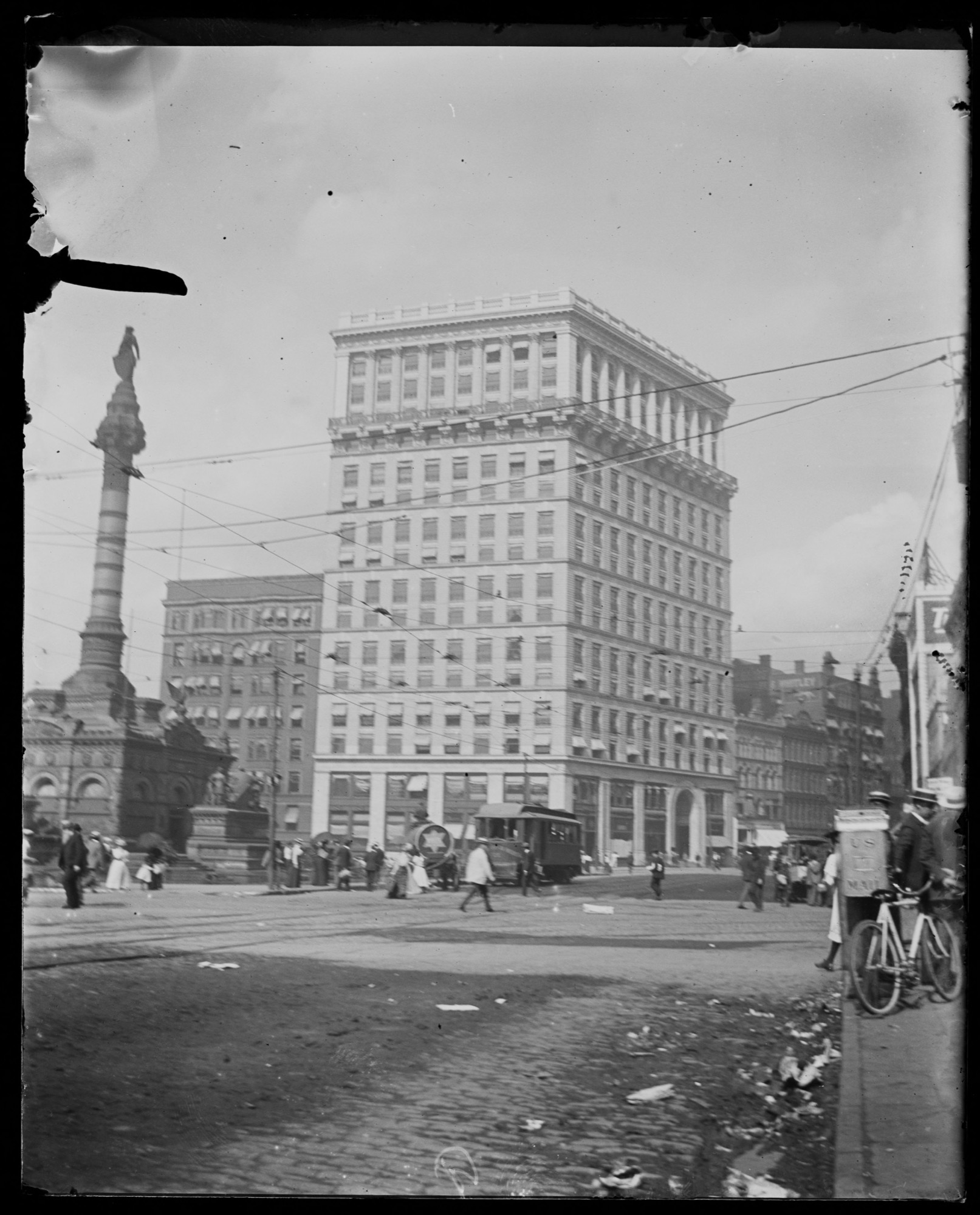
The Cleveland Stock Exchange opened for trading on April 16, 1900, occupying quarters in the newly completed Williamson Building on the southeast corner of Public Square. Designed by George B. Post and Sons—one of America’s most influential architectural firms, known for pioneering skyscraper design—the seventeen-story Williamson Building was the tallest structure in Cleveland at its completion (Encyclopedia of Cleveland History, “Williamson Building”). Post employed an all-steel structural frame, with steelwork fabricated by the local Van Dorn Company, clad in a classically detailed masonry envelope that conveyed civic gravitas. The ground-floor lobby featured a semi-circular plan with marble floors and walls, bronze elevator doors and surrounds, and a grand arched entrance facing Public Square (Encyclopedia of Cleveland History, “George B. Post and Sons”). The exchange’s trading room occupied space within this commercial tower alongside other tenants including the Cleveland Trust Company and, later, the Federal Reserve Bank of Cleveland. In the 1920s the exchange relocated to the Union Trust Building at 925 Euclid Avenue, designed by Graham, Anderson, Probst and White and completed in 1924. That twenty-one-story structure contained over one million square feet of floor space and boasted the world’s largest bank lobby—a four-story L-shaped hall measuring 224 feet along East Ninth Street and 304 feet along Chester Avenue, framed by massive Corinthian columns and barrel-vaulted ceilings (Cleveland Historical, “Union Trust Building”). The Williamson Building was demolished in 1982 to make way for the Sohio (now 200 Public Square) skyscraper, a loss that architectural historians still lament.
The decorative programs of the buildings that housed the Cleveland Stock Exchange reflected the ambitions of a city whose industrial wealth demanded architectural expression. In the Williamson Building, George B. Post integrated ornamental bronze work into the elevator surrounds and lobby fixtures, complementing the polished marble wall surfaces that characterized his classically inflected commercial interiors (Freshwater Cleveland, “George B. Post and Francis Millet,” 2021). Adjacent to the exchange on Public Square stood the Society for Savings Building (1890), designed by John Wellborn Root of Burnham and Root, whose interior banking hall featured a twenty-six-foot-high stained-glass skylight and two large murals by the English illustrator Walter Crane depicting the legend of the goose that laid the golden egg—a didactic allegory of prudent investment that would have resonated with nearby exchange members (Cleveland Historical, “Society for Savings”). When the exchange moved to the Union Trust Building in the 1920s, its members traded beneath a far grander decorative scheme: the monumental bank lobby featured murals by Jules Guerin, the renowned artist who also painted the interior murals of the Lincoln Memorial in Washington, D.C. Guerin’s compositions adorned the barrel-vaulted ceilings alongside elaborate skylights, while enormous marble Corinthian columns established a visual vocabulary of classical finance (Encyclopedia of Cleveland History, “Huntington Building”). The architectural ornament of Cleveland’s financial buildings thus embodied what the cultural historian Daniel Bluestone has called the “moral geometry” of commercial architecture—the use of classical forms to legitimize capitalist enterprise.
The Cleveland Stock Exchange was situated at the heart of what became northeastern Ohio’s foremost financial corridor. Its first home, the Williamson Building, stood on Public Square—the city’s civic and commercial nucleus since Moses Cleaveland’s original 1796 town plan—at the monumental gateway to Euclid Avenue. By 1900, Euclid Avenue was already famous as “Millionaires’ Row,” lined with the mansions of industrial magnates including John D. Rockefeller, Amasa Stone, and Marcus Hanna; Baedeker’s Travel Guide dubbed it the “Showplace of America” (Cleveland Historical, “Millionaires’ Row”). As the avenue’s residential character gave way to commercial development in the early twentieth century, the intersection of Euclid Avenue and East Ninth Street emerged as Cleveland’s banking epicenter. Three rival financial giants—Cleveland Trust (southeast corner), Union Trust (northeast corner), and Guardian Trust (northwest)—clustered within a single block in what is now called the Nine-Twelve District (Encyclopedia of Cleveland History, “Banking”). Cleveland Trust’s 1908 headquarters, also designed by George B. Post, featured a magnificent neoclassical rotunda with a stained-glass dome by the Tiffany Studios. When the stock exchange relocated to the Union Trust Building in the 1920s, it joined a district that rivaled LaSalle Street in Chicago or Wall Street in lower Manhattan as a concentrated node of Midwestern finance. By 1920, Cleveland had risen to the nation’s fifth-largest city, and its downtown financial district channeled the capital flows of the Great Lakes industrial economy.
The Cleveland Stock Exchange was organized in 1899 and commenced trading on April 16, 1900, propelled by the city’s explosive industrial growth during the Gilded Age. Its principal organizer, Charles Augustus Otis Jr.—a Yale-trained steel broker who in 1899 purchased the first New York Stock Exchange seat held by a Clevelander—formed the banking firm Otis and Hough specifically to market steel securities, and subsequently became the exchange’s first president (Encyclopedia of Cleveland History, “Otis, Charles Augustus, Jr.”). In 1912 Otis reorganized his firm as Otis and Co., which grew into one of Cleveland’s leading investment banks; the young Cyrus Eaton joined the firm in 1916 before building his own industrial empire. The exchange served as a crucial venue for capitalizing Ohio’s manufacturing base during the Progressive Era and through World War I. By August 1948, press reports indicated that brokers across the Midwest were discussing a large-scale merger of regional exchanges, projecting a combined annual trading volume of $350 million that would create the largest U.S. exchange outside New York. In October 1949, Cleveland’s members voted to dissolve and merge with the Chicago and St. Louis exchanges to form the Midwest Stock Exchange, effective December 1949 (Eugene N. White, “Competition Among the Exchanges before the SEC,” NBER Working Paper 18712, 2013). The Cleveland Stock Exchange Records, preserved at the Western Reserve Historical Society and cataloged through OhioLINK, document a half-century of regional financial history. The exchange’s absorption into the Midwest Exchange reflected a nationwide pattern of consolidation that reduced over two dozen American regional exchanges to fewer than ten by mid-century.
The Cleveland Stock Exchange distinguished itself from the New York Stock Exchange by emphasizing locally rooted industrial and banking securities rather than railroad issues. In 1900, railroads comprised approximately 40 percent of Cleveland’s listed firms, compared with 52 percent on the NYSE; by 1910, railroads had fallen to just 15 percent of the Cleveland roster, displaced by banks, trust companies, utilities, and manufacturing concerns (Mary O’Sullivan, “The Expansion of the U.S. Stock Market, 1885–1930,” Enterprise and Society 8, no. 3, 2007). The number of manufacturing firms listed on the exchange doubled between 1910 and 1914, reflecting the rapid growth of Cleveland’s steel, iron ore, petroleum refining, chemical, and paint industries—enterprises built on the city’s strategic position at the convergence of Lake Erie shipping and railroad freight (Encyclopedia of Cleveland History, “Industry”). Securities of firms like the Otis Iron and Steel Company, Cleveland Rolling Mill, and companies linked to the Standard Oil empire circulated alongside shares in local banks and trust companies that financed the region’s industrial expansion. Eugene N. White’s analysis of pre-SEC exchange competition found that in the second half of 1927, the Cleveland Stock Exchange handled approximately 700,000 shares—modest alongside Boston’s 5.7 million or Chicago’s 6.8 million, but reflective of a vigorous regional market serving northeastern Ohio’s capital needs (White, “Competition Among the Exchanges,” NBER Working Paper 18712). Haskel Benishay’s 1962 study of Midwest Exchange stocks in the 1950s further documented the investor experience on the consolidated successor that inherited Cleveland’s listings.
Images will be added as the project develops. Photographs by Larry Ng and from research sources.