Cincinnati Chamber of Commerce Building
Cincinnati, United States · Established 1839 (institution); 1889 (Richardson building)
This site requires authorization to access.
To request access, contact
william.goetzmann@yale.edu
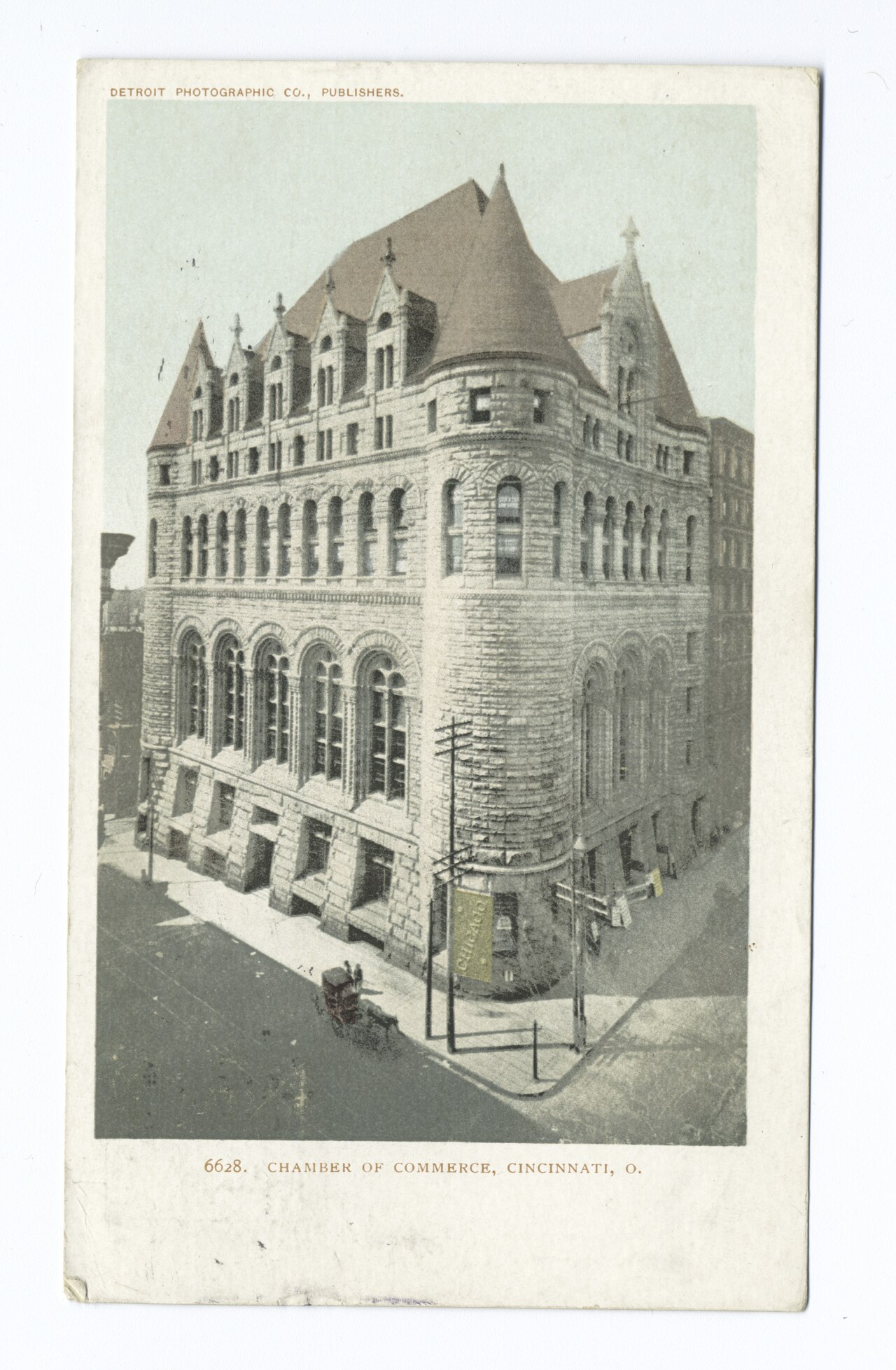
Cincinnati's Chamber of Commerce Building, erected at the southwest corner of Fourth and Vine Streets between 1886 and 1889, was among the last and most celebrated commercial commissions of Henry Hobson Richardson (1838-1886), the Boston architect whose manner gave its name to the Richardsonian Romanesque style. Richardson won the design competition on June 8, 1885 -- announced the previous December -- besting a Flemish-inspired entry by Burnham & Root, but he died in April 1886 with the work only begun; it was carried to completion by his successor firm, Shepley, Rutan and Coolidge. The building was a massive cube of rock-faced 'pink Milford' (Worcester) granite crowned by a steep red-tile hip roof bristling with high-pitched dormers and corner towers, its surfaces wrapped in the broad, three-story round arches that were Richardson's signature. As the architectural historian writing at thearchitectureprofessor.com has noted, Richardson here refined the wall treatment of his earlier Allegheny County Courthouse, drawing the sill courses into the wall plane to produce 'a unified mass that has been wrapped with a continuous surface.' The most ingenious feature was structural: the section was organized in three layers -- ground-floor rental shops, a soaring 48-foot Exchange Hall, and three suspended floors of offices and clubrooms hung from steeply angled iron roof trusses -- so that the trading hall below could remain a vast, column-free room. Richardson had pronounced the structure 'fire-proof throughout,' a claim tragically disproved in 1911.
Artistically the building was austere by the standards of Gilded-Age commercial palaces, its power residing in the sculptural massing of granite rather than in applied ornament -- a discipline characteristic of Richardson's mature work. The chief decorative accents were carved stone detailing on the arches, capitals and string-courses, together with a set of marble eagles; when the building was demolished, four of these eagles were salvaged and relocated to the Melan Arch Bridge on Eden Park Drive, as documented by Cincinnati Magazine's 'Lost City' feature. The lost interior of the Exchange Hall is best preserved today through pictorial record rather than surviving fabric, including the oil painting of the building by the Cincinnati artist Louis Charles Vogt (1864-1939), held by the Cincinnati Museum Center, and contemporary photochrom postcards issued by the Detroit Publishing Company. The most poignant 'artwork' the building yielded is posthumous: the 1972 memorial in Burnet Woods, designed by University of Cincinnati architecture student Stephen Carter and assembled from fifty-one salvaged granite pieces around the fourteen-ton carved 'Chamber of Commerce' lintel, which locals nicknamed Cincinnati's own Stonehenge.
The Chamber stood at the commercial heart of nineteenth-century Cincinnati, at Fourth and Vine in the downtown business district just blocks north of the Ohio River public landing that made the city the 'Queen City of the West' and the gateway of trade to the western frontier. Fourth Street was the city's financial spine, lined with banks and insurance houses, and Richardson's granite pile -- the most monumental structure of its day in the district -- announced the mercantile ambition of a city that in 1850 ranked sixth in the nation. The building was the headquarters and meeting hall of the regional commercial elite, a counterpart in the urban fabric to the produce wharves, packing houses and railroad depots whose business it regulated. After the 1911 fire the site was redeveloped, and the heart of downtown commerce shifted; the building's only physical survivor, the Burnet Woods memorial, now sits more than two miles north near the University of Cincinnati's Clifton campus.
The institution housed in the building was older than its monumental home. As recounted on Wikipedia and on the Cincinnati Regional Chamber's own history, the Cincinnati Chamber of Commerce was organized on October 15, 1839, when seventy-six firms and individuals advertised in the Cincinnati Daily Gazette to form 'a Chamber of Commerce and Board of Trade' for uniform regulation of the city's mercantile interests -- predating by decades the national U.S. Chamber of Commerce, which would hold its inaugural meeting in Cincinnati in 1912. Reorganized as the Chamber of Commerce and Merchants' Exchange (a name preserved on its 1882 stock certificates, per Scripophily.net), the body kept the official records of the city's commerce -- imports and exports by canal, river and rail, and the arrivals and departures of goods. The handsome Richardson hall it commissioned at the peak of its prosperity cost $772,674.05, a figure made notorious when a grease fire in a top-floor clubroom kitchen during a banquet on January 10, 1911 gutted the supposedly fireproof structure; with only $90,000 of insurance, repair proved impossible. Roughly 3,000 tons of granite were saved and stored at Oakley, Ohio, until University of Cincinnati professor John Peterson revived them for the 1972 memorial.
The Chamber's exchange floor served the agricultural and processing economy that earned Cincinnati its nickname 'Porkopolis.' From the 1820s through the 1860s the city was the premier pork-packing center of the United States: in 1840 some 1,200 workers in forty-eight packing houses produced more than three million dollars' worth of packed pork, and the hog's by-products spawned a vast trade in lard oil, candles and soap -- by the 1850s Cincinnati produced a fifth of the nation's lard oil. Around this core the merchants of the Exchange dealt in grain, flour, provisions, whiskey and the produce of the Ohio valley, with the Chamber compiling the price and shipment statistics that ordered the regional market. As the meatpacking trade migrated to railroad-connected Chicago and Kansas City after the transcontinental line opened in 1869 -- Chicago overtaking Cincinnati by 1885 -- the city's commerce shifted toward whiskey and beer, whose combined export value topped $39 million by the early 1890s, nearly twice that of livestock. The Richardson building thus opened just as the trades it served were transforming from frontier provisioning to an industrial economy of distilling, brewing and machine-making.
Images will be added as the project develops. Photographs by Larry Ng and from research sources.