Chicago Stock Exchange
Chicago, USA · Established 1882
This site requires authorization to access.
To request access, contact
william.goetzmann@yale.edu
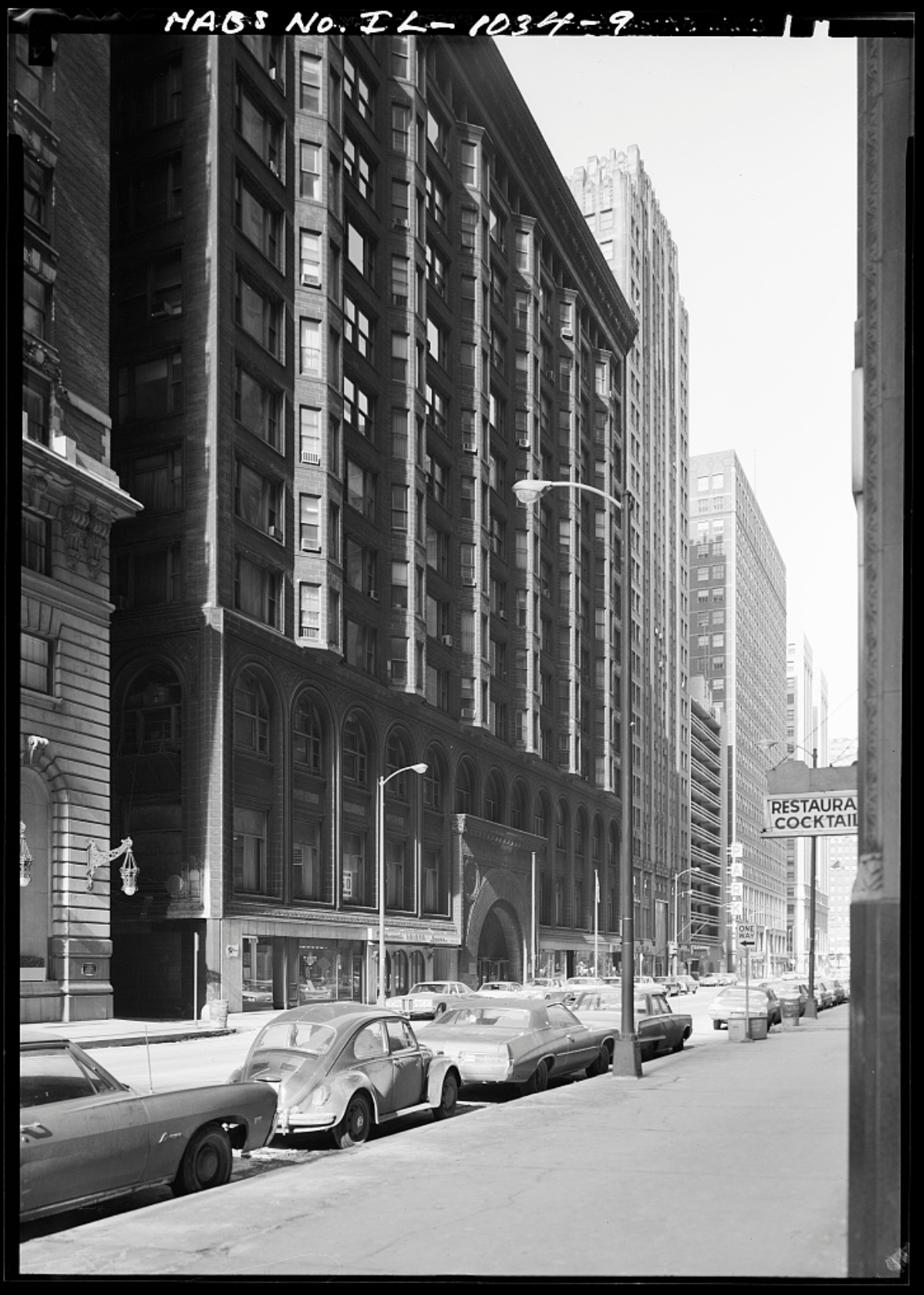
The Chicago Stock Exchange Building, erected in 1893–94 at the southwest corner of LaSalle and Washington Streets, stands as one of the most significant commissions in the partnership of Dankmar Adler and Louis H. Sullivan—second in scale only to their Auditorium Building of 1889. As Robert Twombly documents in Louis Sullivan: His Life and Work (1986), the building was commissioned by the civic leader Ferdinand W. Peck as a thirteen-story speculative office structure with a steel frame clad in buff-colored ornamental terra cotta fabricated by the Northwestern Terra Cotta Company. Rising 172 feet to its roof, the building presented 100 feet of frontage on Washington Street and 180 feet along LaSalle, containing approximately 400 offices, two interior light courts, and ten elevators. The Library of Congress HABS survey (IL-1034) records it as the first building in Chicago to employ caisson foundations—cylindrical shafts hand-dug to bedrock and filled with concrete—an engineering innovation adapted from bridge construction by Adler. The centerpiece was the double-height Trading Room occupying the southern end of the main floor, a vast hall of approximately 7,000 square feet where brokers traded daily. Adler designed massive steel trusses concealed above the Trading Room ceiling to transfer the weight of eleven upper stories onto just four corner columns, creating a column-free trading arena of extraordinary openness. Hugh Morrison, in Louis Sullivan: Prophet of Modern Architecture (1935; revised edition with Timothy J. Samuelson’s introduction, 1998), identified the building as exemplary of the firm’s mature synthesis of structural rationalism and ornamental expression. Despite vigorous preservation campaigns and Chicago Landmarks designation in 1961, the building was demolished in 1971–72 to make way for a forty-three-story office tower. The preservation architect John Vinci, working with the Art Institute of Chicago, salvaged the monumental terra cotta entrance arch—reassembled in the museum’s east garden in 1977—and orchestrated the painstaking reconstruction of the entire Trading Room in a new wing, completed at a cost of approximately $700,000 and earning an Honor Award from the Chicago Chapter of the American Institute of Architects in 1980.
Louis Sullivan’s decorative program for the Chicago Stock Exchange Trading Room represents one of the most fully realized expressions of his philosophy of organic ornament applied to a commercial-financial interior. As Lauren Weingarden argues in Louis H. Sullivan and a 19th-Century Poetics of Naturalized Architecture (Ashgate, 2009), Sullivan translated Ruskinian tenets of Gothic naturalism and Whitman’s poetics of the American landscape into an ornamental system of “fluent geometry”—the fusion of inorganic geometric rigor with organic efflorescence. In the Trading Room, this philosophy materialized in an astonishing decorative ensemble: the walls and ceiling were covered with intricate stencil patterns executed in fifty-two colors, their interlocking vegetal and geometric motifs flowing across surfaces in what William Jordy, in American Buildings and Their Architects (1972), described as architecture where structure and ornament achieved indissoluble unity. Four hundred art-glass skylight panels, fabricated by the firm of Healy and Millet, admitted diffused natural light through the coffered ceiling, casting luminous atmosphere over the trading floor. Massive gold-leaf capitals crowned the cast-iron columns at the room’s corners, their surfaces alive with Sullivan’s signature intertwined foliate carvings. Sullivan’s posthumous treatise A System of Architectural Ornament, According with a Philosophy of Man’s Powers (1924) codified principles already manifest in the Trading Room—the notion that ornament should grow “naturally, logically, and poetically out of all its conditions,” beginning from a geometric seed-germ and unfolding into organic complexity. The decorative program was functional in its commercial context: the richly patterned environment signaled the gravitas and prosperity of the financial institution within, while the soaring, light-filled space channeled the energy and visual openness that securities trading demanded. Tim Samuelson, Chicago’s Cultural Historian, has emphasized that the Trading Room’s ornament constituted Sullivan’s most complete demonstration that architecture’s highest expression lay in integrating structure and decoration. Today, three hundred original art-glass panels, two gold-leaf capitals, and a stencil strip measuring thirty-seven by eighty-nine feet survive in the Art Institute of Chicago’s reconstruction.
The Chicago Stock Exchange Building occupied a site of supreme financial significance: 30 North LaSalle Street, at the intersection with Washington Street, in the heart of Chicago’s rapidly consolidating financial district. As the city rebuilt after the Great Fire of 1871, LaSalle Street emerged as Chicago’s answer to Wall Street—a canyon of banks, brokerage houses, and exchange buildings that would define Midwestern capital markets for over a century. The Board of Trade had originally occupied quarters near LaSalle and Washington before relocating four blocks south to Jackson Boulevard, where its monumental building (designed first by W. W. Boyington in 1885, then replaced by Holabird and Root’s Art Deco tower in 1930) anchored the street’s southern terminus. The Stock Exchange’s placement at the northern end of this corridor established a complementary institutional pole: commodities to the south at the Board of Trade, securities to the north at the Stock Exchange. The building rose during the transformative years of 1893–94, when, as Carl Condit documented in The Chicago School of Architecture (1964), the earliest group of Chicago’s tall buildings reshaped the Loop into a vertical city. Adler and Sullivan’s Stock Exchange stood among contemporaries like Burnham and Root’s Rookery (1888) and Monadnock Building (1891), and Holabird and Roche’s Marquette Building (1895), all clustered within blocks of one another. The building’s two interior courts addressed the practical urban challenge of admitting light and air into a deep commercial block. The demolition in 1972 and replacement by a generic office tower represented precisely the kind of erasure of Chicago School commercial architecture that galvanized the preservation movement—a loss that Tim Samuelson and others have identified as one of the catalytic events in the history of American architectural conservation.
The Chicago Stock Exchange was founded on March 21, 1882, with the banker Charles Henrotin elected as its first president. As Jonathan Lurie notes in The Chicago Board of Trade, 1859–1905 (1979), Chicago’s financial institutions had long been dominated by the Board of Trade, established in 1848. The Stock Exchange emerged to fill a distinct institutional niche: providing an organized marketplace for securities—stocks and bonds of the banking, railroad, and utility companies fueling Chicago’s explosive growth—rather than agricultural futures. During its first year, 750 memberships were sold, and offices opened at 115 Dearborn Street on May 15, 1882. In 1894, the institution moved into its magnificent Adler and Sullivan building at LaSalle and Washington. By 1908, the exchange had outgrown the building, which was subsequently occupied by Foreman Brothers Bank and later Bell Savings and Loan. In 1949, the institution merged with the stock exchanges of St. Louis, Cleveland, and Minneapolis-St. Paul to form the Midwest Stock Exchange, later absorbing the New Orleans Stock Exchange in 1959. The name reverted to Chicago Stock Exchange in 1993. The battle to save the Sullivan building became one of the most consequential preservation fights in American architectural history. The photographer and activist Richard Nickel, who had spent years documenting Sullivan’s endangered buildings, was killed on April 13, 1972, when the partially demolished structure collapsed on him as he attempted to salvage ornamental fragments—a tragedy chronicled in Richard Cahan and Michael Williams’s Richard Nickel’s Chicago: Photographs of a Lost City (2006) that transformed the demolition from a local controversy into a national reckoning with the costs of urban renewal.
The Chicago Stock Exchange was founded in 1882 specifically to provide an organized securities marketplace distinct from the Chicago Board of Trade, which since 1848 had dominated the city’s financial life as a commodity exchange handling grain futures and provisions. As Charles Henrotin and the exchange’s founders recognized, Chicago’s booming industrial economy—its railroads, utilities, packinghouses, and banks—was generating a growing volume of equity and debt securities that required a dedicated trading venue. The exchange specialized from its inception in stocks and bonds of local and regional enterprises: shares in railroad companies connecting Chicago to the continental interior, bonds of gas and electric utilities electrifying the rapidly growing metropolis, and stock in the banking institutions financing it all. Through syndicates organized by figures like Henrotin, the exchange facilitated the placement of securities totaling tens of millions of dollars for ventures such as the Chicago Brewing and Malting Company, the Junction Railways, and the Union Stock Yards Company. The distinction between the Stock Exchange and the Board of Trade was fundamental to Chicago’s financial geography: the Board of Trade, at the southern end of LaSalle Street, set global prices for wheat, corn, and pork bellies through its open-outcry futures pits, while the Stock Exchange, at the northern end, enabled investors to buy and sell ownership stakes in the companies that produced, transported, and financed those commodities. This complementary institutional structure made LaSalle Street one of the most comprehensive financial corridors in the world outside of Lower Manhattan. After the 1949 merger that created the Midwest Stock Exchange, the institution broadened to list over 3,000 securities including issues from the New York Stock Exchange and NASDAQ, evolving from a regional marketplace into a national venue specializing in large block trades for institutional investors.


