Chicago Mercantile Exchange (CME)
Chicago, USA · Established 1898
This site requires authorization to access.
To request access, contact
william.goetzmann@yale.edu
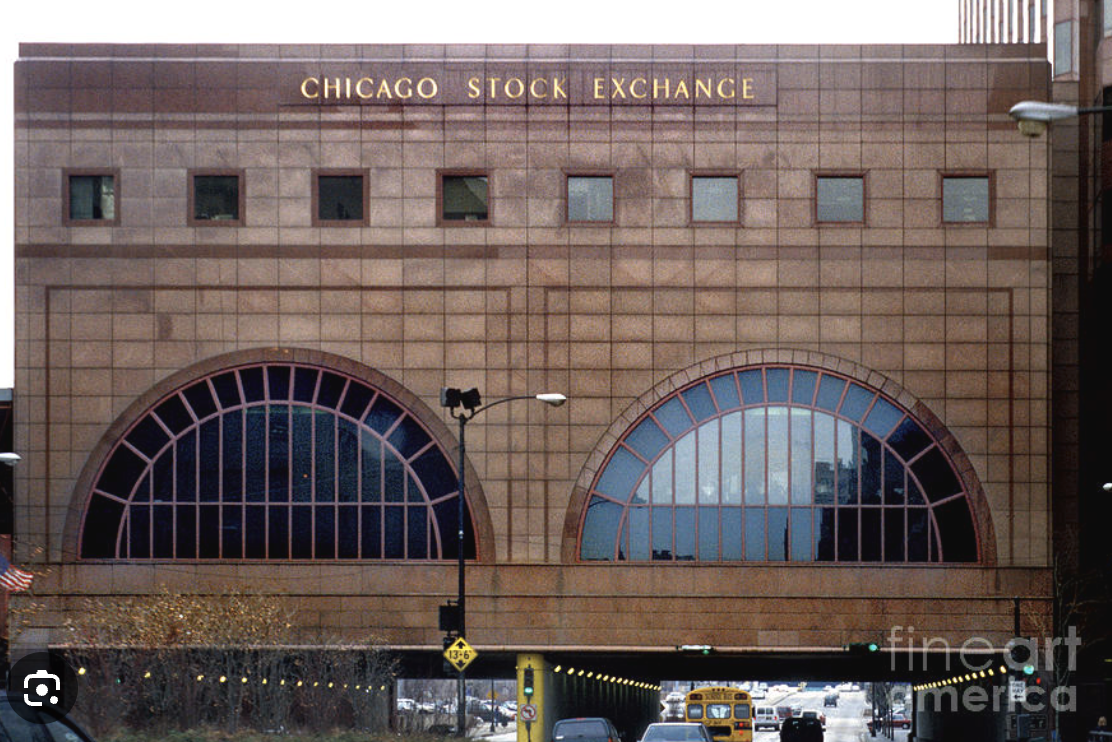
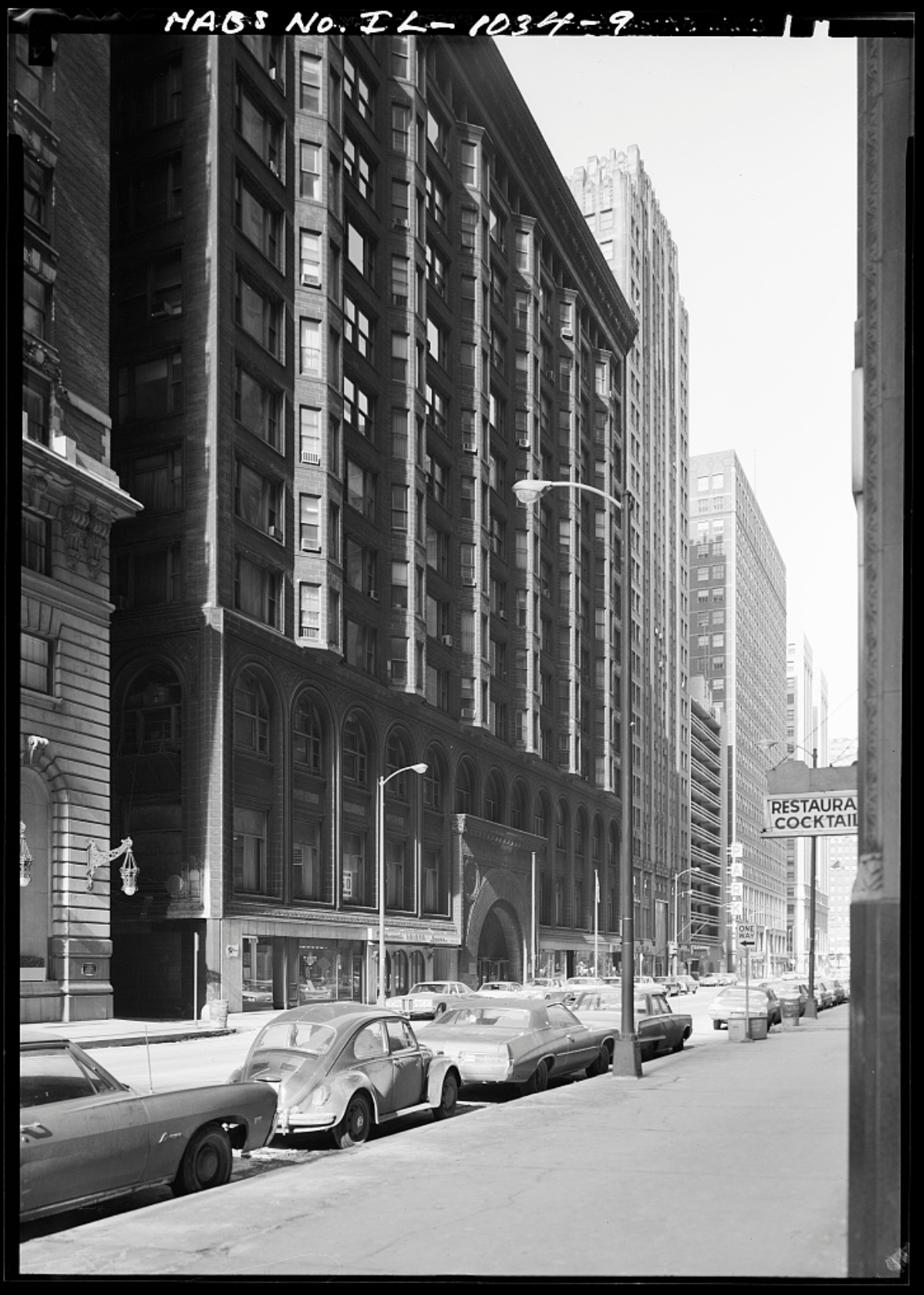
The physical history of the Chicago Mercantile Exchange is a chronicle of architectural ambition tracking the growth of derivatives markets themselves. The exchange’s earliest ancestor, the Chicago Butter and Egg Board, operated from modest quarters at LaSalle and Lake streets beginning in 1898. When the reorganized CME required purpose-built facilities, architect Alfred S. Alschuler designed the Mercantile Exchange Building at 110 North Franklin Street, completed in 1927. As documented in the Preservation Chicago survey (2003), Alschuler’s design combined Beaux-Arts classicism with emerging Art Deco flourishes—incised limestone relief panels depicting maids milking cows and barnyard scenes announced the building’s agricultural trading purpose, while reclining figures of Ceres and Neptune adorned the monumental three-story entrance arch. The CME relocated in 1972 to 444 West Jackson Boulevard, and then to its current complex along South Wacker Drive. The CME Center at 20 South Wacker was designed by Fujikawa Johnson & Associates—the direct successor firm to Mies van der Rohe’s Chicago office, led by Mies’s protégé Joseph Fujikawa. The southern tower opened in 1983 and the northern tower in 1987, yielding a 2.3-million-square-foot twin-tower complex clad in Cornelian granite and solar-gray tinted glass. The podium housed approximately 70,000 square feet of trading hall space—among the largest open-outcry floors in the world—containing the signature stepped octagonal pits patented by R.S. Jennings in 1878. Alschuler’s original 1927 building at 110 North Franklin was demolished in 2003 despite preservationist protests, though its loss catalyzed new Chicago landmark protection legislation.
The decorative program of the CME is inseparable from the functional aesthetics of its trading infrastructure. The stepped octagonal pits—first patented by R.S. Jennings in 1878 and refined over the following century—constituted a form of architectural sculpture, their concentric risers creating amphitheater-like geometries engineered for maximum visual sightlines among hundreds of traders. As examined in “Tumult Unchained: The Chicago Board of Trade Pits and the Order of Noise” (Journal of Architecture, vol. 23, no. 6, 2018), the pits rationalized apparent chaos into a spatially ordered performance where the noise of transactions made “the otherwise abstracted and invisible forces of the market perceivable.” The visual culture of open outcry constituted its own kinetic art form: traders wore color-coded jackets identifying their firms, and communicated through an elaborate system of hand signals—palms facing in to buy, palms out to sell, fingers to the forehead for price, fingers away from the body for quantity. Ryan Carlson’s Trading Pit Hand Signals (2013) catalogs over 400 distinct gestures across Chicago, New York, London, and Singapore, documenting this ephemeral visual language before its extinction. The original 1927 building bore its own decorative program: Alschuler commissioned bronze elevator doors embossed with pastoral scenes—milking, butter-churning, chicken-feeding—connecting the commercial interior to the agricultural commodities traded within. Caitlin Zaloom, in Out of the Pits: Traders and Technology from Chicago to London (University of Chicago Press, 2006), termed the trading floor culture an embodied “craft of speculation”—a performative tradition dissolving into the digital age.
The Chicago Mercantile Exchange is inextricable from the urban geography that made Chicago the world’s premier commodity trading center. As William Cronon demonstrated in his Bancroft Prize–winning Nature’s Metropolis: Chicago and the Great West (W.W. Norton, 1991), Chicago’s position at the junction of the Great Lakes, the Illinois and Michigan Canal (completed 1848), and the radiating network of ten major railroads transformed the city into the central node through which the agricultural output of the entire Midwest flowed. The Union Stock Yards, established in 1865 by a consortium of railroad companies on Chicago’s South Side, concentrated the nation’s meatpacking industry and generated the demand for forward and futures contracts on livestock. The exchange’s successive locations traced the westward drift of Chicago’s financial district: from LaSalle and Lake streets near the Board of Trade’s original quarters, to Alschuler’s building on North Franklin Street, and ultimately to the Wacker Drive corridor along the south branch of the Chicago River. The CME Center sits barely half a mile from the Chicago Board of Trade’s landmark Art Deco tower at 141 West Jackson Boulevard, designed by Holabird & Root (1930)—the two institutions anchoring what the Encyclopedia of Chicago (2004) calls the densest concentration of futures exchanges anywhere in the world. Emily Lambert, in The Futures: The Rise of the Speculator and the Origins of the World’s Biggest Markets (Basic Books, 2011), describes Chicago’s exchanges as a “meeting place for gamblers and farmers”—a characterization rooted in the city’s unique geography as transportation nexus.
The Chicago Mercantile Exchange traces its origins to the Chicago Butter and Egg Board, founded on January 5, 1898, as a spinoff from the Chicago Produce Exchange to standardize trading in perishable dairy and poultry products. The Board reconstituted itself as the Chicago Mercantile Exchange on December 1, 1919, adopting formal futures trading rules. For decades the CME traded agricultural products—butter, eggs, onions, potatoes—remaining in the shadow of its older rival, the Chicago Board of Trade. The exchange’s transformation into a global financial powerhouse began with Leo Melamed, whose memoir Escape to the Futures (Wiley, 1996) recounts the pivotal November 1971 meeting where Milton Friedman endorsed his vision of a futures market in foreign exchange. On May 16, 1972, the CME launched the International Monetary Market with seven currency futures contracts—the world’s first financial futures. Nobel laureate Merton Miller later called financial futures “the most significant innovation of the last twenty years” (Miller, “Financial Innovation: The Last Twenty Years and the Next,” Journal of Financial and Quantitative Analysis, 1986). On December 9, 1981, the CME introduced Eurodollar futures—the first cash-settled futures contract—which became the most actively traded futures contract in the world. The CME launched S&P 500 index futures in 1982 and the Globex electronic trading platform on June 25, 1992, built in partnership with Reuters. The E-mini S&P 500, introduced September 9, 1997, democratized access to equity index futures. The CME demutualized in 2000, went public in 2002, and merged with the Chicago Board of Trade on July 12, 2007, forming CME Group—the world’s largest derivatives exchange.
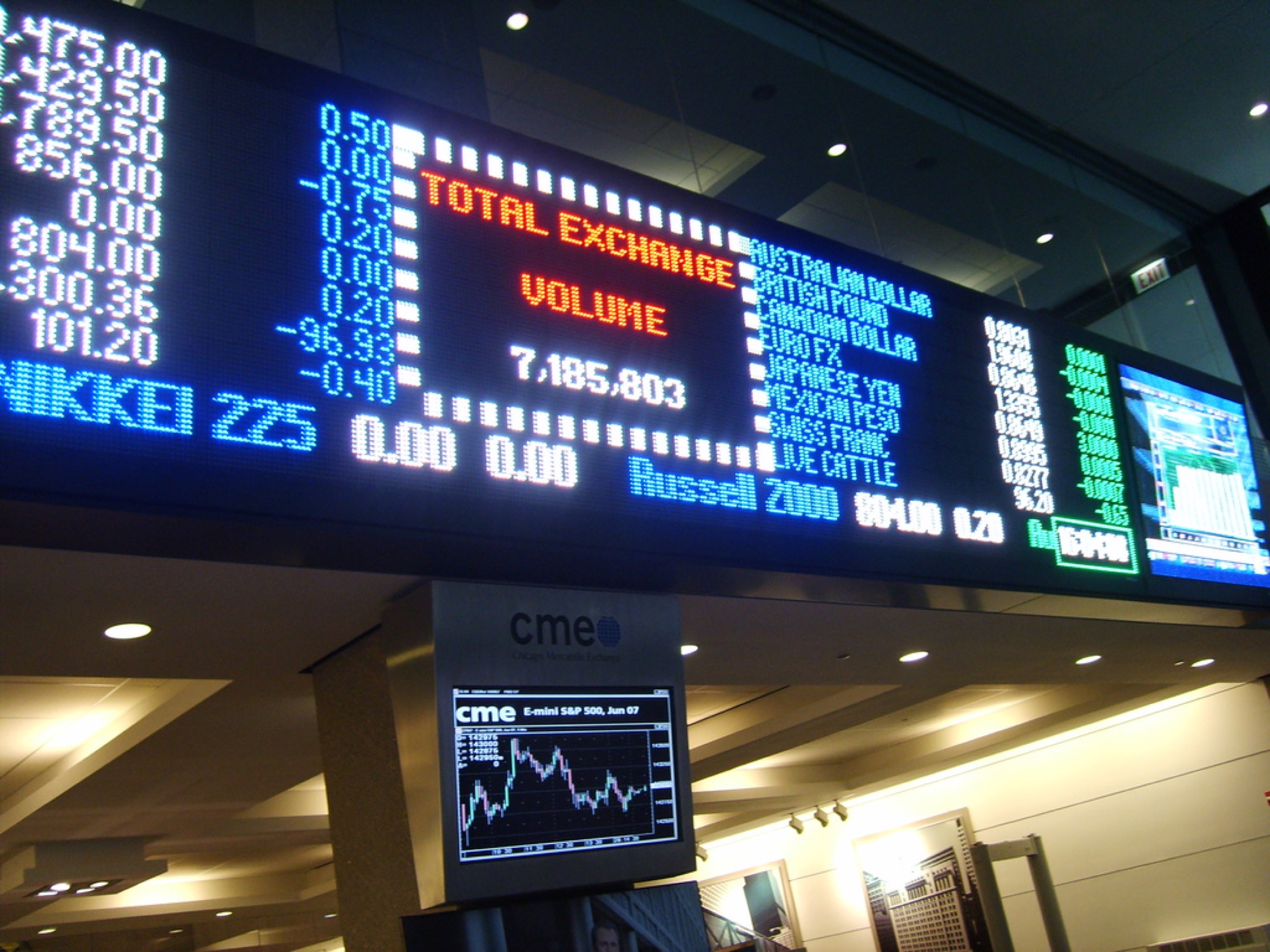
The instruments traded on the Chicago Mercantile Exchange chart the evolution of risk management from barnyard commodities to the frontiers of digital finance. The original Butter and Egg Board dealt exclusively in butter and eggs; after its 1919 reorganization, the CME expanded into onions, potatoes, turkeys, and frozen poultry. The landmark 1961 introduction of frozen pork belly futures—the first futures contract on a stored meat product—was followed by live cattle futures in 1964 and lean hog futures, establishing the CME as the world’s primary livestock derivatives market. Leo Melamed’s 1972 revolution launched currency futures on the International Monetary Market in British pounds, Canadian dollars, Deutsche marks, French francs, Japanese yen, Mexican pesos, and Swiss francs. The 1981 Eurodollar contract pioneered cash settlement and became the world’s most actively traded interest rate futures instrument. S&P 500 futures debuted in 1982, followed by the E-mini S&P 500 in 1997—traded exclusively on Globex, it became the world’s most liquid equity index futures contract. The CME introduced weather derivatives in September 1999, beginning with Heating Degree Day contracts, creating an entirely new asset class enabling businesses to hedge temperature-related risk, as examined in Dornier and Queruel, “The Pricing of Temperature Futures at the Chicago Mercantile Exchange” (Journal of Banking & Finance, 2009). In December 2017, CME Group launched Bitcoin futures—cash-settled contracts based on the CME CF Bitcoin Reference Rate—marking the institutionalization of cryptocurrency trading. Today CME Group facilitates trading in over three billion contracts annually across equities, interest rates, foreign exchange, energy, agricultural commodities, metals, and alternative products.