Chicago Board of Trade (CBOT)
Chicago, USA · Established 1848

This site requires authorization to access.
To request access, contact
william.goetzmann@yale.edu
The Chicago Board of Trade has occupied three successive buildings at the foot of LaSalle Street. The first purpose-built hall, the Chamber of Commerce Building at LaSalle and Washington Streets, opened in 1865 but was destroyed in the Great Chicago Fire of 1871. The exchange relocated temporarily to a wooden structure called 'the Wigwam' before commissioning W. W. Boyington to design a permanent home at 141 West Jackson Boulevard. Boyington's granite-clad structure opened on May 1, 1885, rising ten stories with a 322-foot clock tower containing a 4,500-pound bell and crowned by a nine-foot copper weather vane shaped like a ship. Built of structural steel and gray granite quarried from Fox Island near Vinalhaven, Maine, it was the first commercial building in Chicago to have electric lighting and the tallest structure in the city until the clock tower was removed in 1895. Its great hall measured 152 by 161 by 80 feet, illuminated by a stained-glass skylight with interiors finished in mahogany and frescoes. By the mid-1920s the Boyington building had become structurally unsound and inadequate for the exchange's volume; in 1929 it was demolished. The present forty-four-story Art Deco tower, designed by John A. Holabird and John Wellborn Root Jr. of Holabird & Root, opened on June 9, 1930. Clad in gray Indiana limestone with dark windows and spandrels that emphasize its soaring verticality, it rises 605 feet on a site measuring 174 feet east-west along Jackson Boulevard and 240 feet north-south along LaSalle Street. The setback massing culminates in a copper-clad pyramid roof surmounted by a 31-foot, 6,500-pound aluminum statue of Ceres, the Roman goddess of grain, sculpted by the modernist artist John H. Storrs. On the fourth floor the exchange installed a 19,000-square-foot column-free trading room centered on octagonal pits for individual commodities — at the time the largest trading floor in the world. A three-story open lobby featured seven different types of marble, patterned terrazzo floors, geometric Art Deco moldings, and what was then the world's largest electric light fixture. The building was designated a Chicago Landmark in 1977 and listed as a National Historic Landmark on June 2, 1978.
The building's sculptural program integrates artwork by three artists closely associated with Holabird & Root. On the exterior, Alvin Meyer, head of the firm's sculpture department, carved allegorical reliefs representing the exchange's trading activities directly into the Indiana limestone cladding. Flanking a thirteen-foot-diameter clock on the LaSalle Street facade are two hooded figures: a Babylonian holding sheaves of grain and a Native American holding ears of corn, symbolizing the ancient and New World origins of agriculture. Similar paired figures recur at the uppermost corners of the central tower just below the sloping copper roof. Approximately thirty feet above street level on the north and east facades, sculptural representations of bulls project directly from the limestone. Crowning the pyramid is John Storrs's faceless aluminum Ceres, holding a sheaf of wheat in her left hand and a bag of corn in her right. Storrs, a leading American modernist who studied at the School of the Art Institute of Chicago before working in Paris, deliberately left the figure without facial features, reasoning that at 605 feet no observer would ever see them; contemporary critics praised it as one of the finest pieces of architectural sculpture in America. Inside, the muralist John Warner Norton contributed a large-scale work in the three-story lobby depicting the nation's nineteen national highways as of 1928, along with principal cities and national parks. Norton also painted a monumental three-story mural of Ceres shown bare-breasted in a field of grain for the agricultural trading room; removed in 1973 and stored for nearly a decade, it was restored and reinstalled in the atrium of the 1982 Murphy/Jahn addition. The lobby interior features polished black and white marble surfaces, prominent vertical brass trim, Art Deco chandeliers, and geometric ceiling moldings. When the Boyington building was demolished in 1929, two 12-foot-tall gray granite allegorical statues of Industry and Agriculture, each weighing four and a half tons, were salvaged from the second-floor ledge above the main entrance and eventually installed in a nearby pedestrian plaza.
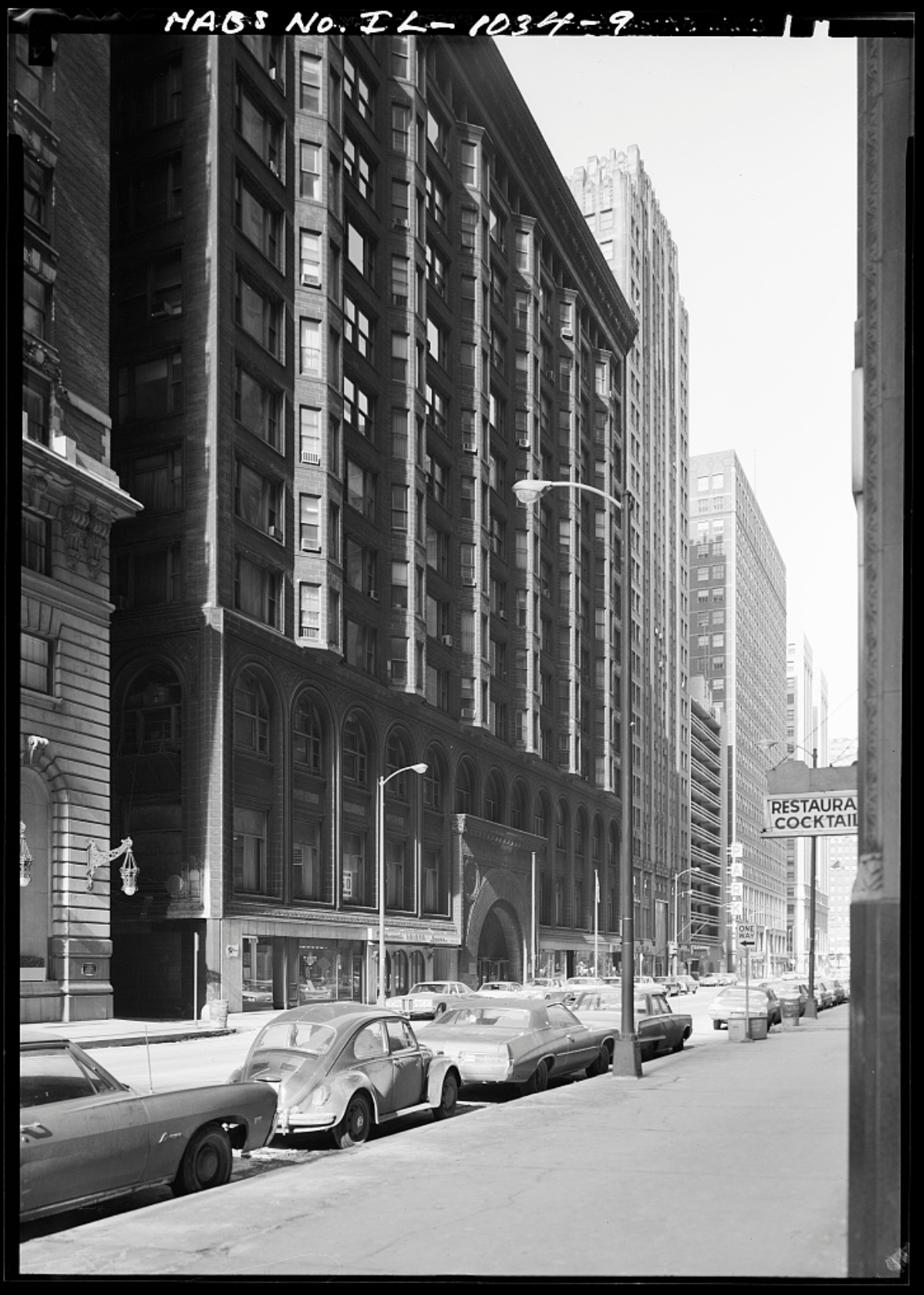
The Chicago Board of Trade Building occupies one of the most symbolically charged sites in American urbanism: the southern terminus of LaSalle Street, Chicago's financial canyon. LaSalle Street runs due north from Jackson Boulevard to the Chicago River, lined on both sides by the headquarters of banks, brokerages, and insurance companies that made Chicago the financial capital of the Midwest. The Board of Trade tower closes this eight-block corridor as a monumental terminus, its stepped Art Deco silhouette visible in perfect axial alignment from the river bridge. This relationship between a single commanding building and a perspectival street recalls European precedents — the Bourse closing the rue Vivienne in Paris, or the Royal Exchange at the head of Cornhill in London — but here the scale is amplified to skyscraper dimensions. The building stands within the Chicago Loop, the rectangle of elevated railway tracks that defines the historic central business district, and its 605-foot height made it the tallest structure in the city from 1930 until the Richard J. Daley Center surpassed it in 1965.
The Chicago Board of Trade was founded on April 3, 1848, by eighty-two merchants meeting above a flour store at 101 South Water Street. The completion of the Illinois and Michigan Canal in 1848, linking the Great Lakes to the Mississippi River system, had made Chicago the funnel through which Midwestern grain reached eastern and European markets. In those early years farmers arrived each autumn with their harvests, flooding the city with supply and collapsing prices; the Board was created to impose order on this chaos. Forward or 'to arrive' contracts began trading almost immediately, allowing farmers to lock in prices before harvest. In 1858 the exchange began standardizing contract terms, and on October 13, 1865, it formalized rules governing margin deposits, delivery procedures, and grievance settlement — the essential architecture of the modern futures contract. A corporate charter granted by the Illinois governor in February 1859 gave the Board self-regulatory authority over its members. The octagonal trading pits, where hundreds of traders communicated by open outcry — shouting bids and offers while using hand signals — became the defining spatial and acoustic experience of the exchange, a system that persisted for over 150 years. In the 1970s the CBOT expanded beyond agriculture into financial instruments: futures on Government National Mortgage Association certificates in 1975, and U.S. Treasury bond futures in 1977, which by 1981 had become the most actively traded contract in the country. The Chicago Board Options Exchange (CBOE), spun off from the CBOT in 1973, pioneered listed options trading. In 2007 the CBOT merged with the Chicago Mercantile Exchange to form CME Group.
The Chicago Board of Trade was established to trade grain — principally wheat, corn, and oats — the staple commodities of the Midwestern agricultural economy. Its earliest transactions were spot trades and forward contracts in these grains, but the formalization of standardized futures contracts in 1865 transformed the exchange into something fundamentally new: a market for trading risk itself, detached from the physical delivery of goods. Contract specifications fixed quantity (5,000 bushels), quality grade (established by CBOT inspectors), delivery location (Chicago grain elevators), and delivery month, making each contract interchangeable and freely tradable before expiration. Soybeans and soybean products were added in the twentieth century. Beginning in the 1970s the CBOT pioneered financial futures, listing contracts on Government National Mortgage Association certificates in 1975 and U.S. Treasury bonds in 1977. Treasury bond futures rapidly became the exchange's most actively traded product, eclipsing the agricultural contracts that had sustained the institution for over a century. Options on futures followed in 1982. The CBOT's fundamental innovation — standardizing contract terms to create fungible, transferable instruments for managing price risk — became the model adopted by commodity and financial exchanges worldwide, making it one of the most consequential institutional inventions in the history of capital markets.