Chemnitz Exchange (Chemnitzer Börse)
Chemnitz, Germany · Established 1862 (Börsenverein); building inaugurated 1867
This site requires authorization to access.
To request access, contact
william.goetzmann@yale.edu
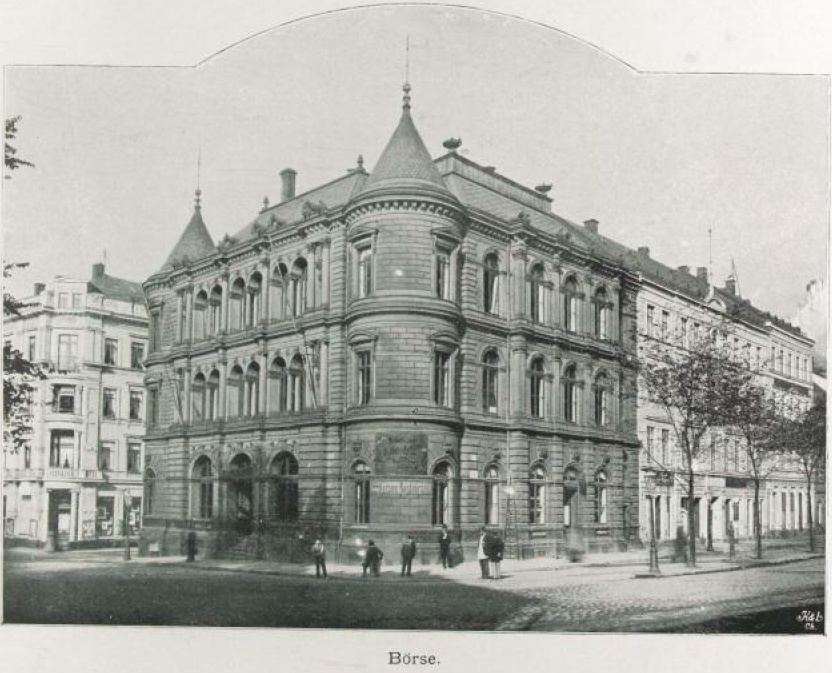
The Chemnitz Exchange was raised in the boom years of the 1860s as a deliberate architectural statement of the city's commercial ambition. After the local Börsenverein, founded on 11 August 1862, outgrew its rented quarters, its members held a design competition that drew seventeen entries; first prize went to the Leipzig architect Constantin Lipsius, whose works also include the Royal Art Academy in Dresden and the Petrikirche in Leipzig (en.wikipedia.org, 'Constantin Lipsius'). The foundation stone was laid on 10 October 1865 under the local builders C. E. Haase and F. G. Ancke Jr., and although the war of 1866 caused brief delays, King Johann of Saxony set the symbolic final stone at a ceremony on 25 June 1867; the building opened on Poststraße on 1 August 1867 (chemnitz-gestern-heute.de). Lipsius cast the exchange in a Neo-Renaissance idiom: a richly ornamented principal facade anchored by round towers at the two street corners, with three mighty ground-floor arcades framing the entrance and the arms of the Kingdom of Saxony and the city of Chemnitz carved into the arcade piers. Behind the facade lay a two-story trading hall and a restaurant hall running the full length of the building, its iron columns carrying stone barrel vaults — a frank expression of the industrial engineering culture of the 'Saxon Manchester.'
The building's decorative programme made its mercantile purpose legible to anyone passing on Poststraße. The three arcades of the ground floor were enriched with sculptural reliefs personifying the productive forces of the region — industry, commerce, agriculture, machine-building, spinning, weaving and shipping — an allegorical catalogue of the very trades whose representatives met inside (chemnitz-gestern-heute.de). The carved coats of arms of Saxony and Chemnitz on the central piers of the arcades bound the institution to both crown and town. The whole composition belonged to the confident historicist taste of the 1860s, in which a manufacturing city borrowed the vocabulary of the Italian Renaissance palazzo to dignify the new world of mechanized commerce.
The exchange stood at the corner of Langestraße and Poststraße, on the square later known as the Beckerplatz, close to the medieval Johannistor at the edge of Chemnitz's historic core (de.wikipedia.org, 'Beckerplatz (Chemnitz)'). This was the commercial heart of a city that nineteenth-century observers dubbed the 'Saxon Manchester' for the density of its textile mills and machine works. The Beckerplatz was largely destroyed in the air raids of March 1945; the only building on the square to survive was the bank that had replaced the exchange on the same site, which still stands today (now Johannisplatz 10) after a 1990s restoration and now houses a café, offices and shops.
The Chemnitzer Börse functioned as a merchant and commodity exchange serving the textile and machine-building economy of the Erzgebirge region. From its opening, traders received daily telegraphic price reports from the Liverpool cotton market and the Manchester yarn market, later supplemented by quotations from New York, Berlin, Leipzig and the Bradford wool market — a measure of how tightly Chemnitz's industry was woven into global commodity flows (chemnitz-gestern-heute.de). The first dedicated Chemnitz yarn exchange (Garnbörse) was held in February 1879, and the hall also hosted weekly grain-trading sessions. In 1899 the Dresdner Bank opened a branch in the building, and in 1904 the exchange association sold the property to the bank for 290,000 marks. Between 1922 and 1924 the Dresdner Bank demolished Lipsius's exchange and replaced it on the old site with a larger building designed by the Chemnitz-born Berlin architect Heinrich Straumer, designer of the Berlin radio tower (de.wikipedia.org, 'Heinrich Straumer'). That successor building survived the war and stands today.
The exchange was above all a market for the raw materials and products of Chemnitz's dominant industries: cotton, yarn and woven textiles, alongside the inputs of its machine-building sector. The reliance on daily Liverpool cotton and Manchester yarn telegraph reports underscores that cotton and spun yarn were the central commodities, with the dedicated Garnbörse (yarn exchange) inaugurated in 1879. Grain was traded at regular weekly sessions for the surrounding Erzgebirge textile district, and wool prices from Bradford fed into the dealings as the trade in textile fibres broadened. As a regional Handelsbörse it dealt principally in physical commodities and merchandise rather than listed securities, mirroring the industrial rather than financial character of the city.
Images will be added as the project develops. Photographs by Larry Ng and from research sources.