ED Miles Mining Exchange (former)
Charters Towers, Australia · Established 1883 (firm); building erected 1887
This site requires authorization to access.
To request access, contact
william.goetzmann@yale.edu
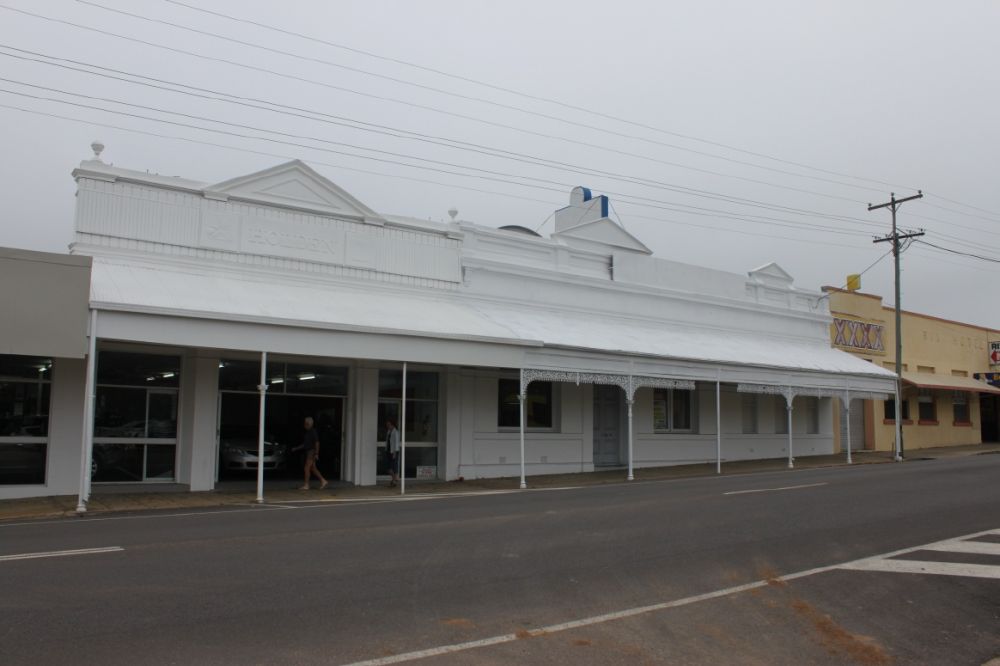
The former ED Miles Mining Exchange at 65 Mosman Street is a single-storey timber building fronted by a rendered masonry facade with classical detailing, erected in 1887 to the design of the Townsville architect William George Smith junior and built by Ben Toll, then extended in 1889, 1891 and 1901 as the firm's business grew (Queensland Heritage Register no. 602801, entered 9 November 2012). The facade carries twin triangular pediments on its parapet above a curved street awning supported on cast-iron posts and edged with cast-iron lacework, while the structure behind is roofed in separate corrugated-iron gables. The Queensland Heritage Register draws particular attention to the building's climate-conscious engineering: a variation of the Tobin-tube ventilation system (an English innovation of the 1870s) integrated with high ceilings, part-height interior partitions, ventilated ceiling roses, operable fanlights, high-level windows and a roof lantern about eight metres high with operable glazing, all of which drew light and a cooling draught through a deep building in the tropical north. The heritage citation describes it as the most intact of only four mining-exchange buildings known to survive in Queensland, all of them in Charters Towers.
The building's distinction lies in its commercial architecture and its ventilation engineering rather than in any programme of fine art; it carries no sculpture, mural or named decorative commission of the kind found in the great European bourses. Such decorative interest as it possesses is architectural and joinery-based: the classical pediments and rendered detailing of the street front, the cast-iron lace of the verandah, and internally the 'handsome cedar polished counters' and cedar bi-fold doors noted in the Queensland Heritage Register listing (no. 602801). These hardwood fittings, typical of a prosperous late-Victorian Queensland office, reflect the wealth that gold-share broking brought to the firm rather than any explicit artistic ambition.
The exchange stands on Mosman Street, the principal commercial thoroughfare of Charters Towers, a goldfield town in inland North Queensland that boomed so spectacularly after the 1871 discovery that locals called it 'The World' for the untapped riches of the earth (State Library of Queensland, 'Charters Towers - The World'). By 1899 the town held roughly 26,500 people and was the second city of Queensland, its centre lined with grand banks, hotels, the School of Mines and the formal Stock Exchange Arcade of 1888. The ED Miles building sat among these institutions a short walk from the Stock Exchange Arcade on Mosman Street, where mining shares were called twice daily; the broking offices, banks and exchange together formed a compact financial quarter that turned a remote reef-mining camp into a recognised node of international mining investment, tied to distant markets by the electric telegraph.
Edward David Miles (1845-1922), a Welsh-born migrant who had come to the Victorian diggings in 1862 and settled at Charters Towers in 1875, served as town clerk before becoming a full-time mining agent in February 1883, founding the firm that bore his name; from 1887 he traded in partnership with Joe Millican, and the building was raised that same year to house the expanding business (Wikipedia, 'Edward David Miles'; 'ED Miles Mining Exchange'). The Charters Towers mining agents had organised themselves into a Mining Exchange in 1885, and by 1891 Miles is reported to have managed some 24 of the 58 listed companies on the field. ED Miles and Company became reputedly the largest share-broking firm in Queensland, providing both company management and broking services through the goldfield's peak. The deep-reef field's yields fell after 1899 and the formal Stock Exchange closed in 1916; the Miles firm itself was wound up shortly after Miles died on 10 March 1922, ending nearly forty years of operation. Miles, who was mayor of Charters Towers in 1897 and a member of the Queensland Legislative Council from 1902 until his death, was throughout a central figure in the field's mining institutions.
What changed hands here were shares in gold-mining companies working the Charters Towers goldfield, the highest-producing field in Queensland and the third largest in Australia. Unlike the alluvial rushes elsewhere, Charters Towers gold lay in deep, downward-sloping reefs whose extraction demanded shafts, batteries and, after 1892, the capital-hungry MacArthur-Forrest cyanide process; financing this required pooled investment, and share-broking firms such as ED Miles and Company supplied it by floating, managing and trading the scrip of the mining companies (Queensland Heritage Register no. 602801; Citigold Corporation, 'Charters Towers Story'). The firm acted both as company manager and as broker for operations including the rich Brilliant Reef group and neighbouring shafts. Trading on the field followed a call system, with sessions held by the exchange twice a day - a noon call and an evening call open to the public - and from the 1890s the Charters Towers exchange was connected by telegraph to the wider world, so that local mining shares could be quoted and dealt in alongside distant markets at the dawn of financial globalisation.
Images will be added as the project develops. Photographs by Larry Ng and from research sources.