Charters Towers Stock Exchange Arcade (Royal Arcade)
Charters Towers, Australia · Established 1890 (exchange occupied arcade); building completed 1888
This site requires authorization to access.
To request access, contact
william.goetzmann@yale.edu
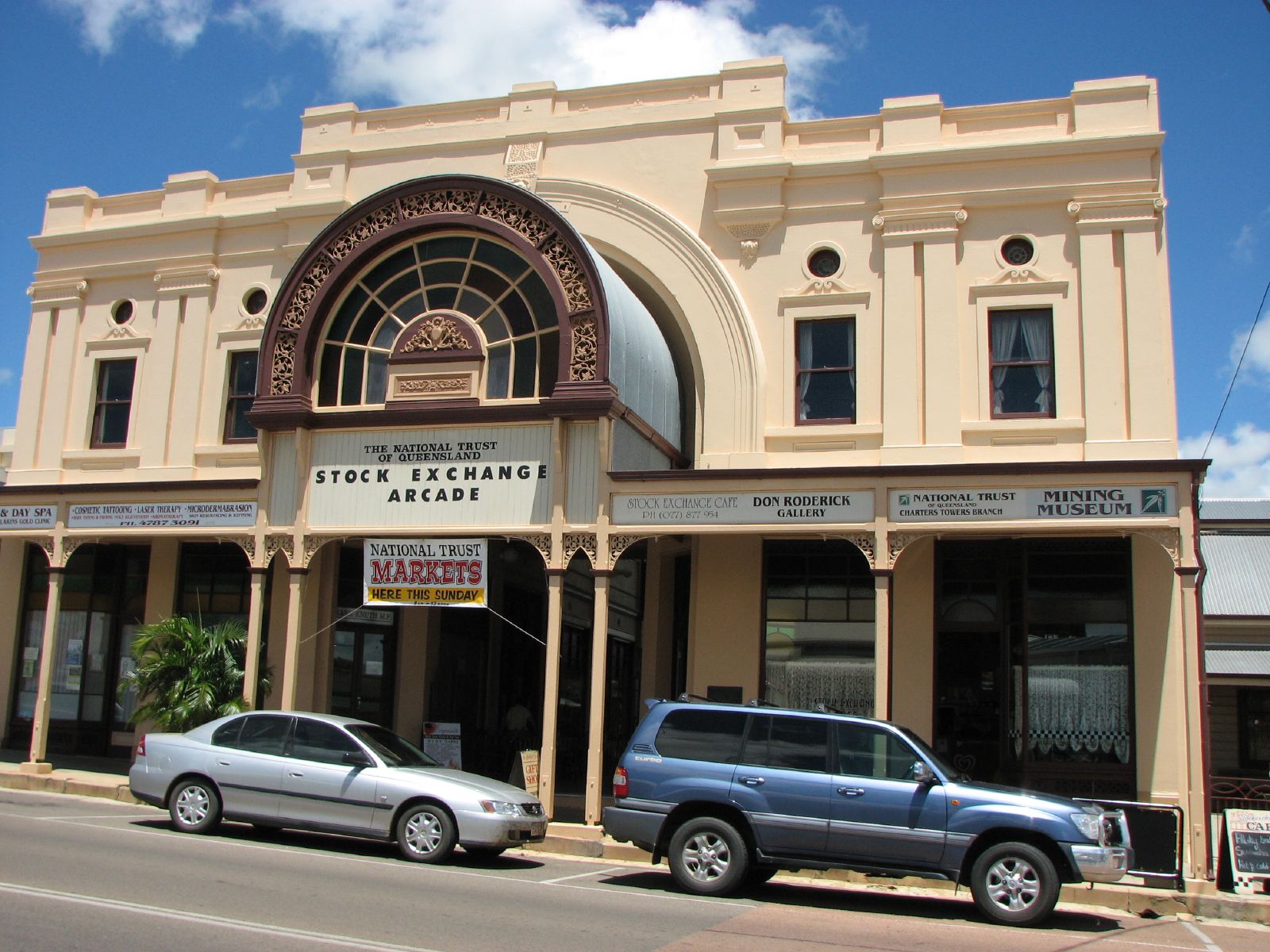
Built in 1888 to the design of the Sydney architect Mark Cooper Day and erected by the Sydney firm of Sandbrook Brothers, the structure first opened as the Royal Arcade, a speculative shop-and-office building commissioned by the local civic figure Alexander Malcolm to replace his earlier timber premises on Mosman Street. As described in the Queensland Heritage Register citation (Reference 600406, registered 21 October 1992) and summarised on its Wikipedia entry, it is a masonry arcade of small offices ranged on both sides of a narrow central court that is roofed by a glazed vault carried on steel trusses with decorative inset webs. The street front is dominated by a landmark barrel-vaulted entrance portico and crowned by a stepped, balustraded parapet, while the interior preserves a tessellated tile floor, coloured-glass and cast-iron panelling, and timber-framed shopfronts fitted with cast-iron vents that aided ventilation in the north Queensland heat. The Register singles out the building as a rare, early example of a shopping arcade in Queensland, valued for its scale, its landmark vaulted entrance, its traditional shopfronts, and the quality of its materials and detail.
The arcade is a work of commercial architecture rather than a vehicle for fine art, and its aesthetic appeal lies chiefly in craftsmanship and ornamental detail rather than in painting or statuary. The principal decorative effects, as recorded in the Queensland Heritage Register listing and the National Trust of Queensland's site notes, are the patterned tessellated-tile floor of the central hallway, the coloured-glass paand cast-iron panels of the shopfronts, and the play of light through the glazed barrel vault overhead. These elements, together with the balustraded parapet and cast-iron vents, give the interior its character; there is no significant programme of murals, mosaics, or sculpture of the kind found in metropolitan exchanges, a modesty appropriate to a working goldfields trading house.
The arcade stands at 76 Mosman Street in the centre of Charters Towers, the inland goldfield town that grew rapidly after reef gold was discovered nearby in late 1871 by a prospecting party that included Hugh Mosman, after whom the principal street is named. At the height of the boom around 1899 the town held roughly 26,500 people and was, by some reckonings, the second most important urban centre in Queensland, its prosperity so renowned that it was nicknamed 'The World.' Mosman Street formed the commercial spine of this district, lined with banks, brokers' offices, and substantial masonry buildings whose grandeur, the Heritage Register notes, illustrates the wealth and confidence of Charters Towers in the nineteenth century. The arcade sat at the heart of this streetscape, its public evening share calls drawing crowds into the central court.
A Mining Exchange had formed at Charters Towers in 1885 to enable speculation in the shares of the field's reef-mining companies, and when the exchange was reorganised in 1890 it took up offices in the Royal Arcade under a three-year lease at ten pounds a month, after which the building came to be known as the Stock Exchange Arcade. As the Wikipedia entry and Queensland Heritage Register record, it was one of only two stock exchanges to operate outside an Australian capital city, both of them on goldfields, making it a singular institution in the nation's financial history. The exchange flourished alongside the goldfield, which reached peak production of 319,572 ounces in 1899, but the deepening of the shafts steadily raised costs; the mining warden reported in 1912 that the limit of profitable mining had been reached, and as returns and population fell away the exchange closed in 1916. The arcade later fell into disrepair and was saved from demolition in the 1970s by the Charters Towers and Dalrymple Historical Society; the city council acquired it in 1971 as trustee, the National Trust of Queensland restored it in two stages in 1972 and 1975, and it survives today as offices, shops, and a gallery.
The business of the exchange was the buying and selling of shares in the gold-mining companies of the Charters Towers field, both as genuine investment and as outright speculation. Because the gold lay in deep quartz reefs rather than in alluvial deposits, extraction demanded heavy capital for shafts, crushing batteries, and machinery from the outset, and the share market was the mechanism by which that capital was raised and traded. As the Heritage Register and Wikipedia account describe, trading was conducted by 'calls': to begin with two were made each day, one at noon and a second in the evening that was open to the public, when hundreds of townspeople would crowd into the arcade's central court to follow the bidding. The shares that changed hands were those of the reef companies working 'The World,' Queensland's richest goldfield, so that the fortunes traded on the floor rose and fell directly with the depth and yield of the mines outside the town.
Images will be added as the project develops. Photographs by Larry Ng and from research sources.