Chang’an West Market (Guifang Counting Houses)
Chang’an (Xi’an), China · Established c. 618 CE
This site requires authorization to access.
To request access, contact
william.goetzmann@yale.edu
The West Market of Tang Dynasty Chang’an was a massive walled commercial complex occupying an area of approximately one square kilometer—archaeological surveys have measured it at 1,031 meters from north to south and 927 meters from east to west, as documented in Victor Xiong’s comprehensive study Sui-Tang Chang’an: A Study in the Urban History of Late Medieval China (University of Michigan Press, 2000). The complex was divided into nine rectangular blocks by two principal north-south streets and two east-west streets, each up to sixteen meters wide, with narrower alleys threading through the interior of each block. This rigid grid housed more than 220 trade categories and over 40,000 permanent shops, earning the market its epithet “the Golden Market.” The market was enclosed by rammed-earth walls pierced by gates on each side, creating a self-contained commercial precinct within the city’s broader ward (fang) system. Archaeological excavations conducted from the 1960s onward—culminating in a major campaign in 2006 led by An Jiayao of the Institute of Archaeology at the Chinese Academy of Social Sciences—revealed a stone bridge, an elaborate waterway and drainage system, wells with intact stone mouths, the tracks of wagon wheels scored into paved surfaces, and the foundations of workshops and commercial buildings. The infrastructure attested to sophisticated urban engineering: the drainage channels carried wastewater away from the market’s densely packed shop fronts, while the wells provided fresh water for a population that at peak times may have numbered 150,000 visitors daily. In April 2010, the Tang West Market Museum opened on the excavation site at No. 118 South Laodong Road in modern Xi’an, built at a cost of 320 million yuan. Designed as the first privately funded museum in China erected directly atop an archaeological site, it preserves 2,500 square meters of in situ ruins beneath glass floors, allowing visitors to view the original foundations, the ancient well mouth, sewer channels, and cart ruts. The museum’s total display area extends to 8,000 square meters within a 32,000-square-meter building, housing more than 20,000 artifacts spanning from the Shang Dynasty through the Qing Dynasty, with a primary focus on Tang Dynasty material culture.
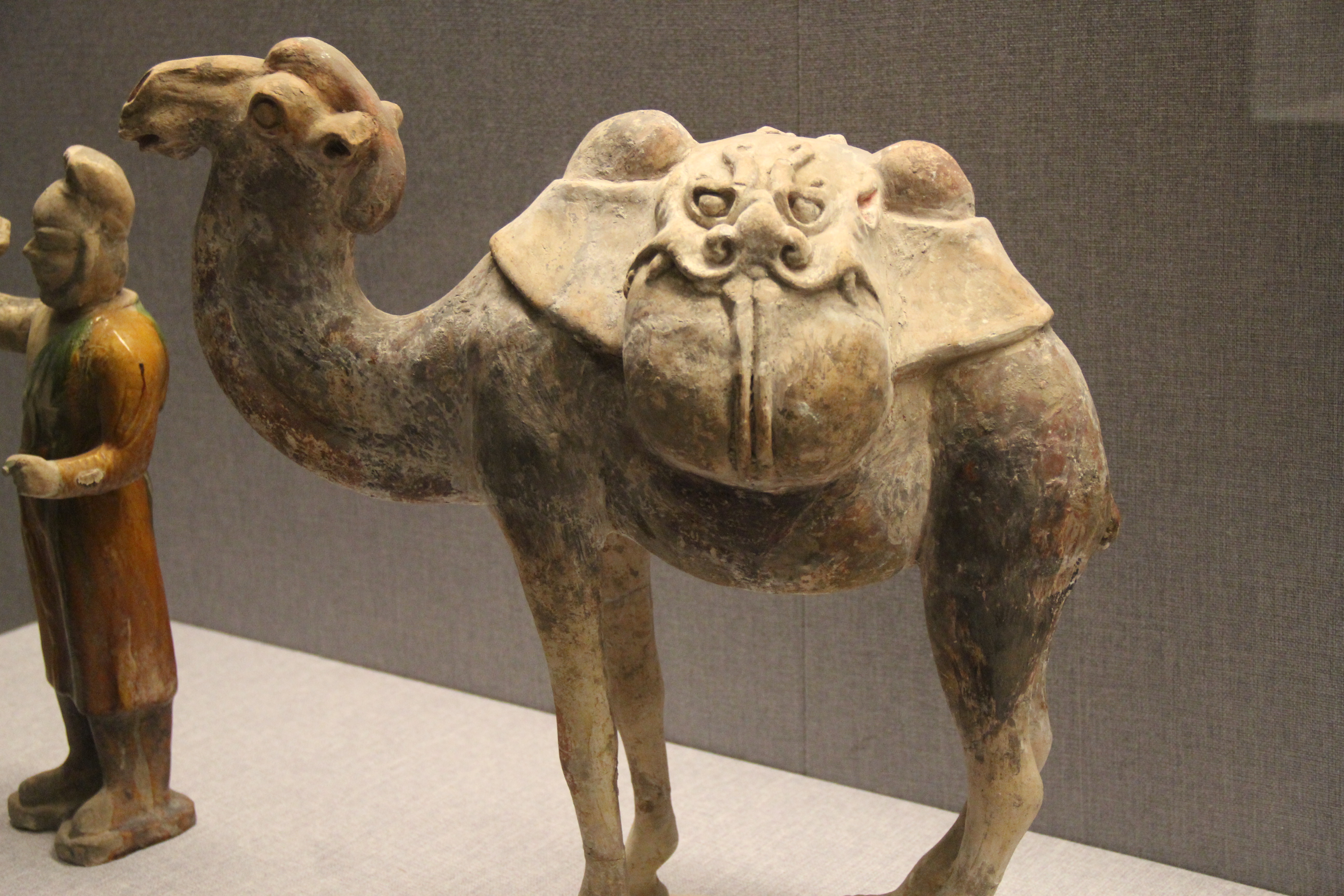
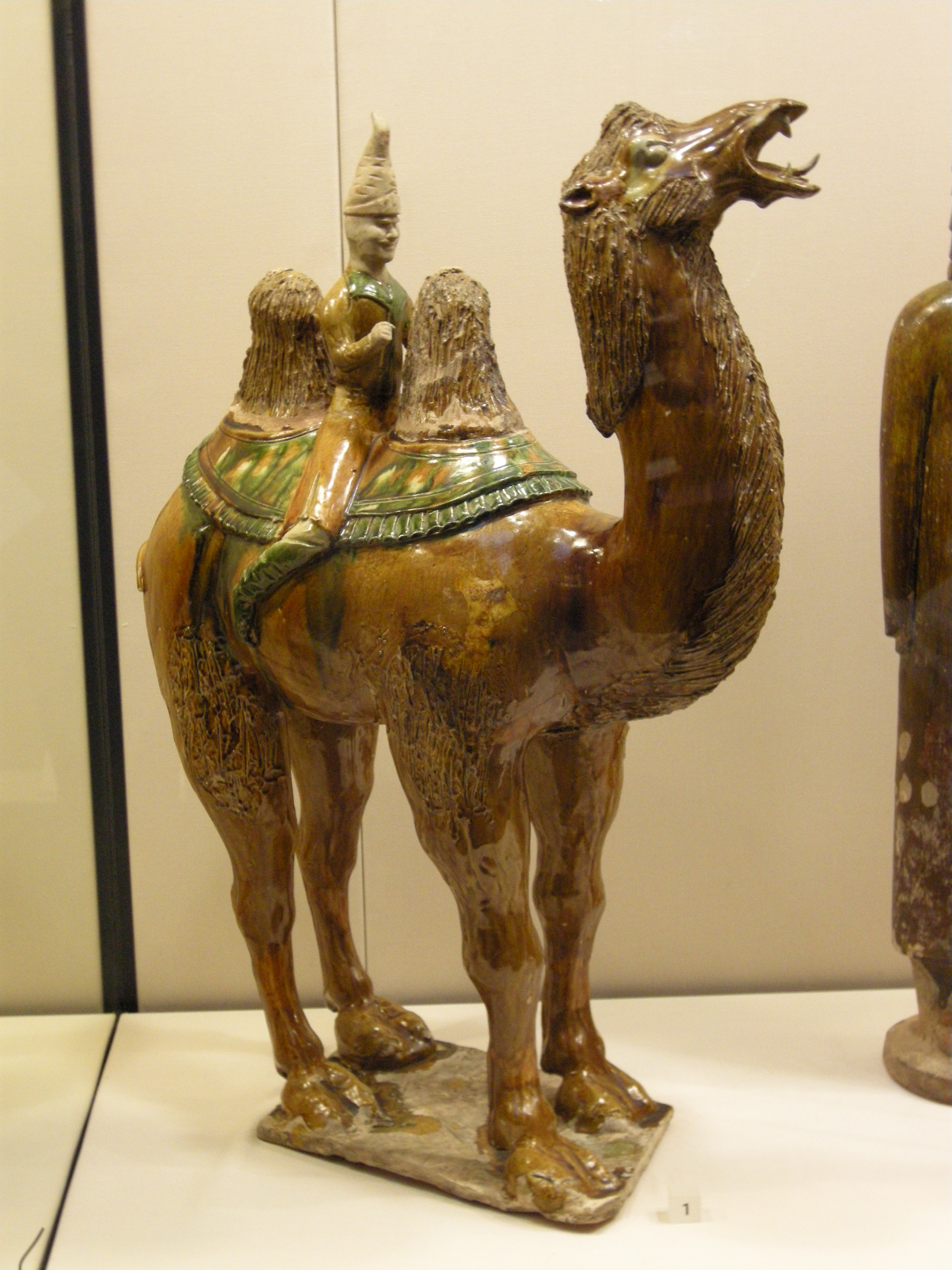
The Tang West Market Museum’s collection of more than 20,000 artifacts includes bronze vessels, brightly glazed sancai (“three-color”) ceramics, expressive terracotta figures, gold and silver ornaments, fine silk fabrics, and intricately carved jade—material evidence of the extraordinary artistic culture that flourished in the market quarter. Among the most celebrated artistic legacies of Tang commercial life are the mingqi (spirit goods), ceramic tomb figurines that accompanied the dead into the afterlife. As Edward Schafer observed in The Golden Peaches of Samarkand: A Study of T’ang Exotics (University of California Press, 1963), Tang society’s cosmopolitan appetite for the foreign and the exotic pervaded its artistic production. Glazed sancai figurines of Bactrian camels laden with goods and driven by bearded Sogdian caravaneers—their features rendered with vigorous naturalism in amber, green, and cream lead glazes—have been recovered from tombs throughout the Chang’an region and now fill major museum collections worldwide, including the Smithsonian’s National Museum of Asian Art and the British Museum. Foreign merchant figurines, identifiable by their deep-set eyes, prominent noses, and Central Asian garb, provide an artistic census of the Sogdian, Persian, and Turkic traders who thronged the West Market. Among the most remarkable artifacts connecting art to finance are the paper figurines excavated from tomb 206 at the Astana cemetery near Turfan (Xinjiang Province), belonging to Zhang Xiong (d. 633) and his widow Lady Qu (d. 689). As Valerie Hansen and Ana Mata-Fink documented in their chapter “Records from a Seventh-Century Pawnshop in China” in The Origins of Value (Goetzmann and Rouwenhorst, eds., Oxford University Press, 2005), the arms of a female dancer figurine from this tomb were fashioned from recycled pawnshop tickets originating in Chang’an—demonstrating that discarded financial documents were repurposed as raw material for funerary art. The dancer herself wore textiles of Sogdian and other silk types, linking the artistic and commercial worlds of the Silk Road. Tang Dynasty wall paintings and murals, particularly those surviving in the Mogao Caves at Dunhuang and in princely tombs near Chang’an, depict bustling market scenes, caravans, and the diverse peoples of the empire’s commercial thoroughfares, preserving a visual record of daily life in the world’s greatest medieval marketplace.
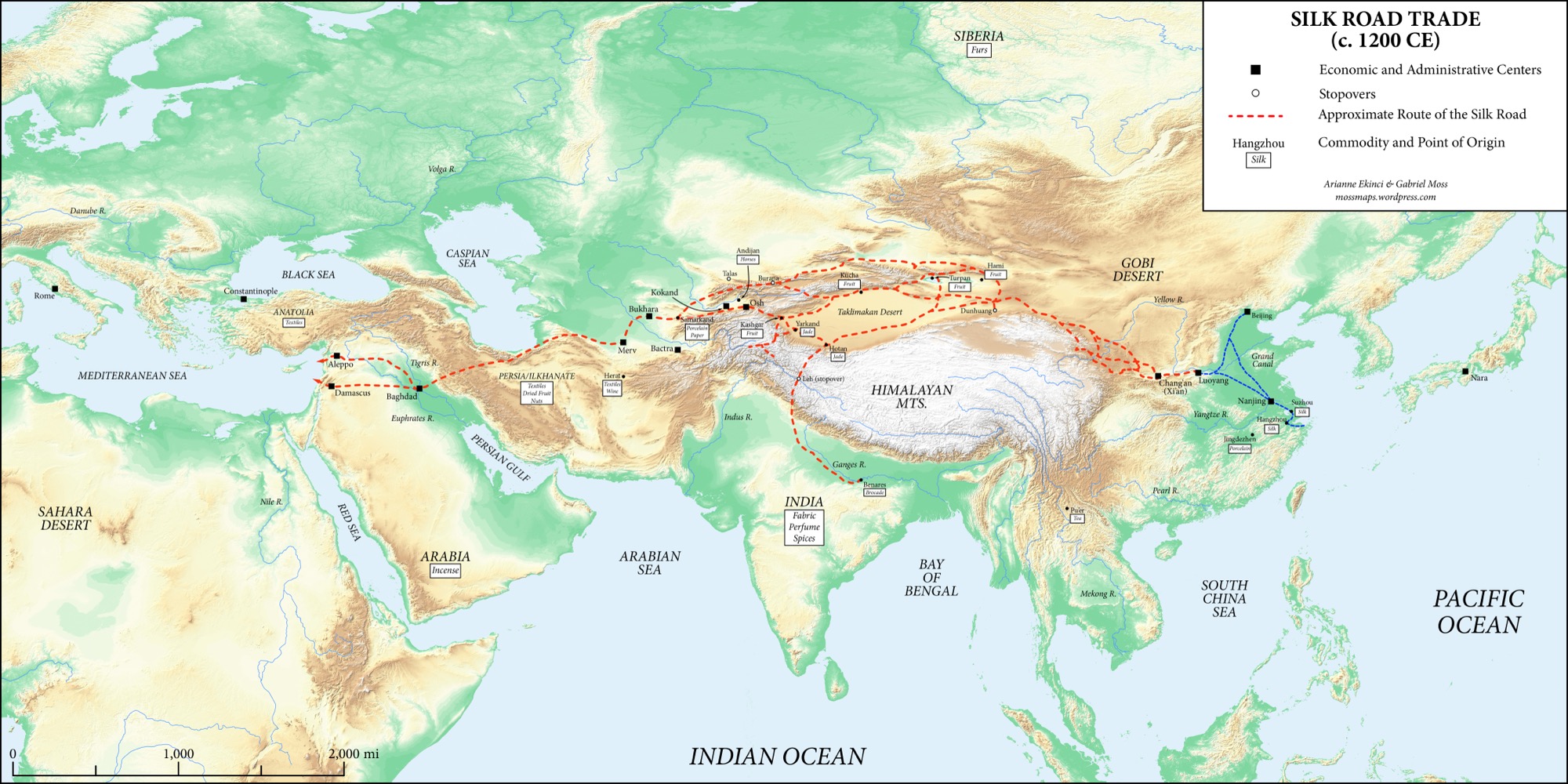
Chang’an occupied a position of singular importance in world history as the eastern terminus of the Silk Road—the vast transcontinental network of trade routes connecting China to Central Asia, Persia, the Mediterranean, and beyond. As Xinru Liu documented in The Silk Road in World History (Oxford University Press, 2010), the city’s role as the premier entrepot of Eurasian commerce reached its zenith during the Tang Dynasty (618–907 CE). Victor Xiong’s study of the capital (Sui-Tang Chang’an, 2000) describes a city of approximately 84 square kilometers, laid out on an immense rectangular grid oriented to the cardinal directions, with a population reaching close to one million within the walls and perhaps two million in the surrounding suburbs—making it, by most scholarly estimates, the largest city in the world during the seventh and eighth centuries. The city was organized under the fang (ward) system: 108 walled residential wards, each enclosed by its own walls and accessible only through guarded gates, were arranged in a grid of broad, tree-lined boulevards. Two great markets punctuated this urban grid. The East Market (Dongshi) served the Chinese aristocracy and court officials, trading in domestic luxury goods. The West Market (Xishi), situated in the southwestern quadrant of the city near the foreign quarter, was the international commercial center. As Étienne de la Vaissière demonstrated in Sogdian Traders: A History (Brill, 2005), Sogdian merchants from Samarkand and other Central Asian oasis cities formed the commercial backbone of the overland Silk Road trade, and their community in Chang’an was concentrated around the West Market. Sogdian temples, taverns, and counting houses lined the market’s streets. Beyond the Sogdians, the West Market quarter attracted Persian, Arab, Turkic, Indian, Korean, and Japanese residents, creating what UNESCO’s Silk Roads Programme has described as “one of the most cosmopolitan cities of the premodern world.” Foreign religions flourished: Zoroastrian fire temples, Nestorian Christian churches, Manichaean congregations, and Islamic mosques all operated within the city. Camel caravans arrived from the west bearing spices, gemstones, metals, and exotic goods, while Chinese silk, tea, and ceramics flowed outward along the same routes. The West Market’s position at the terminus of these routes made it the largest and most dynamic international marketplace of the medieval world.
The West Market was established in the early years of the Tang Dynasty (618–907 CE), inheriting the commercial traditions of the Sui Dynasty capital Daxingcheng, which had been laid out by the architect Yuwen Kai in 582 CE with designated market wards. Under Tang rule, the market was governed by strict regulations documented in the Tang Code (Tanglü shuyi) and administrative statutes: markets opened at noon to the sound of 300 drum strokes and closed at sunset with another 300 strokes, as described in Victor Xiong’s Sui-Tang Chang’an (2000). Market officials (shiling) supervised weights and measures, enforced pricing regulations, and maintained order among the tens of thousands of daily traders. Within the market, a distinctive institution emerged: the guifang, or counting houses, operated by foreign merchants—primarily Sogdians. As Lien-sheng Yang documented in Money and Credit in China: A Short History (Harvard University Press, 1952), these counting houses accepted deposits for safekeeping and issued instruments that allowed depositors to draft checks cashable by third parties, constituting a form of proto-banking that predated European bills of exchange by centuries. The guifang also extended call loans from their deposits, creating an early credit market. A parallel development in monastic finance was the Inexhaustible Treasury (Wujinzang yuan), established at the Huadu Monastery in Chang’an by followers of the monk Xinxing. As Jacques Gernet detailed in Buddhism in Chinese Society: An Economic History from the Fifth to the Tenth Centuries (Columbia University Press, 1995; originally published in French, 1956), the Inexhaustible Treasury accumulated vast wealth from anonymous donations—money, silk, and precious goods left at its doors by penitents—and used these funds to repair temples across the empire and to make loans to residents of the capital. Lien-sheng Yang’s foundational article “Buddhist Monasteries and Four Money-Raising Institutions in Chinese History” (Harvard Journal of Asiatic Studies, 1950) demonstrated that Buddhist monasteries pioneered the pawnshop in China as early as the fifth century, and the Huadu Treasury represented the most ambitious extension of this monastic banking tradition. In 721 CE, Emperor Xuanzong confiscated the Inexhaustible Treasury, condemning what he characterized as fraudulent banking practices and distributing its wealth to other Buddhist and Taoist institutions; the temple never recovered its former prominence. The An Lushan Rebellion (755–763 CE) devastated Chang’an: the capital was sacked in 756 and again in 757, its population plummeting from perhaps one million to a fraction of that number. Though the West Market recovered partially in subsequent decades, a catastrophic fire in the ninth year of Taihe (835 CE) destroyed the entire complex in a single day. The Tang Dynasty itself collapsed in 907 CE, and the market was never rebuilt, though its ruins remained visible for centuries until modern archaeological excavation began in the 1960s.
The West Market was a comprehensive emporium where more than 220 recognized trade categories operated, encompassing virtually every commodity circulating along the Silk Road. As Edward Schafer catalogued in The Golden Peaches of Samarkand (1963), the exotic imports flowing into Tang Chang’an included golden peaches from Samarkand, lapis lazuli from Badakhshan, amber from the Baltic, rhinoceros horn from Southeast Asia, frankincense and myrrh from Arabia, horses from Ferghana, jade from Khotan, coral, ivory, rare woods, drugs, diamonds, and spices of every description. Domestic goods included silk—the fundamental medium of exchange and international trade commodity—as well as tea, grain, salt, livestock, and timber. The market’s financial operations were among its most historically significant features. The guifang (counting houses), operated primarily by Sogdian and other foreign merchants, accepted cash deposits and issued what Lien-sheng Yang in Money and Credit in China (1952) described as drafts that allowed depositors to authorize payments to third parties—an instrument functionally equivalent to a check. These counting houses also extended call loans, creating a credit market within the bazaar. The later Tang innovation of feiqian (“flying money” or “flying cash”), formally recognized in 812 CE, grew from similar practices: merchants deposited coins at government or private offices and received certificates redeemable at distant locations, eliminating the need to transport heavy copper currency. The West Market also housed pawnshop operations with deep roots in Buddhist monastic lending. As Valerie Hansen and Ana Mata-Fink documented in “Records from a Seventh-Century Pawnshop in China” (in Goetzmann and Rouwenhorst, eds., The Origins of Value, Oxford University Press, 2005), the earliest surviving Chinese pawn tickets—dating to approximately 662–689 CE—were excavated from the Astana cemetery near Turfan, where they had been recycled as material for paper tomb figurines. These records reveal the mechanics of Tang pawnbroking: borrowers pledged goods as collateral and received loans documented on standardized tickets specifying the item, its appraised value, the loan amount, interest rate, and redemption deadline. Jacques Gernet’s Buddhism in Chinese Society (1956/1995) demonstrated that Buddhist monasteries were the original operators of Chinese pawnshops from the fifth century onward, and that monastic lending practices—including the Inexhaustible Treasury at Huadu Monastery—provided the institutional framework for the secular credit markets that flourished in the West Market. Valerie Hansen further explored the use of contracts in daily economic life, including pawn agreements, in Negotiating Daily Life in Traditional China: How Ordinary People Used Contracts, 600–1400 (Yale University Press, 1995), drawing on the rich documentary record preserved in the Turfan tombs.