Caracas Stock Exchange (Bolsa de Valores de Caracas)
Caracas, Venezuela · Established 1947 (open-air brokerage at the Ceiba de San Francisco from the mid-19th century)
This site requires authorization to access.
To request access, contact
william.goetzmann@yale.edu
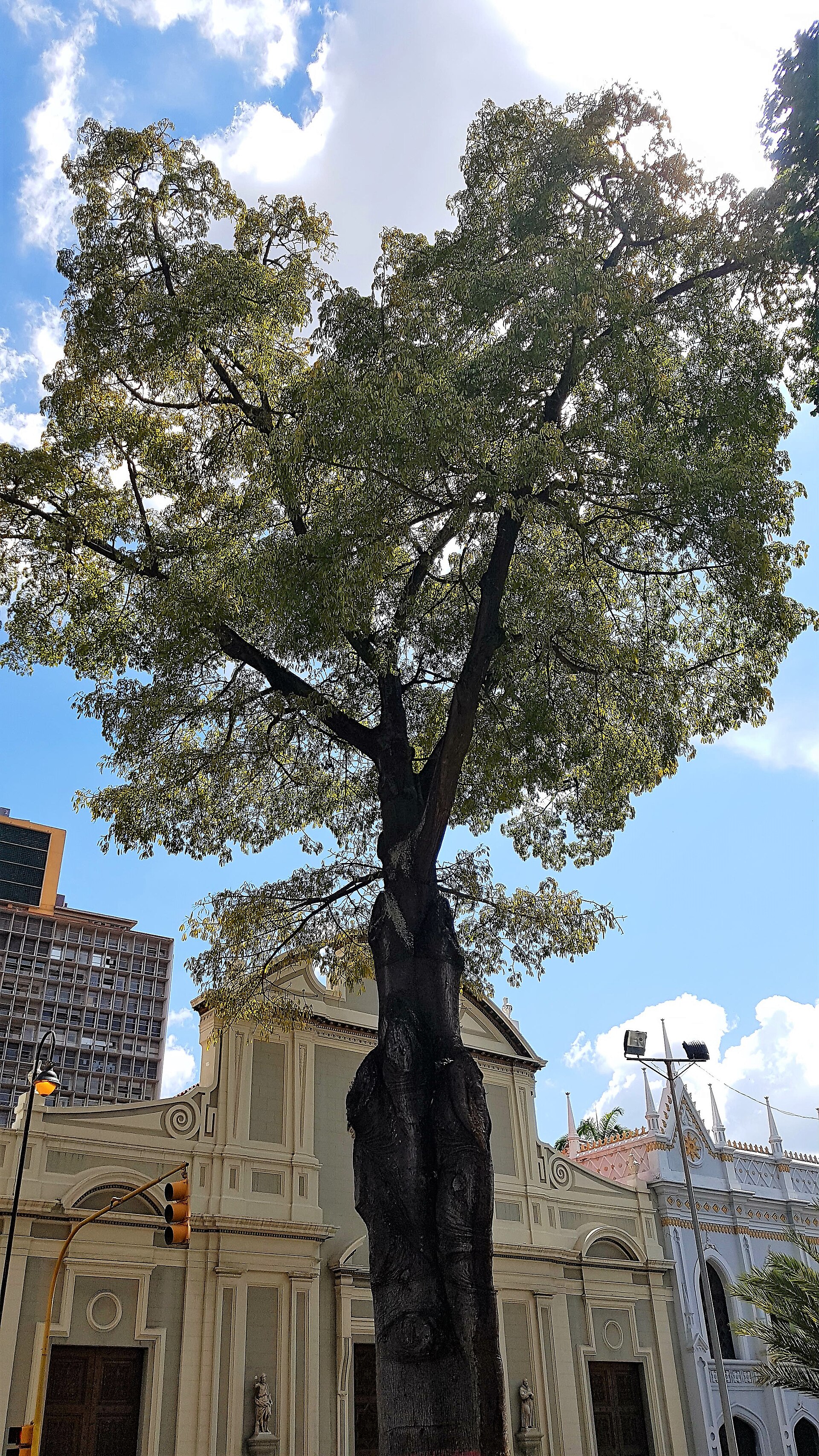
The Caracas Stock Exchange is unusual among the world's bourses in that, for most of its institutional prehistory, its 'building' was a tree. From the mid-nineteenth century, brokers and merchants gathered daily in the open air at the corner long known as the Esquina de la Bolsa, on the present Avenida Universidad, and in the shade of the great silk-cotton tree opposite the Church of San Francisco — the Ceiba de San Francisco. During the modernizing administrations of Antonio Guzmán Blanco the trunk was ringed with a masonry and timber enclosure that served as a desk and messenger post where dealers from the Esquina de la Bolsa recorded their transactions (es.wikipedia.org, 'Ceiba de San Francisco'). When the exchange was formally constituted in 1947 it had no monumental palace of its own: its first sessions were held in central Caracas, and through the later twentieth century it occupied successive commercial premises. Since the early 1990s the Bolsa de Valores de Caracas has occupied the Edificio Atrium, a late-modern office building of 1987–88 by the architects Edmundo Díquez, Oscar González and José A. Rivas in the Urbanización El Rosal, distinguished by a glazed central atrium opening onto the street, hanging gardens and an ordered colonnade (guiaccs.com, Guía de Arquitectura Contemporánea de Caracas). The institution's true architectural monument, however, remains the living ceiba, declared Patrimonio Natural in 2001.
Because the exchange grew out of street trading rather than from a purpose-built loggia, its principal 'artwork' is emblematic rather than architectural: the silhouette of the Ceiba de San Francisco, drawn in the foreground with the Church of San Francisco and the neo-Gothic Palacio de las Academias rising behind it, was adopted as the exchange's corporate emblem and remains its logo to this day (es.wikipedia.org, 'Ceiba de San Francisco'). The ceiba itself, planted by tradition around 1866 and surrounded today by a paved median on Avenida Universidad, has become a celebrated piece of Caracas's civic iconography — one of the most photographed natural landmarks of the old town and the subject of repeated documentation in the Wiki Loves Monuments campaigns. The Edificio Atrium contributes its own restrained late-twentieth-century aesthetic, built around the play of light, shadow and texture in its central void and its tropical hanging gardens, a design that earned recognition at the 1990 Bienal de Arquitectura de Quito.
The historic heart of the institution lies in the colonial grid of central Caracas, roughly a hundred metres from the Plaza Bolívar, where the Esquina de la Bolsa and the Ceiba de San Francisco stand on the Avenida Universidad opposite the Iglesia de San Francisco and the Palacio de las Academias — a district saturated with the symbols of Venezuelan independence and statehood (es.wikipedia.org, 'Ceiba de San Francisco'). For roughly seven decades brokers transacted business in this open-air setting in the very centre of the city. The modern exchange, by contrast, sits in El Rosal in the Chacao municipality of eastern Caracas, the city's principal post-war financial and corporate district: the Edificio Atrium occupies a plot on Avenida (Calle) Sorocaima between Avenidas Tamanaco and Venezuela, amid the office towers and banking headquarters that migrated east as Caracas expanded in the twentieth century (bolsadecaracas.com, 'Nosotros'). The institution's geography thus traces, in miniature, the displacement of Latin American commercial life from the colonial plaza to the modern financial quarter.
Antecedents of organized exchange in Caracas reach back to 1805, when Bruno Abasolo and Fernando Key Muñoz obtained licence from the Capitanía General to open a 'Casa de Bolsa y Recreación de los Comerciantes y Labradores' in Santiago de León de Caracas (es.wikipedia.org, 'Bolsa de Valores de Caracas'). Continuous open-air trading at the Esquina de la Bolsa and the Ceiba de San Francisco is documented from at least the 1830s–1840s. The modern institution was formally founded on 21 January 1947 as the Bolsa de Comercio de Caracas, on the initiative of the Caracas Chamber of Commerce, and held its first trading session on 21 April 1947 with twenty-two authorized brokers (en.wikipedia.org, 'Caracas Stock Exchange'; bolsadecaracas.com). Following Venezuela's first securities-market law and the absorption of a rival Bolsa de Miranda in 1974, and a shareholders' resolution of 6 May 1976, the institution took its present name, Bolsa de Valores de Caracas, C.A. It remains the principal securities market of Venezuela, regulated by the national securities supervisor (the Comisión Nacional de Valores / Superintendencia Nacional de Valores) under the Ministry of Finance.
In its open-air infancy the market dealt in the commercial paper, bills and merchandise of a colonial and early-republican port economy oriented to coffee, cacao and other Caribbean staples, with brokers literally registering deals at the foot of the ceiba. After its 1947 formalization the Bolsa developed into a conventional securities exchange trading equities and fixed-income instruments — shares (renta variable), corporate bonds and obligations, participation certificates, treasury bills and other government and private debt (es.wikipedia.org, 'Bolsa de Valores de Caracas'; en.wikipedia.org, 'Caracas Stock Exchange'). For much of the later twentieth century it served as the principal venue for Venezuelan corporate and bank shares and public debt. Its modern fortunes have been bound up with the volatility of the Venezuelan economy and currency, but it continues to operate as the country's central market for listed securities and government instruments.
Images will be added as the project develops. Photographs by Larry Ng and from research sources.