Cape Town Commercial Exchange
Cape Town, South Africa · Established 1819
This site requires authorization to access.
To request access, contact
william.goetzmann@yale.edu
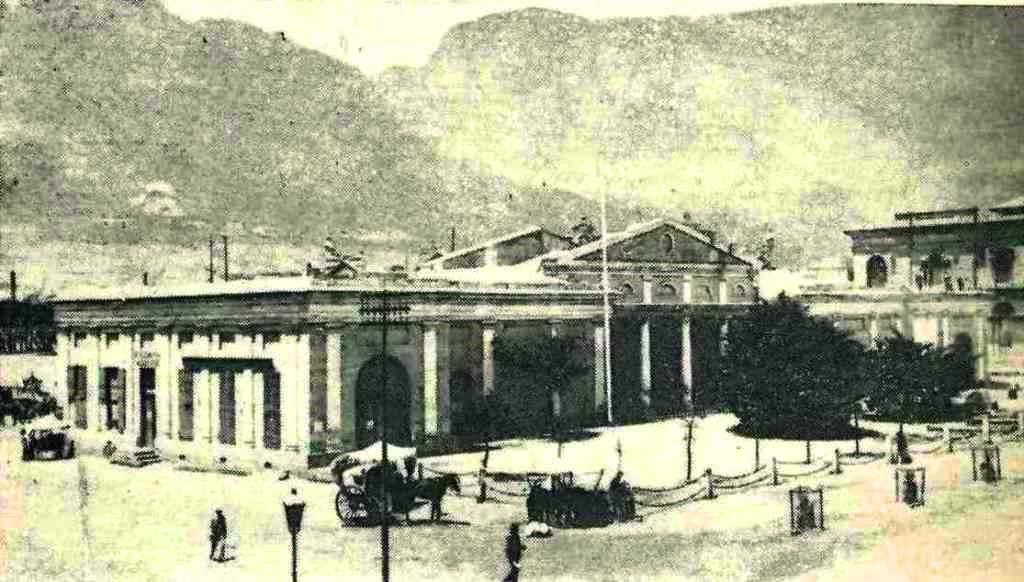
The Commercial Exchange of Cape Town was raised on the Heerengracht -- the broad watercourse-lined avenue later renamed Adderley Street -- between 1819 and 1822, the first purpose-built merchants' exchange in British colonial South Africa. The original concept was supplied by John Chisholm, and the building was designed and executed by the partnership of Durham and Warren, who gave it the restrained Georgian neoclassical idiom that characterised the better commercial architecture of the early Cape (Artefacts.co.za, building record 985; R. Lewcock, Early Nineteenth Century Architecture in South Africa). A two-storey masonry block fronting the principal thoroughfare, the Exchange combined a ground-floor commercial room and reading room with a large upper assembly hall, and was for decades the most substantial public meeting space in the town. Its appearance around 1830 is preserved in a watercolour by H. C. de Meillon, and a Cape Town Chamber of Commerce photograph of 1887 records the mature building shortly before its demolition.
As a working merchants' exchange rather than a monumental bourse, the building carried little programmatic sculpture or allegory of the kind found in the great European exchanges; its dignity derived instead from proportion, colonnaded fenestration and the civic prominence of its position on the Heerengracht. The principal surviving visual records of the building are themselves the works of art most associated with it: the circa-1830 watercolour of the Commercial Exchange by Henry Clifford de Meillon, one of the most important topographical painters of the early Cape, and the 1887 albumen photograph from the Cape Town Chamber of Commerce collection that documents the streetscape of Adderley Street with the Exchange and the adjoining Standard Bank.
The Exchange stood at the commercial heart of Cape Town on the Heerengracht, the artery running up from Table Bay that was renamed Adderley Street in 1850 in honour of the British MP Charles Bowyer Adderley, who had helped block the colony's conversion into a penal settlement. The building anchored the city's mercantile quarter alongside the Standard Bank and the customs and shipping interests clustered near the foreshore, and its forecourt served as the principal civic gathering place of the port. After the Exchange was pulled down in 1895 its site was taken by the new General Post Office, built of Saldanha Bay stone, which still occupies the block and fixes the location at the corner of Adderley and Darling Streets in the modern City Bowl.
A distinction was originally drawn between a Commercial Room and a Public Exchange, and on 8 September 1819 a joint general meeting of subscribers to both institutions inaugurated the combined undertaking; the building was completed by 1822 (Cape Chamber of Commerce histories). For the better part of seven decades it functioned as the merchants' meeting place of the colonial capital. In its early years it also housed the South African Public Library -- one of the first free libraries in the British Empire -- which was accommodated in the Commercial Exchange during the late 1820s before moving to its own premises. On 4 July 1849 the Exchange became the focal point of the Cape's anti-convict agitation, when a multi-ethnic crowd estimated at over five thousand, around a quarter of the town's population, assembled outside the building, signed petitions to Queen Victoria and formed the Anti-Convict Committee with John Fairbairn as secretary. From the 1840s the institution's finances faltered; proposals from 1841 to replace it with a chamber of commerce culminated in the establishment of the Cape Town Chamber of Commerce in 1860-61, the Exchange's institutional heir. The building was demolished about 1895 to make way for the General Post Office.
The Commercial Exchange was a general merchants' exchange serving the maritime and produce economy of the Cape -- a provisioning and entrepot port on the sea route between Europe and the East. Subscribers met there to transact the colony's staple trades: wine and brandy, wool (which rose to dominance in Cape exports across the nineteenth century), wheat and other agricultural produce, hides, and the shipping, freight, marine insurance and bills of exchange that accompanied a busy harbour. The attached commercial reading room supplied the shipping intelligence, price currents and newspapers on which this trade depended, making the Exchange the information as well as the bargaining centre of colonial commerce until that role passed to the Chamber of Commerce after 1861.
Images will be added as the project develops. Photographs by Larry Ng and from research sources.