Stourbridge Fair (Stourbridge Common) and its Leper Chapel
Cambridge, United Kingdom · Established Chartered 1199; first held 1211
This site requires authorization to access.
To request access, contact
william.goetzmann@yale.edu
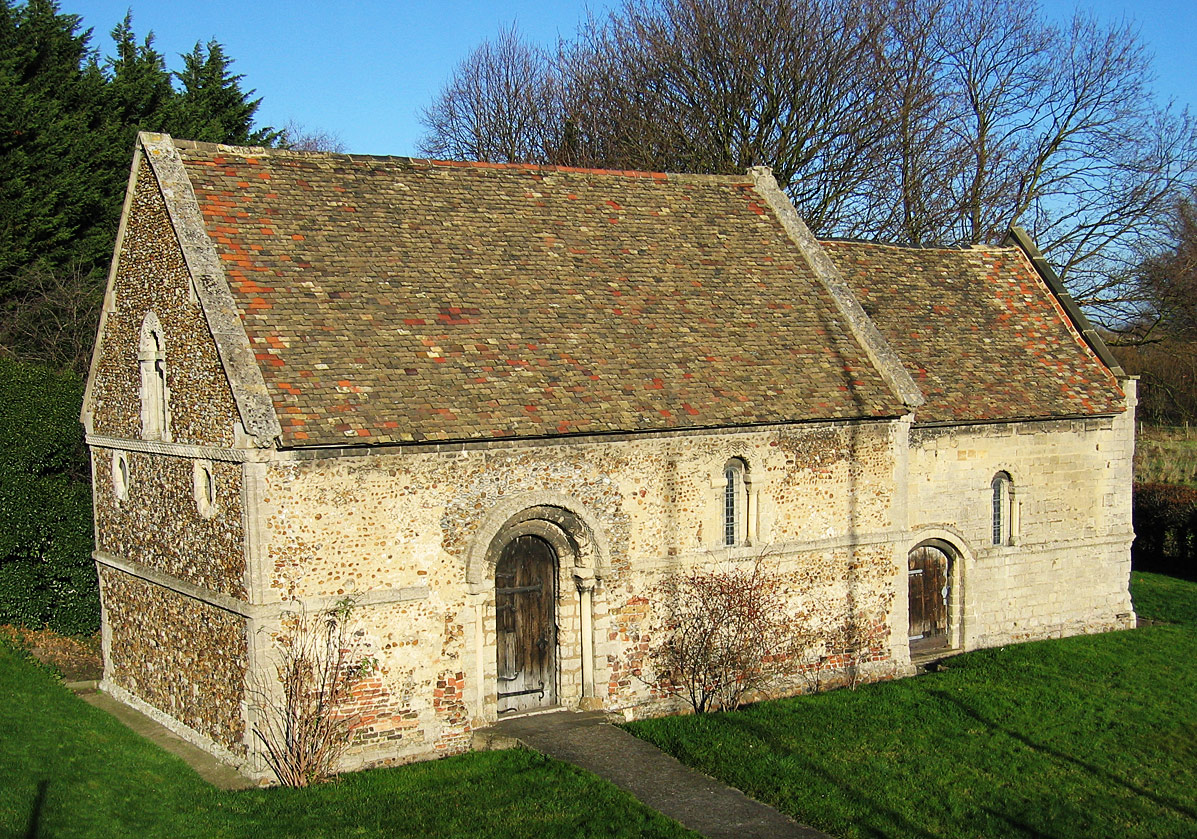
Unlike the purpose-built bourses and exchange halls of later centuries, Stourbridge Fair possessed no permanent trading edifice: for some seven hundred years it was conducted in the open air on Stourbridge (or Sturbridge) Common, a meadow beside the River Cam to the east of medieval Cambridge, where rows of wooden booths and canvas-roofed stalls were erected each September and dismantled when trade was done. Its single enduring built relic is the Chapel of St Mary Magdalene, the so-called Leper Chapel, a small Norman structure of about 1125 that served the leper hospital whose endowment first secured the right to hold the fair. As the listing on the National Heritage List for England records (Historic England, list entry 1126144, Grade I, designated 26 April 1950), the chapel is a complete and little-altered chapel of the mid-twelfth century, consisting of chancel and nave only, built of ashlar, flint and brick beneath a tiled roof of about 1400, with the west wall altered in 1867. Its most celebrated feature is the Romanesque chancel arch enriched with chevron (zigzag) moulding, together with a carved south doorway, which together make it, in the words of the Historic England description, a rare surviving example of a twelfth-century hospital chapel and one of the most complete pieces of Norman architecture in the county. Nikolaus Pevsner, in The Buildings of England: Cambridgeshire (1954), found the little building standing 'desperately alone' amid the encroaching railway sidings and gasworks of nineteenth-century Barnwell.
The artistic interest of the site is modest and concentrated almost wholly in the carved Romanesque ornament of the Leper Chapel rather than in any movable furnishings, for the fair itself left no monumental art. The chapel's chancel arch carries bold chevron and roll mouldings characteristic of English Romanesque sculpture of the 1120s, and the blocked north and south doorways retain simple carved detail of the same period; later medieval work survives in the lancet windows and the timber roof of about 1400 noted in the Historic England listing. The building had fallen to use as a barn and store before the antiquary and Cambridge librarian Thomas Kerrich purchased and restored it in 1816, an episode documented by the watercolours that John Sell Cotman made of the chapel in 1818. Beyond this fabric, the visual record of the fair survives chiefly in topographical prints and in literary description rather than in painting or sculpture commissioned for the place.
Stourbridge Common lay just outside the medieval bounds of Cambridge, between the town and the village of Barnwell, on the road toward Newmarket and within easy reach of the River Cam and the navigable Ouse to King's Lynn and the sea. This combination of river, road and open meadow was decisive: goods could be barged inland from the east-coast ports and the Low Countries, while the common provided the unencumbered ground on which a temporary city of booths could rise each autumn. The fair was laid out, as contemporaries described, in named rows and 'streets' of stalls -- Garlic Row, Cheese Hill, the Duddery for wool and cloth -- so that for a few weeks it formed, in Daniel Defoe's phrase from his Tour Thro' the Whole Island of Great Britain (1724), 'not only the greatest in the whole nation, but in the world,' resembling 'a well-fortified city' for its order. The Leper Chapel survives today marooned amid the later Victorian railway landscape of Newmarket Road, the last fixed point of a marketplace that has otherwise vanished back into common ground.
The institution's origin lay in charity rather than commerce: a leper hospital dedicated to St Mary Magdalene stood at Steresbrigge by the early twelfth century, and in 1199 King John granted its lepers the right to hold a three-day fair to raise funds for their support, the first being held in 1211 around the Feast of the Holy Cross on 14 September (University of Cambridge, 'The 800-year-old story of Stourbridge Fair'). When the hospital ceased to admit lepers later in the thirteenth century, the lucrative fair passed into contention, and control was disputed between the Crown, the town of Cambridge and the University; Elizabeth I confirmed the town's right to the profits while granting the University powers of oversight, including assay of weights and measures. From the fifteenth to the eighteenth century Stourbridge was the pre-eminent fair of England and, by repute, of Europe, drawing merchants from across the Continent. It was visited and immortalised by famous men: Isaac Newton bought a copy of Euclid's Elements there in 1663 and, by tradition, a prism for his optical experiments; Samuel Pepys recorded a visit; and John Bunyan is generally held to have modelled the 'Vanity Fair' of The Pilgrim's Progress (1678) upon it. Improved roads and canals, and the rise of fixed shops and exchanges, drained the fair of its commercial purpose; reduced to a pleasure fair, it was opened for the last time in 1933 by the Mayor of Cambridge, Florence Ada Keynes, and formally abolished in 1934. The chapel, given to the University and in 1951 to the Cambridge Preservation Society, is today maintained by Cambridge Past, Present and Future.
Stourbridge functioned above all as a great wholesale entrepot where bulk goods changed hands between long-distance merchants. The fair contained distinct markets for wool and cloth -- the Duddery being the centre of the cloth trade -- alongside fish, salt, wax, spices, timber, iron, leather, hops, pewter, glass and silks, much of it sold in large quantities at wholesale prices to be distributed across the country in the following months. Defoe in 1724 catalogued its goldsmiths, toyshops, braziers, turners, milliners and haberdashers, and noted that the wholesale dealings in wool and other staples ran to tens of thousands of pounds, settled by bargains and credit between merchants who never unpacked their goods on the ground. It was thus a marketplace in the fullest medieval sense -- periodic, itinerant and governed by its own court of pie-powder for the swift settlement of mercantile disputes -- rather than a permanent securities or commodity exchange, and as such it stands as the foremost English example of the great open-air merchant fair that preceded and complemented the rise of the fixed urban bourse.
Images will be added as the project develops. Photographs by Larry Ng and from research sources.