Cambridge Corn Exchange
Cambridge, UK · Established 1875
This site requires authorization to access.
To request access, contact
william.goetzmann@yale.edu
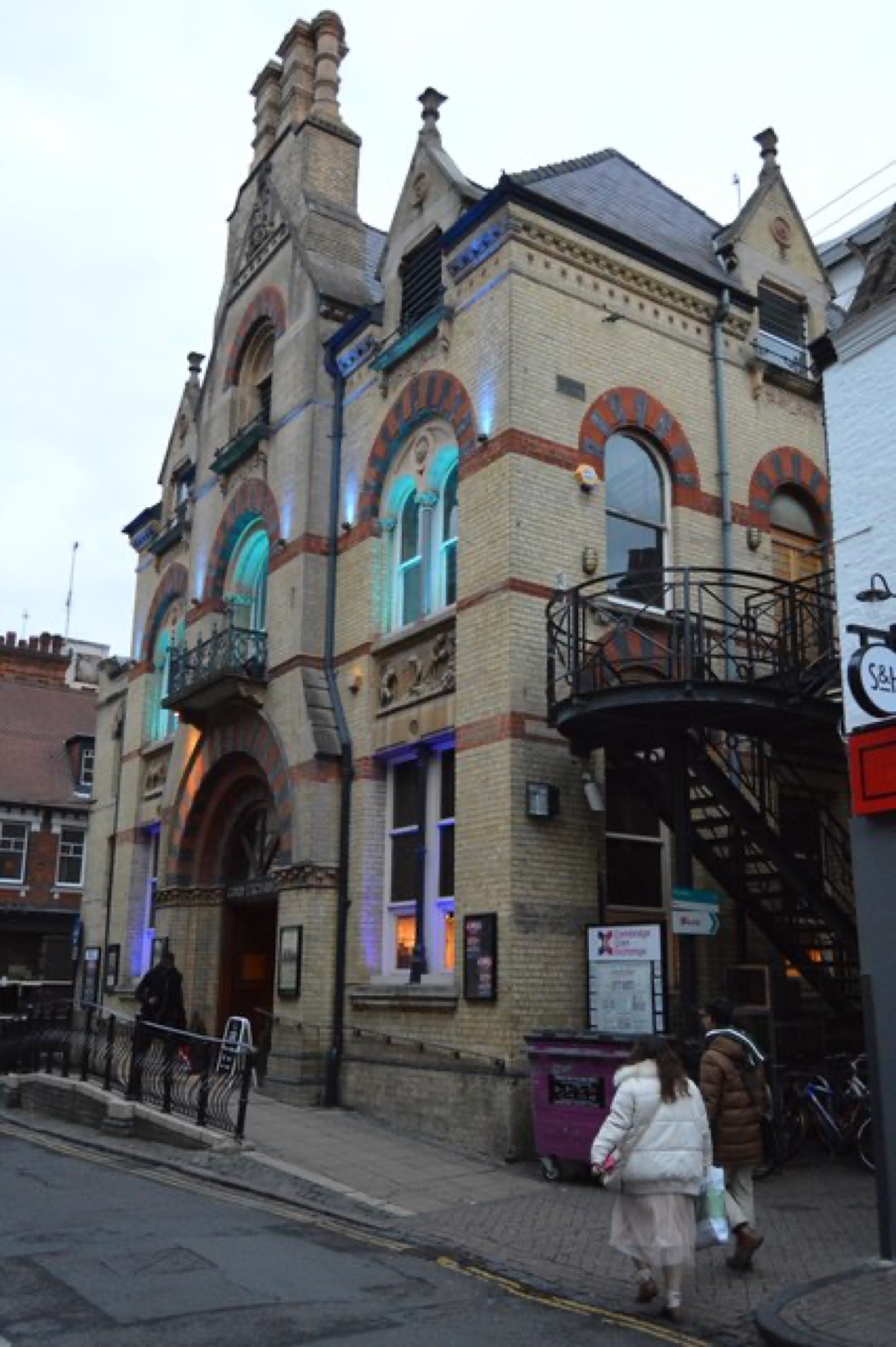
The Cambridge Corn Exchange, situated on Wheeler Street in the heart of the city’s commercial quarter, stands as one of the finest surviving Victorian grain-trading halls in eastern England. The present building, opened on 6 November 1875, was designed by the local architect-engineer Richard Reynolds Rowe, F.S.A., F.R.I.B.A. (1824–1899), who won an architectural competition assessed by the eminent Alfred Waterhouse. Six designs were submitted; Waterhouse favored the more economical Greco-Italian scheme of John Edlin, but the borough council ultimately selected Rowe’s bolder Gothic entry for its civic grandeur. Constructed of grey gault brick with red and dark blue brick dressings, tiles, faience, and Welsh slate roofing, the building presents a symmetrical three-bay frontage to Wheeler Street but extends ten bays down Corn Exchange Street, each containing a pointed-arch recess with two-light windows and rose windows above. Nikolaus Pevsner, in The Buildings of England: Cambridgeshire (1954, revised by Simon Bradley, 2014), famously dismissed the exterior as “very ugly, in a mixed Byzantine and general Rundbogen style,” though later scholars have been kinder to its polychromatic exuberance. The great interior hall, spanning nearly 11,000 square feet, featured a high ceiling supported by exposed iron trusses and a glass roof providing natural ventilation and light—essential for the inspection of grain samples. Corn trading ceased in 1965 when operations moved to a new facility. After closure in 1981 due to an unsafe roof, a major refurbishment (1982–1986) converted the hall into a multipurpose concert and exhibition center, earning a Europa Nostra Diploma in 1987 for conservation and adaptive reuse.
The decorative program of the Cambridge Corn Exchange reflects the High Victorian conviction that civic commercial buildings deserved rich ornamental treatment befitting their public importance. Rowe’s design makes “considerable decorative use of both local and industrial materials,” as the Historic England Grade II listing (1967, entry 1126025) records, combining coloured bricks, cast iron, terracotta, encaustic tiles, and faience in an integrated scheme. The exterior’s polychromatic brickwork—yellow, red, and dark blue—creates bold patterning characteristic of the Rundbogenstil, with rounded arches and inverted crenellations under the eaves. Most distinctive are the terracotta relief panels on the Wheeler Street facade, designed by Rowe himself and carved by the renowned Cambridge firm of Rattee and Kett, whose workshop, founded in 1843, had previously executed carvings for the Palace of Westminster and Ely Cathedral. One panel depicts a detailed harvesting scene: a farmhand cutting corn, a woman binding sheaves, another laborer carrying a bundle, and an infant resting beneath a tree—a pastoral vignette encoding the agricultural purpose of the exchange into its very fabric. A companion panel illustrates ploughing with minute documentary precision. Such agricultural motifs were conventional in Victorian corn exchanges, as Mark Girouard notes in The Victorian Country House (1979), signifying the dignified alliance of commerce and husbandry. Inside, the exposed iron roof trusses combine structural function with decorative ambition, their circular-ribbed principals creating rhythmic repetition across the hall.
The Cambridge Corn Exchange occupies a pivotal site in the city’s commercial core, positioned between Wheeler Street and Corn Exchange Street just steps from the ancient Market Hill—the open-air market space that has served as Cambridge’s mercantile heart since before the Norman Conquest. As the Victoria County History of Cambridgeshire (1959) documents, the marketplace was the “true, dynamic centre of the town,” organized into specialized zones: shambles for meat, a corn market for grain and poultry, and a garden market around the market cross. The exchange building replaced the Black Bear Inn, the Haunch of Mutton public house, and several shops on what was formerly known as Butchers Row, embedding the new institution within a dense palimpsest of commercial activity. To the south lies Peas Hill—named for the medieval pea market and site of recurring town-gown conflicts—while Petty Cury, whose name derives from the cookshops (parva cokeria) recorded in 1330, runs to the east. The exchange thus sat at the junction of town commerce and university life, a duality that defined Cambridge’s character. The River Cam, navigable to King’s Lynn and the Wash, served as “one of the main thoroughfares of trade in the Eastern Midlands” from the twelfth century through the railway era, carrying grain downriver and returning coal, salt, fish, and wine. Cambridge was simultaneously a university city and an agricultural market town, and the Corn Exchange architecturally formalized this mercantile identity, giving permanent monumental expression to the grain trade that had long animated the streets around it.
Cambridge’s role as a grain market reaches deep into the medieval period. Gregory Clark, in “Markets before Economic Growth: The Grain Market of Medieval England” (Cliometrica, 2015), demonstrates that the English grain market was “both extensive and relatively efficient as early as 1209,” with prices at scattered manorial estates moving in close correlation—evidence of surprisingly low transport costs and active arbitrage. Cambridge was a natural node in this system, situated at the junction of the fenland waterways and the agricultural hinterland of East Anglia. The great Stourbridge Fair, granted by King John to a leper hospital in 1211 and held annually on the common east of the town, grew into what Daniel Defoe in A Tour Thro’ the Whole Island of Great Britain (1724) called “the greatest in the whole nation, but in the world,” surpassing Leipzig and Frankfurt, with wool sales alone reaching £60,000. By the sixteenth century, grain moved “in a continuous stream” from Cambridge to London. The first purpose-built Cambridge corn exchange opened on St Andrew’s Hill in 1842, but by the late 1860s it was judged inadequate for the expanding trade. The new exchange of 1875 arrived in the wake of the Corn Laws’ repeal in 1846, which, as Cheryl Schonhardt-Bailey argues in From the Corn Laws to Free Trade (MIT Press, 2006), represented the decisive pivot toward free trade, stimulating construction of grand exchange buildings across England’s grain counties. Cambridge’s exchange served as a mechanism of price discovery: farmers and dealers inspected grain samples, negotiated prices, and established benchmarks that radiated outward through the regional market. Physical corn trading persisted until 1965, ending over a century of formalized grain commerce on Wheeler Street.
The Cambridge Corn Exchange served as the principal marketplace for the agricultural produce of one of England’s most productive cereal regions. Wheat was the dominant commodity, grown extensively across the heavy clay soils of southern Cambridgeshire, but barley held particular importance for the surrounding district. East Anglia—Norfolk, Suffolk, and Cambridgeshire especially—was the heartland of English malting barley production, its light, well-drained soils and relatively dry climate producing grain of the low-nitrogen quality prized by brewers. The Maris Otter variety, later raised at the Plant Breeding Institute near Cambridge, became the benchmark for English ale malt. Oats and rye also featured in the exchange’s trade, alongside beans and peas—the latter so prominent in the medieval market that the nearby Peas Hill took its name from the trade. The draining of the Fens, accelerated by the Bedford Level Corporation from the 1660s onward, brought vast new acreage under cultivation, increasing the volume of grain flowing through Cambridge’s markets. Malt itself was a major article of commerce: the Victoria County History records Cambridge’s importance as a clearinghouse, with grain moving downriver on the Cam to maltsters and brewers at King’s Lynn and beyond. Hops, imported from Kent and Surrey, were traded at the Stourbridge Fair and later through the exchange for the regional brewing industry. Seeds, including clover and turnip seed essential to the Norfolk four-course rotation, butter, and cheese rounded out the agricultural commodities that passed through Cambridge’s trading halls, reflecting the rich and diversified output of the East Anglian countryside.
Images will be added as the project develops. Photographs by Larry Ng and from research sources.