Buffalo Stock Exchange
Buffalo, USA · Established 1929
This site requires authorization to access.
To request access, contact
william.goetzmann@yale.edu
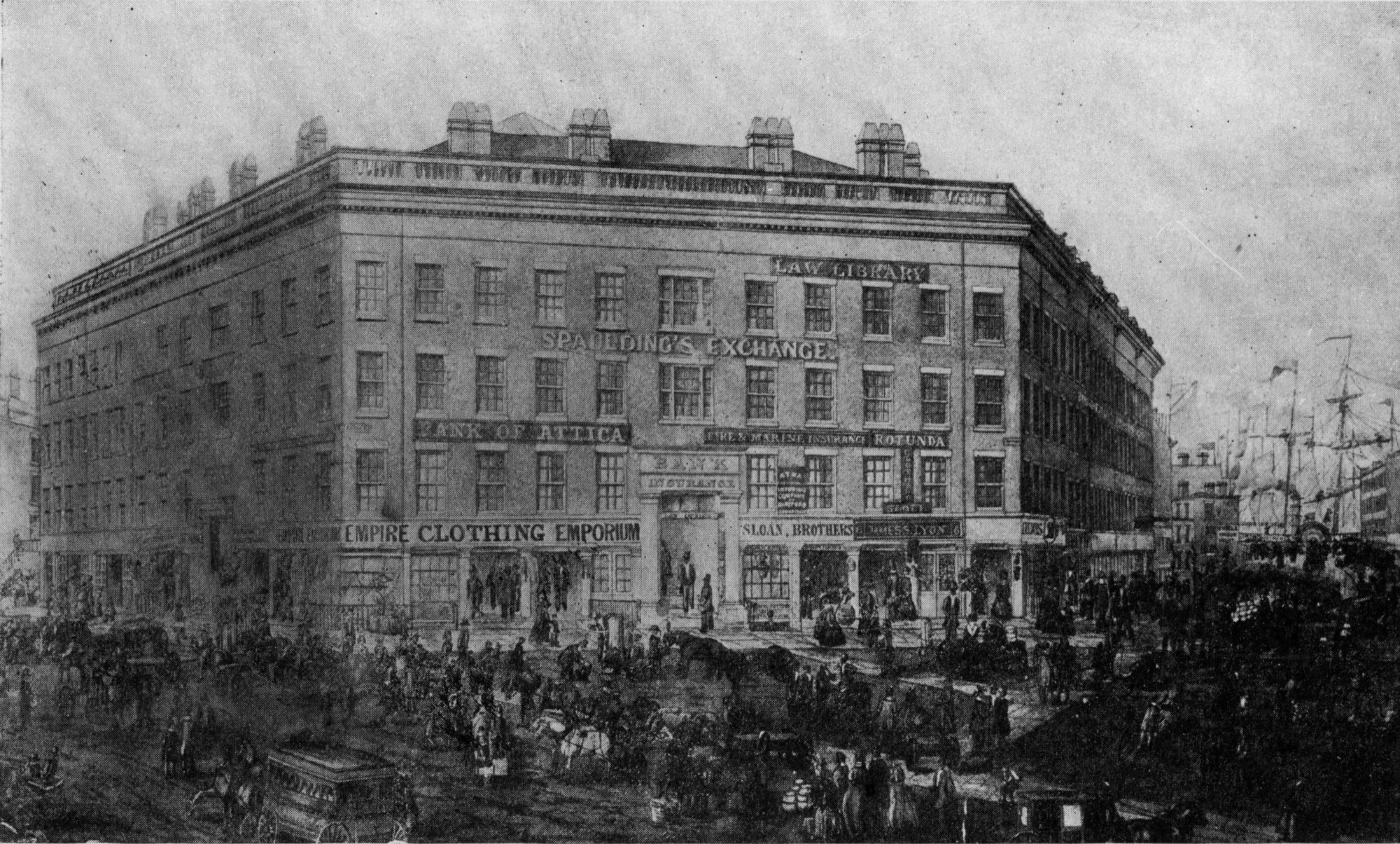
The Buffalo Stock Exchange occupied a building at 210 Pearl Street, between Eagle and Court streets, in the heart of Buffalo’s downtown financial district. The structure had been erected in 1895 as the Real Estate Exchange and was subsequently known as the Mutual Life Building before it was repurposed for securities trading in 1929. As Steve Cichon documented in his Buffalo News historical column “Torn-Down Tuesday” (2019), the building was a representative specimen of the Romanesque-influenced commercial architecture that lined Pearl Street in the late nineteenth century—four to five stories of load-bearing brick with iron storefronts, typical of what the city’s Preservation Ready Areas Survey identifies as the Canal District commercial vernacular. The exchange’s immediate surroundings constituted Buffalo’s densest concentration of financial architecture. One block north on Main Street stood the Ellicott Square Building, designed by Charles Atwood of D. H. Burnham & Company and completed in 1896—at the time, the largest office building in the world, with its monumental central court finished in Italian marble beneath an iron-and-glass roof. Two blocks south, Louis Sullivan and Dankmar Adler’s Guaranty Building (1896) at 28 Church Street rose thirteen stories in burnt-orange terra cotta, a National Historic Landmark that the architectural historian Francis R. Kowsky, in Buffalo Architecture: A Guide (MIT Press, 1981), called “one of the supreme masterpieces of American architecture.” Nearby stood Green & Wicks’s Beaux-Arts Buffalo Savings Bank (1899–1901) at Main and Genesee, and the Marine National Bank Building (1913), whose classical facades projected the stability and ambition of a city that, as Mark Goldman argued in High Hopes: The Rise and Decline of Buffalo, New York (SUNY Press, 1983), had by 1900 developed a financial infrastructure commensurate with its status as the nation’s eighth-largest city. The Stock Exchange building itself was demolished in the mid-twentieth century and the site is now a parking ramp.
The decorative program of Buffalo’s commercial district provided an extraordinarily rich architectural setting for the Stock Exchange’s brief existence. The supreme ornamental achievement was Louis Sullivan’s Guaranty Building (1896), whose thirteen-story façade was sheathed entirely in reddish-brown terra cotta executed by the Northwestern Terra Cotta Company of Chicago. As Olaf William Shelgren Jr. detailed in his monograph for the Niagara Frontier Landmarks series (1977), Sullivan’s ornamental vocabulary drew on organic forms—flowers, seedpods, and spreading branches—rendered in a plastic, almost Art Nouveau idiom that covered piers, spandrels, tympani, columns, and arches in continuous foliate relief. Inside, Sullivan designed bronze elevator cages, a mosaic-tile lobby with stained-glass skylights, and art-glass transoms above the storefronts, creating what the Metropolitan Museum of Art has described as a total decorative environment. Baluster fragments from the Guaranty’s interior are now held in the Met’s American Wing collection. A block away, the Ellicott Square Building offered a contrasting aesthetic: its Italian Renaissance exterior of pearl-gray brick and granite gave way to the great rectangular central court, where a mosaic floor designed by William Winthrop Kent and James A. Johnson in 1930 depicted sun symbols drawn from civilizations around the world—a cosmopolitan gesture befitting the building’s function as the hub of Buffalo’s legal and financial professional class. The Buffalo Savings Bank contributed a Beaux-Arts interior featuring a golden dome, colossal Corinthian columns, and a triumphal-arch entrance motif that Green & Wicks derived from Roman models. As Kowsky observed in Buffalo Architecture (1981), these ornamental programs collectively expressed the commercial confidence of a city whose leaders believed, on the eve of the Pan-American Exposition, that Buffalo stood poised to rival Chicago as the great inland metropolis of the United States.
Buffalo’s emergence as a financial center was inseparable from its geographic position at the eastern terminus of the Great Lakes and the western terminus of the Erie Canal. When the canal opened in 1825, it transformed a frontier settlement of 2,400 inhabitants into the critical transshipment point for the vast grain harvests of the American interior. As the New York State Museum’s economic history division has documented, grain moved across the western Great Lakes to Buffalo, was unloaded into elevators, and transferred to canal boats for the 363-mile journey east to Albany. In 1842, Joseph Dart and the Scottish engineer Robert Dunbar built the world’s first steam-powered grain elevator at the mouth of Buffalo Creek, an innovation that Reyner Banham celebrated in A Concrete Atlantis: U.S. Industrial Building and European Modern Architecture (MIT Press, 1986) as the origin of a building type that would profoundly influence European modernism. By the 1890s, Buffalo could boast twenty-nine elevators and was the largest grain port in the world, handling more tonnage than New York or London. Main Street, running north from the Buffalo River, formed the commercial spine of this booming metropolis: streetcars, railroads, and canal traffic all converged at its southern terminus, and the blocks between Eagle and Seneca streets became the financial district proper. Three epochal developments in the late 1890s—the availability of Mesabi Range iron ore via Great Lakes shipping, the relocation of the Lackawanna Iron and Steel Company to the Lake Erie shore in 1899, and the arrival of cheap hydroelectric power transmitted twenty-five miles from Niagara Falls—propelled Buffalo to its zenith. The Pan-American Exposition of 1901, as Kerry S. Grant documented in The Rainbow City (2001), attracted more than eight million visitors and heralded the city’s ambitions as a commercial-industrial powerhouse, with the Electric Tower’s thousands of incandescent bulbs powered by Niagara Falls serving as a spectacular advertisement for the new age of alternating current.
Although securities had been traded informally in Buffalo’s banking parlors and brokerage offices throughout the late nineteenth and early twentieth centuries, the Buffalo Stock Exchange was not formally constituted until May 1, 1929, when trading commenced at 210 Pearl Street with stock in sixty-five local companies available for transaction. As Eugene N. White demonstrated in his NBER working paper “Competition Among the Exchanges before the SEC: Was the NYSE a Natural Hegemon?” (2013), the bull market of the 1920s had spawned a wave of new regional exchanges across the United States, as rapidly proliferating industrial issues—particularly in the automobile, electrical, and chemical sectors—outstripped the listing capacity of the New York Stock Exchange. Buffalo’s exchange averaged 12,000 trades per day in its early months, reflecting the robust demand for shares in local grain elevator companies, railroads, steel manufacturers, and hydroelectric power firms that constituted the backbone of Western New York’s industrial economy. The timing, however, proved catastrophic: on October 29, 1929—just five months after the exchange opened—the Wall Street crash obliterated share values nationwide. Mark Goldman, in High Hopes (SUNY Press, 1983), documented how Buffalo’s economy, already overly dependent on heavy industry and transshipment, suffered disproportionately during the Depression, with unemployment in Erie County exceeding 30 percent by 1933. The exchange struggled on through years of diminished volume before suspending trading in March 1935. The Securities Exchange Act of 1934, which created the SEC and imposed new listing and reporting requirements, raised compliance costs that small regional exchanges could not sustain. As White’s analysis confirms, exchanges in Buffalo, Denver, and Hartford simply closed their doors rather than absorb the regulatory burden. The building at 210 Pearl Street was subsequently demolished, erasing the physical trace of Buffalo’s brief experiment in formal securities exchange—a venture that Goldman characterized as emblematic of the city’s persistent “high hopes” and their recurrent disappointment.
The Buffalo Stock Exchange listed shares in sixty-five local companies at its opening in 1929, a portfolio that reflected the diversified industrial economy of Western New York at its apogee. Grain elevator and flour milling companies figured prominently: Buffalo had been the world’s largest grain port since the mid-nineteenth century, and by 1930 it had become the largest flour milling center in the world, with major operations including the George Urban Milling Company and the Washburn Crosby mills (later General Mills), as documented by the Western New York Heritage Press. Railroad stocks were central to the exchange’s listings, given Buffalo’s status as the second-largest rail hub in North America: the New York Central Railroad, the Erie Railroad, the Delaware, Lackawanna and Western Railroad, and the Lehigh Valley Railroad all maintained substantial terminal facilities in the city. Steel and iron company shares reflected the massive Lackawanna Steel Company plant (later Bethlehem Steel) that had relocated to the Lake Erie shore in 1902, creating the industrial city of Lackawanna. Hydroelectric power companies constituted a distinctive local asset class: the Niagara Falls Power Company, successor to the Niagara Falls Hydraulic Power & Manufacturing Company that Jacob F. Schoellkopf had developed beginning in 1877, had issued $26 million in capital stock by the time of its consolidation, as recorded in Edward Dean Adams’s Niagara Power: History of the Niagara Falls Power Company, 1886–1918 (privately printed, 1927). Shares in electrochemical and electrometallurgical firms—including the Carborundum Company, which had built its Niagara Falls plant in 1895 to exploit cheap electricity—represented the new industrial frontier. Banking stocks rounded out the lists: the Manufacturers and Traders Trust Company (founded 1856), the Marine National Bank (founded 1850, later Marine Trust Company), and the Erie County Savings Bank all served as pillars of the local financial ecosystem that the exchange was designed to formalize and expand.
Images will be added as the project develops. Photographs by Larry Ng and from research sources.