Buenos Aires Stock Exchange (Bolsa de Comercio de Buenos Aires)
Buenos Aires, Argentina · Established 1854
This site requires authorization to access.
To request access, contact
william.goetzmann@yale.edu
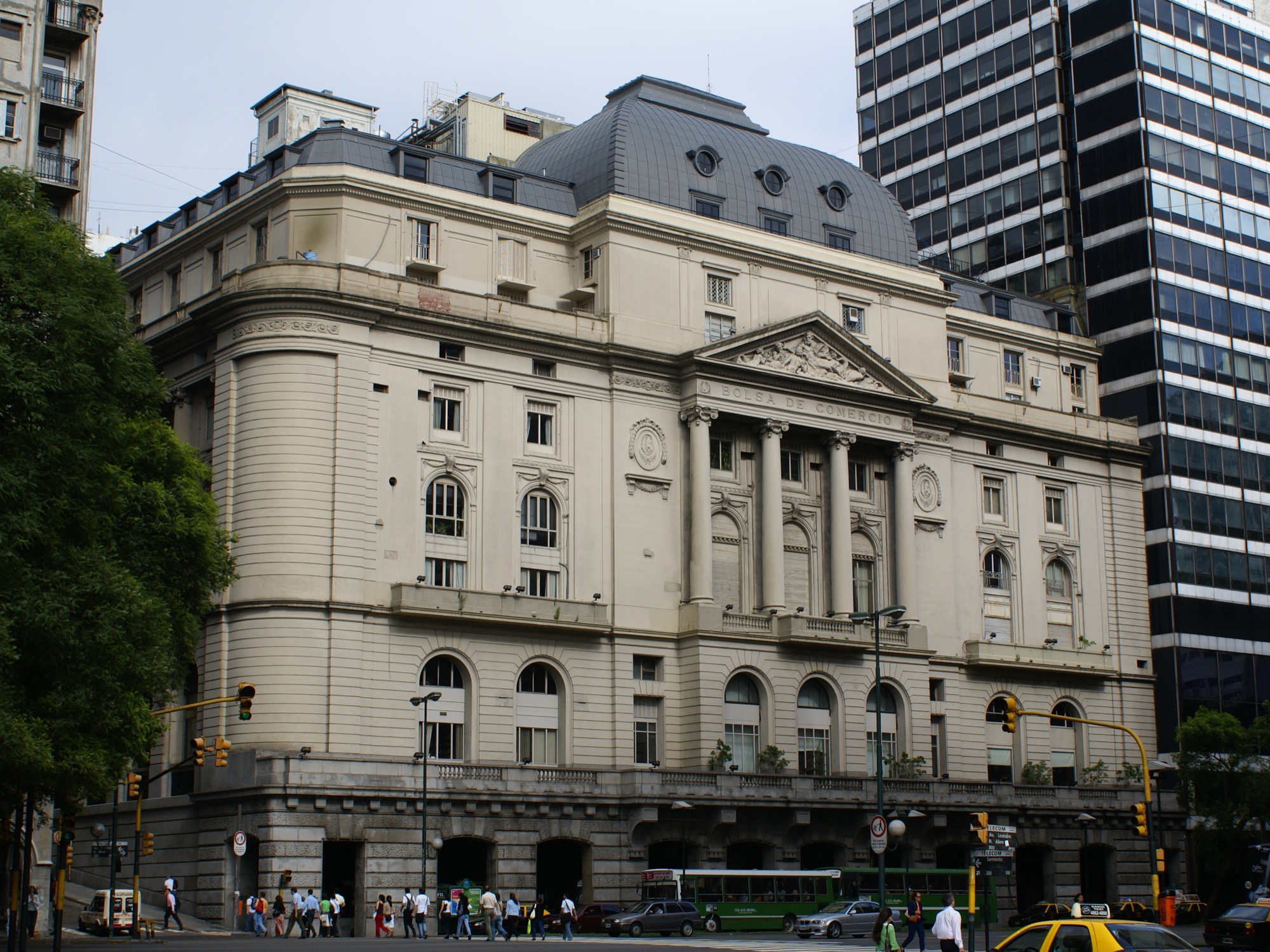
The current Bolsa de Comercio de Buenos Aires occupies a monumental Beaux-Arts palace at Sarmiento 299, designed by the Norwegian-Argentine architect Alejandro Christophersen (1866–1946), who had trained at the Académie Royale des Beaux-Arts in Antwerp and the École des Beaux-Arts in Paris under Jean-Louis Pascal. Christophersen won an invitational competition for the commission in 1913; construction began in September 1914 and the building was inaugurated on December 16, 1916. As architectural historian Claudia García Rijo analyzed in her study of the Bolsa as a paradigmatic case of classical composition (Cuadernos del Centro de Estudios de Diseño y Comunicación, 2020), Christophersen displayed explicit mastery of academic rules, rendering the classical tripartite division of base, shaft, and cornice with exceptional clarity. The facades, clad in faux Paris stone, present three street elevations along Avenida Leandro N. Alem, Calle Sarmiento, and Calle 25 de Mayo. The building rises fourteen stories including two basement levels, supported by a modern steel structural frame—advanced technology for Buenos Aires at the time. The spatial sequence moves from three principal entrances through an oval vestibule inscribed in a rectangle of root-two proportion, through a small transitional chamber, into the Grand Hall (Salón Principal), a double-height claustral space with a perimeter gallery supported by columns of red Verona marble spaced 16.50 meters apart, elevating a twenty-meter-high building mass above the hall without intermediate supports. The interior palette is predominantly beige—light-toned floors, walls, and ceilings—contrasted by the warm red marble columns and bronze fittings, reflecting what the 1918 project memoir described as decorations that were not excessive and consonant with the seriousness that the building’s function required. Upper floors housed the Rueda de Títulos (securities trading floor) and the Rueda de Cereales (grain trading floor), along with the Assembly Hall, boardroom, and six floors of rental offices organized around a central courtyard for light and ventilation. The building succeeded three earlier locations: in 1854, the exchange first operated in a house belonging to the family of General José de San Martín at Calle San Martín 118; in 1862, it moved into its first purpose-built structure at San Martín 216, designed by architects Henry Hunt and Hans Schroeder and inaugurated by Governor Bartolomé Mitre (that building, now a National Historic Monument, serves as the Numismatic Museum of the Central Bank); and in 1885, a third building was erected facing the Casa Rosada at the corner of Rivadavia and 25 de Mayo, on land now occupied by the Banco de la Nación Argentina. Trading continued in Christophersen’s hall until 1984, when operations relocated to a modern annex designed by Mario Roberto Álvarez.
Christophersen conceived the Bolsa de Comercio as a Gesamtkunstwerk—a total work of art—in which every decorative element, from monumental sculpture to restaurant china, fell under the architect’s direct supervision. The building’s allegorical program centers on Hermes/Mercury, the Greco-Roman deity of commerce, whose image pervades the interior as the institution’s emblematic figure. Two stained-glass vitraux by the Catalan vitrallist Amadeo Vilella, installed above the oval vestibule ceiling, depict the mythological dialogue between Zeus and Hermes: Neptune holds a wooden helm and rests upon a vessel pouring water, representing the navigable waterways of the Americas, while Hermes bears his caduceus—rendered as intertwined serpents with white ribbons symbolizing the power to bind and dissolve commercial relationships—and winged ornaments expressing divine swiftness. The panels are dated 1916 and incorporate the figures of the Argentine Republic alongside the classical deities. On the first floor, a carved bust depicts Mercury wearing his characteristic petasos (winged helmet), symbolizing agile and elevated thought, while a full-length statue—identical to one in Valencia’s Jardín de Monforte—shows Mercury in a short cloak holding the caduceus in his left hand and a marsupium (money pouch) in his right. Four nineteenth-century Carrara marble sculptures representing the Four Seasons stand at the interior corners of the Grand Hall, their classical allegory reinforcing the building’s connection between natural cycles and commercial rhythms. On the main staircase landing hangs a Flemish tapestry depicting Cleopatra receiving Mark Antony, while the upper landing displays a sixteenth-century Brussels tapestry titled Europa—reportedly the only piece from its set of four located outside of Europe. The bronze decorative program is equally comprehensive: five-ton cast bronze entrance doors were manufactured in the workshops of Italian immigrant Silvestre Zamboni and his sons, while the ornamental ironwork—elevator cages, staircase railings, and entrance gates—was executed by Genovese artisan Luis Questa to Christophersen’s designs. The architect also designed custom luminarias for the lateral galleries, featuring truncated pyramid forms with geometric brass frames that reference classical cornices, fabricated by the Etienne and Durand workshops. Even the carpet was woven under the supervision of textile expert Clemente Onelli. The institution also houses a significant collection of paintings and period furniture in its museum spaces.
The Bolsa de Comercio sits at the heart of Buenos Aires’s Microcentro, the financial nerve center of Argentina, with its principal facade on Avenida Leandro N. Alem and secondary entrances on Calle Sarmiento and Calle 25 de Mayo. The avenue’s origins trace to 1780, when Viceroy Juan José de Vértiz y Salcedo had a two-lane promenade built along what was then the shore of the Río de la Plata, landscaped with cottonwood trees and known as the Paseo de la Alameda. As the port expanded—President Julio Roca commissioned its ambitious redevelopment in 1881, financed by Barings Bank, which required reclaiming over two hundred hectares of underwater land—the Paseo de Julio was widened into a grand boulevard, and clapboard structures gave way to French-influenced office buildings distinguished by their archways. The Bolsa’s 1916 headquarters joined a constellation of major institutional buildings along this waterfront axis, including the Mihanovich Shipping Company offices and the Bunge y Born headquarters, establishing the avenue as the spine of Argentine commercial life. The exchange stands just blocks from the Plaza de Mayo, the ceremonial heart of the republic since the colonial era, and from the Casa Rosada (Government House), which faces the site of the Bolsa’s third building (1885). Calle 25 de Mayo, running along the exchange’s southern flank, was one of the earliest streets laid out in Juan de Garay’s 1580 grid and historically connected the port to the central plaza, making it a natural corridor for commercial activity. The broader San Nicolás neighborhood, in which the exchange is located, remains Argentina’s financial center, concentrated with the headquarters of the Central Bank, the Banco de la Nación Argentina, and major private banks. The French Beaux-Arts and academic architectural language of the Microcentro—visible in buildings along Avenida de Mayo and Diagonal Norte—reflects the cultural aspirations of Argentina’s belle époque, when Buenos Aires modeled itself on Paris during its period of extraordinary export-driven prosperity between 1880 and 1914.
The Bolsa de Comercio de Buenos Aires was founded on July 10, 1854, shortly after the promulgation of Argentina’s National Constitution of 1853, by a group of prominent merchants including Nicolás Anchorena, José María Roxas y Patrón, and the future president Bartolomé Mitre. The institution traced its lineage to the Banco Mercantil, established in 1822 by Bernardino Rivadavia, and to the informal commercial networks that had long operated in the cafes, plazas, and public spaces of Buenos Aires. Before formal premises were secured, merchants executed transactions in gold ounces in a house belonging to the family of General José de San Martín. By 1856, corporate shares began trading on the exchange, and in 1862 Governor Mitre inaugurated the first purpose-built exchange building, where gold, mortgage bonds (cédulas hipotecarias), foreign exchange, and shares of the Banco Nacional were traded. Argentina’s integration into global commodity and capital markets accelerated dramatically during the so-called belle époque of 1880–1914. As Roberto Cortés Conde documented in The Political Economy of Argentina in the Twentieth Century (Cambridge, 2009), this was a period of extraordinary growth: by 1913 Argentine per capita income rivaled that of France and Germany. British capital poured into the country—investments grew from roughly twenty million pounds sterling in 1880 to one hundred and fifty-seven million by 1890—financing the railway network that expanded from four hundred kilometers in 1870 to over ten thousand by 1890. Much of this infrastructure was securitized through exchange-listed bonds and debentures. The speculative boom of the 1880s, however, exposed profound vulnerabilities. As A. G. Ford analyzed in his classic study Argentina and the Baring Crisis of 1890 (Oxford Economic Papers, 1956), the reliance on external capital combined with inflationary monetary policy under President Juárez Celman culminated in a devastating financial collapse. Baring Brothers, which had handled over one hundred million gold pesos of Argentine securities between 1882 and 1890, faced bankruptcy in November 1890; securities values on the Buenos Aires exchange were halved, and trading operations were temporarily suspended. The crisis triggered the Revolution of the Park and brought Carlos Pellegrini to the presidency, who as John Edward Hodge documented in Carlos Pellegrini and the Financial Crisis of 1890 (Hispanic American Historical Review, 1970), moved to restore fiscal discipline by founding a new national bank and prohibiting gold trading on the stock exchange. Kris James Mitchener and Marc Weidenmier, in their study of the broader regional fallout (Journal of Economic History, 2008), demonstrated that the crisis increased Latin American yield spreads by more than two hundred basis points. Recovery came gradually: convertibility was restored in 1899 under the Caja de Conversión (currency board), and as Gerardo della Paolera and Alan M. Taylor showed in Straining at the Anchor (University of Chicago Press, 2001), the institution of a gold-standard regime brought renewed stability. The exchange’s growing activity through the early twentieth century necessitated the construction of Christophersen’s grand new palace, inaugurated in 1916 at the height of Argentina’s export prosperity. The building housed both securities and grain trading operations until 1984, when the modern trading floor designed by Mario Roberto Álvarez took over daily operations.
The Bolsa de Comercio de Buenos Aires served as both a securities exchange and a commercial exchange, reflecting the dual character of Argentina’s economy as both a capital-importing and commodity-exporting nation. From its earliest years the exchange facilitated transactions in gold ounces and foreign currency, essential instruments in a young republic navigating between inconvertible paper money and metallic standards—a dynamic analyzed in detail by J. H. Williams in Argentine International Trade under Inconvertible Paper Money, 1880–1900 (Harvard University Press, 1920). By 1862, the exchange listed shares of the Banco Nacional, government bonds, and cédulas hipotecarias—mortgage-backed securities issued by the Banco Hipotecario Nacional that financed the settlement and development of the pampas. These cédulas circulated widely in London, where they were known as Argentine National Cedulas, and became central instruments in the speculative boom of the 1880s. Railway securities constituted a major category of listed instruments: the shares and bonds of companies such as the Buenos Aires Great Southern Railway, the Buenos Aires Western Railway, and the Central Argentine Railway channeled British capital into the vast rail network that connected the agrarian hinterland to the port of Buenos Aires. The Rueda de Cereales (grain trading floor) within the Christophersen building handled forward contracts and spot transactions in wheat, maize, and linseed, commodities that transformed Argentina from a wheat-importing country in 1875 to one of the world’s leading grain exporters by 1903, when the country shipped over seventy-five million imperial bushels of wheat. The exchange’s operations also encompassed the products of the pastoral economy—cattle hides, salted and jerked beef, tallow, grease, and wool—which had been the staples of Argentine export trade since the colonial era and were, as Jonathan Brown documented in A Socioeconomic History of Argentina, 1776–1860 (Cambridge University Press, 1979), coveted by the manufacturing sectors of Britain and northern Europe. A weather vane (rosa de los vientos) installed atop the building tracked wind conditions to inform grain trading prices, a practical device linking meteorological observation directly to market operations. Trading was conducted by open outcry, with prices manually recorded on chalkboards positioned around the upper perimeter of the trading hall. Provincial land bonds and shares in colonization companies also circulated, as the commodification of the pampas drove both agricultural settlement and financial speculation during Argentina’s golden age of export growth.
Images will be added as the project develops. Photographs by Larry Ng and from research sources.