Budapest Stock Exchange (Budapesti Értéktőzsde)
Budapest, Hungary · Established 1864
This site requires authorization to access.
To request access, contact
william.goetzmann@yale.edu
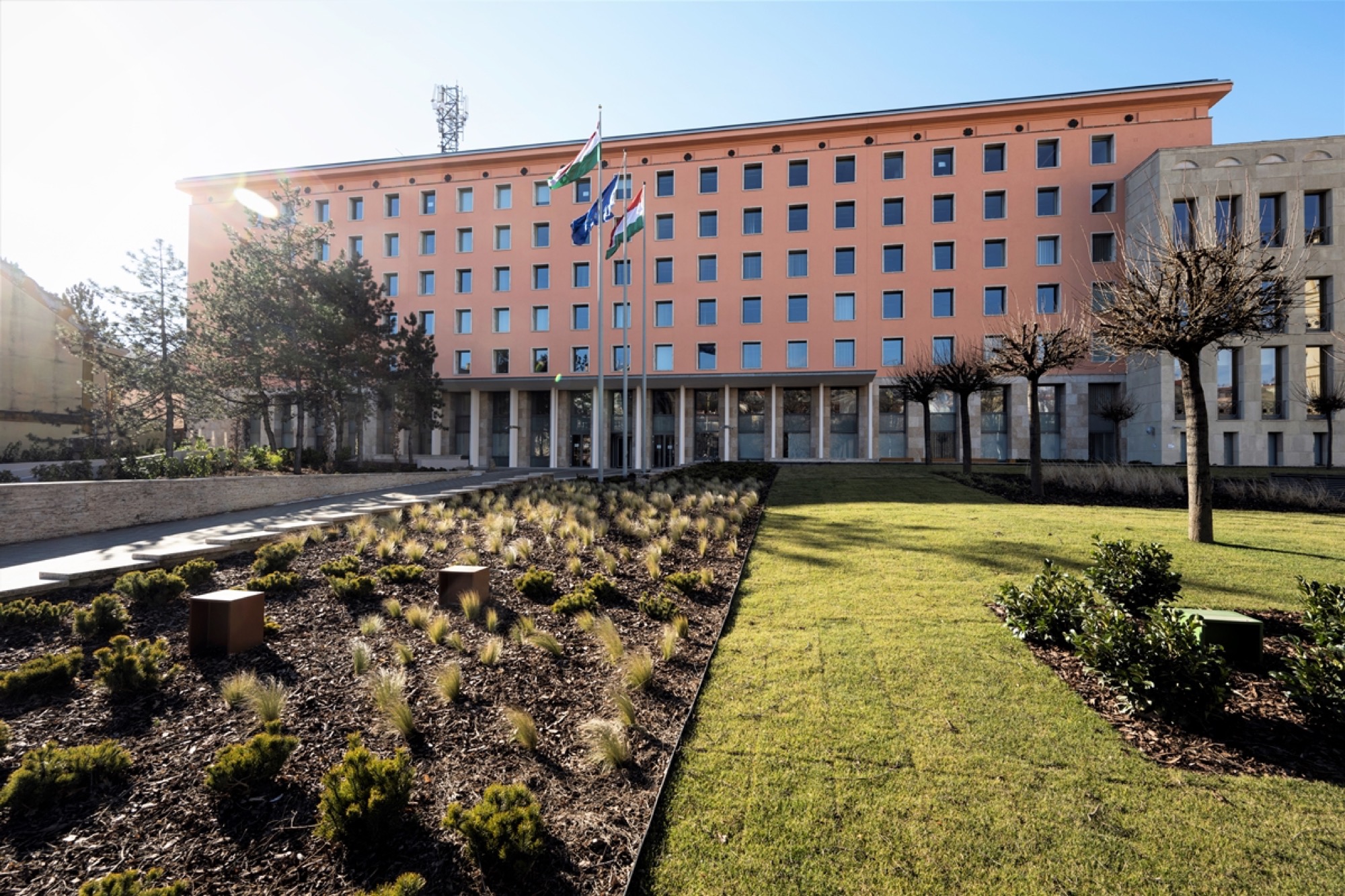
The Budapest Stock Exchange first operated from 1864 in the Lloyd Mansion (Lloyd-palota), a neoclassical palace on the Danube embankment designed by József Hild and completed in 1830, which housed the Pesti Lloyd Society’s commercial activities. After the exchange outgrew a subsequent premises on Wurm Street (now Szende Pál Street), occupied from 1873, it moved into the purpose-built Tőzsdepalota (Exchange Palace) on Szabadság tér in 1905. Designed by Ignác Alpár (1855–1928), the foremost Hungarian practitioner of late historicism, the Exchange Palace was the largest structure of its kind in Europe, measuring 145 meters in length and 41 to 61 meters in width (Budapest Stock Exchange Museum, “Épületek”). Alpár, who had trained under Alajos Hauszmann and Imre Steindl before studying in Berlin, developed a distinctive eclectic vocabulary blending neo-Renaissance, neo-Baroque, and Secession elements (Rosch Gábor, Alpár Ignác építészete, Enciklopédia Kiadó, 2005). The monumental gateway was flanked by two neo-Renaissance lion towers surmounted by a tympanum bearing allegorical sculptures of Mercury and Hephaestus, gods of trade and industry. The façade employed limestone quarried from Süttő and Sóskút, while the entrance hall was paved in marble and granite. General contractors were the Grünwald brothers and Miksa Schiffer, with stonemasonry by Béla Seenger and József Kauser. The Zsolnay factory of Pécs supplied distinctive pyrogranite majolica elements for the decorative program. Alpár simultaneously designed the Austro-Hungarian Bank headquarters (now the Hungarian National Bank) directly across Szabadság tér, calibrating the proportions of both buildings so they would produce a unified monumental effect on the square (Pestbuda.hu, “The Wedge of Szabadság Square Is Renewed,” 2021). After the exchange’s dissolution in 1948, the Palace was converted in 1955 into the headquarters of Magyar Televízió (Hungarian State Television), which substantially altered the interior to accommodate broadcasting studios and sound stages. The building was designated a protected historic monument. In the 2010s, the New York–based firm Beyer Blinder Belle prepared adaptive reuse plans to restore the historic façades and principal interior spaces, including the main entrance stair hall and the central domed rotunda (Architectural Record, “Exchange Palace,” 2009). Gránit Asset Management acquired the property in 2024 to undertake a comprehensive restoration.
The decorative program of the Tőzsdepalota ranks among the most ambitious artistic ensembles in early twentieth-century Budapest. The façade reliefs and sculptural elements were executed in the workshop of Géza Maróti (1875–1941), a versatile sculptor, architect, and applied artist who had trained in Budapest and Vienna before undertaking major commissions across Hungary and internationally, including work on the Palacio de Bellas Artes in Mexico City (1908) and Cranbrook School in Michigan (1927). For the Exchange Palace, Maróti’s workshop produced mythological reliefs depicting scenes of commerce and industry, while the tympanum bore seated figures of Mercury and Hephaestus as allegories of trade and manufacturing. Atop the roofline, gold-painted sculptures of Mercury served as crowning ornaments. The interior decorative scheme was coordinated by Ödön Faragó (1869–1935), a furniture designer and interior architect who had trained in Vienna and Paris and maintained connections to the Gödöllő artists’ colony (Oxford Reference, “Ödön Faragó”). Faragó designed the ornate wooden doors, the layout of the foyer, and the furnishing of the meeting halls in what contemporaries described as regal splendor. The first and second floors were finished with high-quality materials, including marble imported from Siena and French escalette stone. The stained glass windows that enveloped the interior of the upper floors were the work of Miksa Róth (1865–1944), Hungary’s preeminent glass artist, whose career spanned more than seventy major commissions across Budapest, including the Hungarian Parliament Building, the Gresham Palace, and the Franz Liszt Academy of Music. Róth, who won a gold medal at the 1902 Turin World Exhibition and the 1904 St. Louis World’s Fair, brought his characteristic mastery of light and color to the Exchange Palace’s stair halls and principal rooms (Róth Miksa Memorial House, Collection Documentation). Additional decorative sculpture was provided by Ignác Langer, while the Zsolnay factory contributed majolica ornamental elements—products of the innovative pyrogranite technique patented in 1886, which yielded frost-resistant ceramic ideal for architectural applications (Bard Graduate Center, Hungarian Ceramics from the Zsolnay Manufactory, 1853–2001). Wrought-iron work was executed by Gyula Jungfer, one of Budapest’s leading ornamental metalworkers. The ensemble thus represents a collaboration among the leading decorative artists of fin-de-siècle Hungary.
The Exchange Palace occupies a commanding position on the western side of Szabadság tér (Liberty Square) in the Lipótváros quarter of Budapest’s Fifth District, the historic political and financial heart of Pest. The square itself was created in 1897–1898 following the demolition of the Ujépület, a Habsburg military barracks that had served as a prison where Hungarian political figures, including Prime Minister Lajos Batthyány, were executed after the failed 1848–1849 revolution. Budapest formally acquired the site from imperial military control in October 1897, clearing approximately 20,000 square meters to create the public square, which was named Szabadság tér to evoke the ideals of Hungarian independence. The transformation of this former symbol of imperial repression into a monumental civic space lined with financial institutions carried deep political significance during the era of the Dual Monarchy. Directly across the square, Ignác Alpár designed the Austro-Hungarian Bank headquarters (completed 1905, now the Hungarian National Bank) in a complementary neo-Baroque style, creating an architectural dialogue between the institutions of private capital and state banking. The square is situated only two blocks from the Hungarian Parliament on Kossuth Lajos tér, reinforcing Lipótváros’s concentration of political and economic power. The exchange’s original 1864 home, the Lloyd Mansion on the Danube embankment near the Széchenyi Chain Bridge, placed it at the geographic nexus of Pest’s commercial life, adjacent to the river traffic that carried grain from the Great Hungarian Plain to European markets. As the financial district consolidated around Szabadság tér in the early twentieth century, the neighborhood attracted banks, insurance companies, and government ministries, including the Ministry of Finance. The grand Revival-style buildings that ring the square represent what architectural historians consider the greatest period of Budapest’s urban development, from the 1867 Austro-Hungarian Compromise through the First World War, when the city served as co-capital of a vast Central European empire. The Chain Bridge, completed in 1849 to designs by the British engineer William Tierney Clark, linked Pest’s commercial districts to the Buda hills and facilitated the 1873 unification of Buda, Pest, and Óbuda into a single metropolis—a consolidation that accelerated the financial district’s growth.
The Budapest Stock Exchange was founded on 18 January 1864 in Pest, operating initially from the Lloyd Mansion on the Danube embankment. The organizing committee was led by Baron Frigyes Kochmeister (1816–1907), a prominent banker associated with the Pesti Magyar Kereskedelmi Bank, who served as the exchange’s first president until 1900 (Budapest Stock Exchange Museum, “Kochmeister Frigyes”). At its launch, the exchange listed 17 equities, one debenture, 11 foreign currencies, and 9 bills of exchange. In 1868, the exchange absorbed the Grain Hall (Gabona Csarnok) to become the Budapest Commodity and Stock Exchange (Budapesti Áru- és Értéktőzsde, BÁÉT), combining securities and commodity trading under one institution. The market’s first major crash came in May 1873, discouraging domestic investment for nearly fifteen years. Recovery followed the Austro-Hungarian Compromise of 1867, which integrated Hungary into a common customs area of 51 million consumers and facilitated the flow of foreign capital. As Marc Flandreau documented in “The Bank, the States, and the Market: An Austro-Hungarian Tale for Euroland, 1867–1914” (Oesterreichische Nationalbank Working Paper 43, 2001), the dual monarchy’s single currency system and common central bank created a framework in which both Austrian and Hungarian capital markets could develop under the discipline of international bond markets. By the 1890s, Budapest stock prices were published in Vienna, Frankfurt, London, and Paris, and the exchange became Europe’s leading grain market. By 1913, nearly 500 securities traded on the exchange, with annual share turnover of one million and the Budapest Giro and Mutual Society processing 2.7 billion Crowns in transactions. The exchange closed on 27 July 1914 at the outbreak of World War I, though informal broker trading continued. The post-war period brought severe inflation; the introduction of the pengő in 1927 (replacing the korona at 12,500:1) temporarily stabilized markets. The 1929 New York crash reverberated through Budapest, and on 14 July 1931 the exchange closed again following the German banking moratorium and the collapse of continental banks. Bond trading resumed in 1932, and equities returned gradually, with the market peaking in 1936. Hungary’s entry into World War II sparked a speculative boom in heavy-industry stocks before government restrictions in 1942 curtailed private trading. Operations ceased during the siege of Budapest in December 1944. After hyperinflation—the worst in recorded history, reaching 4.19 × 10^16 percent per month—the exchange briefly reopened in August 1946 with the introduction of the forint, but declining prices and widespread defaults doomed the institution. Two months after the 1948 nationalization of private enterprise, the government dissolved the BÁÉT; the last trading day was 25 May 1948. After 42 years of dormancy under communist rule, the exchange was re-established on 21 June 1990 as one of the first post-communist securities markets in Central Europe, opening with 41 founding members and a single listed equity, IBUSZ.
From its founding in 1864, the Budapest exchange traded both securities and, after 1868, agricultural commodities, making it one of Europe’s most diversified marketplaces. The initial securities listings comprised 17 equities, one government debenture, 11 foreign currency pairs, and 9 bills of exchange. The 1872 boom brought a dramatic expansion when the Minister of Trade approved the articles of incorporation of 15 industrial and 550 financial joint-stock companies, whose shares then entered exchange trading. Government bonds—denominated first in the Austro-Hungarian Crown, later in the pengő—formed a major segment of the market, alongside railway shares and bank stocks that reflected Hungary’s rapid industrialization under the Dual Monarchy. As Ágnes Pogány of Eötvös Loránd University has documented, Budapest was a major center of flour milling, and the financial instruments associated with that industry—mill company equities, commodity contracts—were heavily traded (“Crisis Management Strategies after World War I: The Case of the Budapest Flour Mills,” Hungarian Historical Review 4, no. 4, 2015). The commodity side of the exchange handled enormous volumes of grain—principally wheat and corn from the Great Hungarian Plain—growing from approximately 400,000 tons in 1875 to one million tons by 1900 and nearly 1.5 million tons by the outbreak of World War I, making Budapest the leading grain exchange in Europe. Flour, oilseeds, and other agricultural products also featured prominently. By 1913, nearly 500 individual securities were listed, with annual share turnover reaching one million units and the Budapest Giro and Mutual Society clearing 2.7 billion Crowns. The interwar period saw continued securities trading, including significant volumes in heavy-industry and armaments stocks during World War II before the government imposed restrictions. Upon the exchange’s reopening on 21 June 1990, IBUSZ (Hungary’s largest travel agency) was the sole listed equity. The modern exchange introduced the BUX index on 31 March 1995 alongside the launch of the futures market, and by July 1998 the BSE became one of the first exchanges in the world to offer derivative contracts based on individual equities. The contemporary market trades equities, government bonds, corporate bonds, mortgage bonds, investment fund units, and structured products, with the BUX index serving as the primary benchmark of Hungarian blue-chip performance.
Images will be added as the project develops. Photographs by Larry Ng and from research sources.